

In a newly released report, the National Academy of Sciences takes direct aim at the United States as the world’s largest contributor to the plastic waste floating about in the oceans. But this misleading claim demands closer examination.
Other sources don’t support the Academy’s position that this is an American problem. The source of most of the plastic, the overwhelming majority, is Asia. Currently, China, India, and the Philippines expend little or no effort to intercept consumer-generated plastic before it goes out to sea. Those three nations are recognized as the principal generators, with the U.S. coming in a distant eighth place in one study and further down the list in others.
Recommended Stories



In fact, the U.S. contribution to plastic ocean waste is believed to be less than 2% of the world’s total.
The ultimate destination for Asian-derived plastic waste is a slowly rotating gyre — or, if you prefer, a lethargic whirlpool of Pacific water — lying north of the Hawaiian Islands and covering an area allegedly three times larger than France.
A second “garbage patch” is found in the Atlantic Ocean, extending below Bermuda, south toward the Tropic of Cancer. The “Sargasso Sea,” as referenced by early Portuguese navigators, covers a broad expanse of water often becalmed for lack of wind. Vast beds of kelp, a seaweed known as “sargassum,” stretch far beyond the horizon in a mosaic pattern.
Waste originates from the continents defining the Atlantic Basin. On arrival, flotsam mixes in with kelp and serves as a substrate for barnacles and other sessile marine creatures. Together, they form impenetrable mats. A plastic object light enough to float in seawater can be ferried great distances on prevailing surface currents.
The Atlantic currents on the periphery push flotsam into the gyre, effectively preventing its escape. These are the Gulf Stream along the western edge, the North Atlantic Current to the north, the Canary Current to the east, and the North Atlantic Equatorial Counter Current to the south.
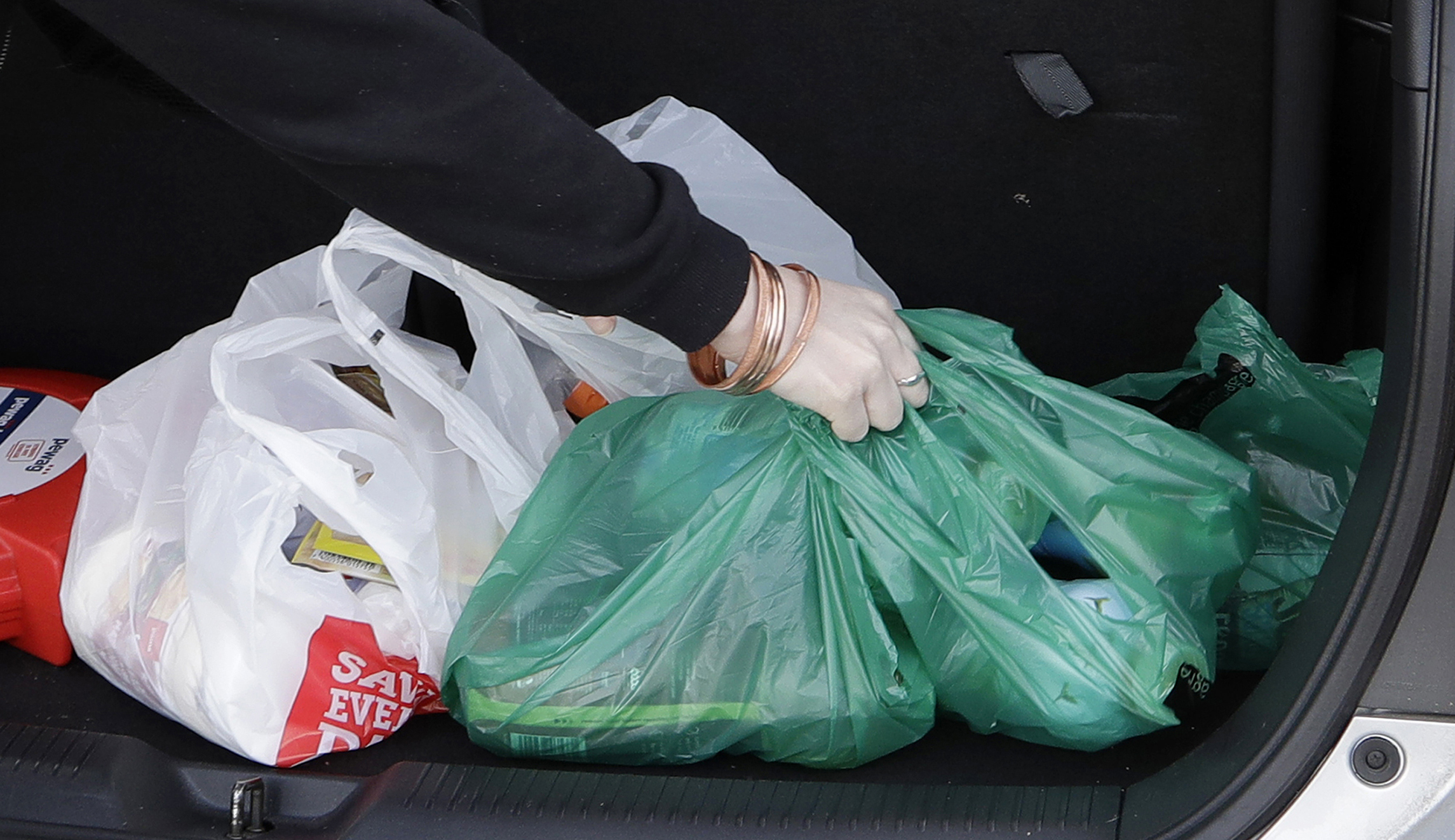
A number of coastal U.S. municipalities have banned plastic drinking straws and bags with a goal of reducing the burden of ocean plastic. But even a countrywide ban on plastic consumer items by the federal government would not solve this problem given the tiny U.S. contribution to plastic littering worldwide compared to Asian nations and several countries in Africa and South America, where solid waste management is still in a very early stage of development.
Moreover, note that not one of the 10 major rivers that transport the bulk of the plastic waste seaward is even in North America.
A recent personal experience recalled news stories of sea life becoming entangled in abandoned fishing gear adrift on the ocean. I noticed a partially submerged plastic bag as it moved erratically down a tidal creek. I retrieved the bag and found a very-much-alive largemouth bass inside. I released it and later disposed of the bag.
Turtles, birds, and whales are threatened by fishing gear lost at sea. They may run afoul of abandoned netting, floats, hooks, and line, to their distress.
And therein lies an important question: What presents a greater danger to sea life? Is it the flotsam consisting of plastic cups, bags, and similar items that become fixed in the kelp beds? Or is it inherently hazardous sharp objects and webbing related to the fishing trade that remain afloat indefinitely? I am not sure we know.
The best final resting place for plastic waste is a properly managed landfill. Better yet are the efforts to recover plastic and concentrate it with other combustible materials as fuel to generate electricity. And even better, to recycle it into consumer goods made from recoverable plastics. Some popular brands of designer clothing use recycled fishing line that is re-melted and spun into yarn and fleece for ski wear.
Plastics’ opponents suggest substituting materials such as biodegradable paper (plant fiber) in drinking straws. Indeed, the paper straw preceded plastic varieties by many decades. But a straw becomes a nuisance if it collapses before the beverage is consumed.
The conundrum of what to do about plastics offshore remains unresolved. From our perspective, a comprehensive solution lies beyond U.S. regulatory powers and resides overwhelmingly in the hands of foreign nations responsible for the other 98% of plastic waste in the oceans.
William D. Balgord holds a doctorate in geochemistry and heads Environmental & Resources Technology, Inc. in Fort Pierce, Florida. Previously, he coordinated environmental and resource recovery policies for a major trade association.
