

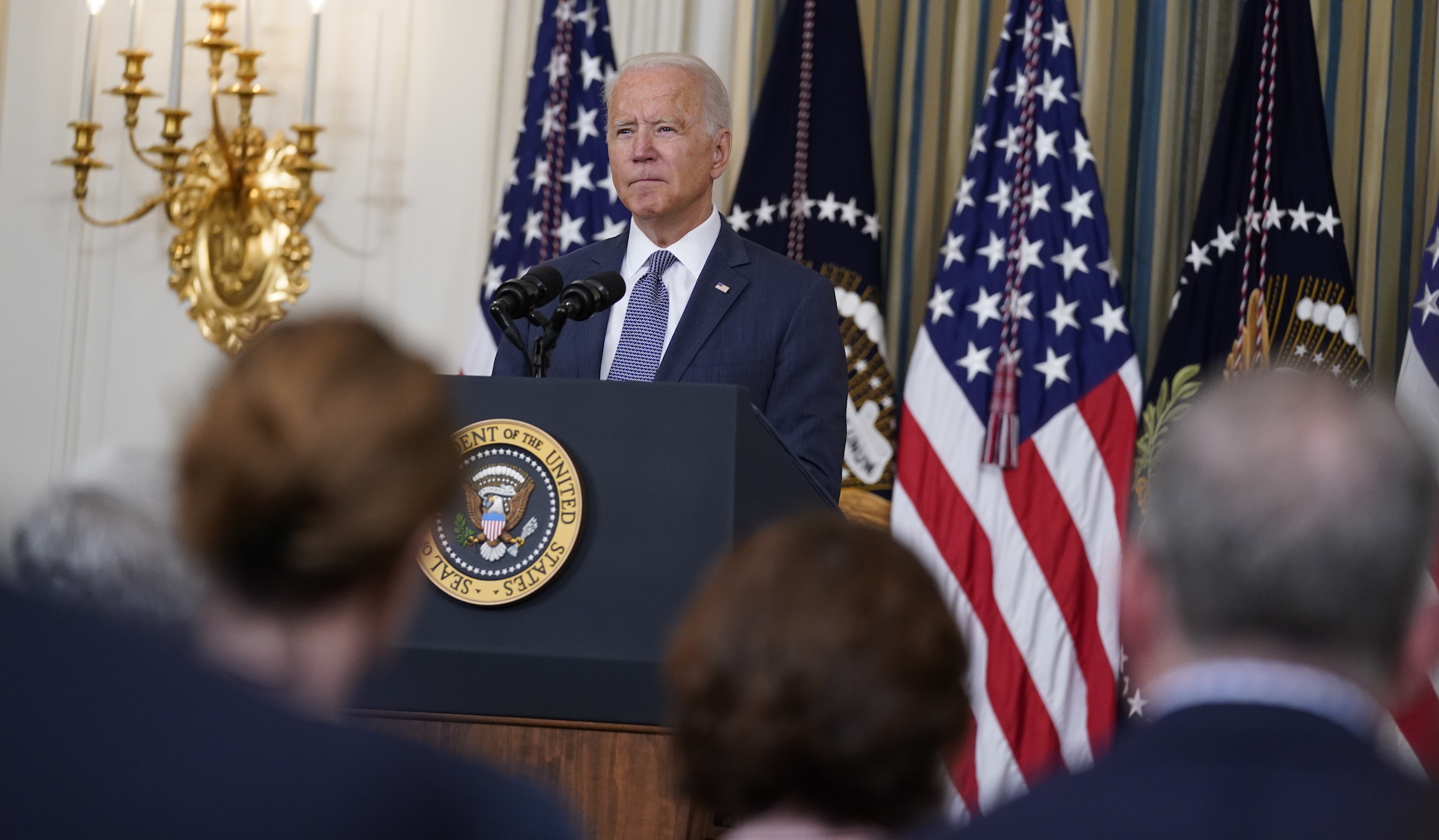
Candidate Joe Biden promised his term, following four years of Donald Trump’s daily chaos, would be boring. But, his lack of pizzazz and declarations that his own speeches are dull risks alienating some voters.
Biden’s confessed inability to hold the public’s attention or stoke its imagination may be a relief to voters exhausted by Trump’s reality television-style tenure. Yet, experts say it could blunt the power of the bully pulpit as he tries to ramp up support for his $1.8 trillion “human” infrastructure proposal.
Recommended Stories


BIDEN AND DEMOCRATS CAN’T HIDE ELECTORAL JITTERS OVER RISING CRIME RATES
There are no downsides to Biden’s low-key, no-frills attitude toward the presidency, according to Eric Schultz, a top White House spokesman for former President Barack Obama.
“Since January 20, 2017, the American people have been yearning for government to function again, and that’s exactly what Joe Biden delivered as president,” he told the Washington Examiner.
Indeed, Obama stumped for his vice president for the first time in person when he pitched Biden being a bore as a political asset last fall.
“With Joe and Kamala at the helm, you’re not going to have to think about the crazy things they said every day. And that’s worth a lot,” Obama said, referring to Biden’s then-running mate Kamala Harris. “You’re not going to have to argue about them every day. It just won’t be so exhausting.”
But, Republican strategist John Feehery disagreed. Feehery contended being dull was only great “if you are defending the status quo.”
Meanwhile, Biden attempts to appease liberal Democrats and emulate Franklin Roosevelt’s New Deal approach to federal bureaucracy.
“Boring is terrible if you are trying to enact disruptive change,” Feehery said.
Biden’s popularity is steady, though his disapproval ratings are on the rise. Yet, when it comes to attracting eyeballs, his TV ratings essentially align with downward trends. Only 27 million people tuned into his maiden address to a joint session of Congress in April, which is fewer than his four predecessors, according to Nielsen.
The previous low, George W. Bush’s 2001 speech, attracted roughly 40 million viewers.
As a counterpoint, Biden’s inaugural remarks in January drew 40 million people, compared to Trump’s 38 million viewers in 2017. And today’s hyperpartisan politics guarantees outrage coverage from news outlets with ideological leanings opposed to that of the president.
But the 78-year-old’s low-energy, doddering presence behind a microphone for set-piece occasions or in front of reporters in unscripted moments frequently fails to inspire people to join his cause.
Biden’s problem is also reflected in data regarding low-information voters. The president’s spending packages have generally been well-received.
That is often the case when frameworks include direct payments or other financial kickbacks. Yet, a POLITICO/Morning Consult poll from May revealed more than two-thirds of respondents did not know about his $2.3 trillion so-called “American Jobs Plan,” which has since evolved into a $1.2 trillion bipartisan “hard” infrastructure deal. The same percentage was not familiar with the “American Families Plan” that focuses on “soft,” “human” infrastructure.
Biden only turned to tout the social welfare measure this week. His aides scheduled a trip to Illinois on Wednesday to chalk up its benefits as Democrats prepare to pass it without Republicans through the streamlined process known as reconciliation. It was during that jaunt Biden was candid about his own lackluster performance.
“Thank you, ladies and gentlemen. I know that’s a boring speech, but it’s an important speech,” he said.
After Democrats exhaust their opportunities to use reconciliation, Biden’s legislative agenda will likely be thwarted by Senate filibusters — unless the president can coalesce his party behind the issue.
Republican strategist Duf Sundheim said voters care about policy and outcomes. He listed the economy, particularly concerns about too generous unemployment programs, and crime as priorities.
“The Dems are spending too much time on the people who are not pulling their weight — and not enough on good schools, etc. That to me is Biden’s risk: Not that he does not go far enough — that he goes too far,” he said.
CLICK HERE TO READ MORE FROM THE WASHINGTON EXAMINER
“Bottom line: process rarely matters, policies that directly impact people’s lives do,” he added.
