

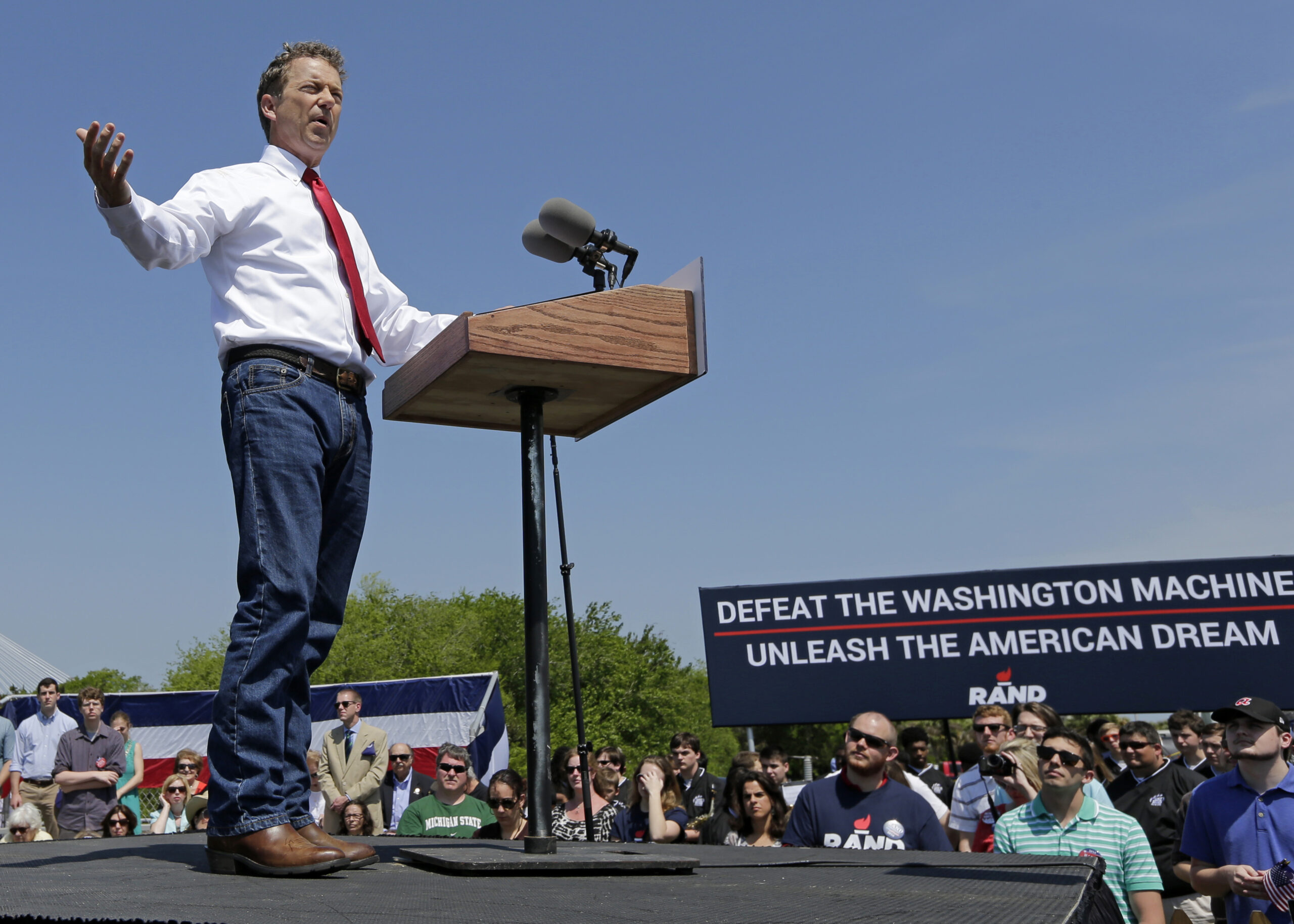
Sen. Rand Paul’s increasingly combative tone in media interviews has drawn a fair amount of criticism from the nation’s newsrooms, but there may be a method to the Kentucky Republican’s madness.
On Wednesday, the newly announced 2016 presidential candidate chided NBC News’ Savannah Guthrie for “editorializing” her interview questions. Later that morning, after Associated Press reporter Phillip Elliot pushed Paul during a lengthy interview to clarify his position on exceptions to proposed restrictions on abortion, Paul said bluntly, “I gave you about a five-minute answer. Put in my five-minute answer.”
Recommended Stories


On both occasions, Paul was mocked and criticized by media for being “prickly,” for “dodging” questions and for being “petulant” with reporters.
However, Paul’s rejection of journalists’ questions also drew high praise from people whose influence in conservative media could sway Republican opinion toward the freshman senator.
“Hey GOP: Rand Paul just took an abortion question, gave a good answer, and sent Democrats spinning their wheels on defense. Pay attention,” Commentary magazine’s Seth Mandel noted on social media.
The Federalist’s Mollie Hemingway penned an article titled, “Finally! Rand Paul Exposes Media’s Serious Abortion Double Standards.”
As the media establishment fumed over Paul’s lack of deference to employees of NBC and AP, conservative blogger Stephen Miller joked, “Man, sucks for [Paul]. People really love and trust reporters. Campaign over.”
This last point — that Paul’s aggressive style with reporters won’t hurt him for the simple reason that voters already dislike media – may be the key to understanding the senator’s combative interview behavior.
Right-leaning voters have long maintained that newsrooms are steeped in anti-conservative bias and that reporters are mostly liberal partisans. Paul’s treatment of journalists Wednesday almost certainly won him points with the conservative base.
For Bloomberg News’ Dave Weigel, the theory that a shrewd Team Paul is working to build support among conservative voters by playing to their longstanding dislike for media isn’t so crazy.
“Some politicians have warm, back-slapping relations with the press; some can dodge questions while maintaining poker faces. Rand Paul may never be that kind of politician,” Weigel wrote. “But his abortion answer was not a stumble. It may have been his analogue to the moment Ronald Reagan fought for his microphone at a Nashua, N.H. candidate forum–not a gaffe, but a moment of harmony with the base.”
However, there’s another angle to consider: Distrust for media is apparently shared by more than just right-leaning voters, according to Gallup, meaning Paul likely has little to lose by challenging reporters.
Newspapers, news on the Internet and television news are among the least trusted institutions in the country, trailing behind public schools, the police, and even banks, according to a bipartisan Gallup survey of U.S. voters.
Considering that voters on both sides of the aisle apparently have little love for media, it seems likely that Paul’s recent treatment of reporters will hurt him in only one place: Newsrooms.
It is also notable that Paul is apparently already well-liked by voters. In theoretical match-ups between the Kentucky senator and the presumed 2016 Democratic Party candidate, former first lady Hillary Clinton, in three swing states, Iowa, Colorado and Virginia, Paul wins two of three, according to a Quinnipiac survey.
For Colorado, Paul wins 44 to 41; in Iowa, he wins 43 to 42; in Virginia, Clinton wins 47 to 43.
Taking each of these points into consideration — that conservatives cheer anyone who fights the press, that Gallup shows bipartisan disgust for media, and that Quinnipiac shows Paul beating the presumed Democratic candidate in key swing states – Paul’s argument with the media makes strategic sense.
Paul is not the first Republican to score points with conservatives by lambasting a reporter. However, there is a fine line between tapping into voters’ fed up sentiments, as former House Speaker Newt Gingrich reportedly did during the 2012 GOP primaries, and coming across as “jerky,” as New Jersey Gov. Chris Christie supposedly does whenever he takes on reporters and hecklers.
Should Paul manage to toe this fine line between challenging and berating members of the press, he could turn out to be the first to impress both conservative and moderate voters who already feel media are untrustworthy.
