

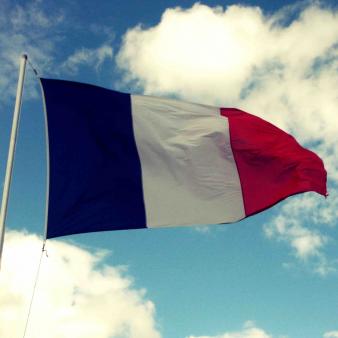
There are a few tentative observations to be gleaned in the aftermath of the Paris attacks:
* Claire Berlinski has a helpful dispatch in which she touches on the resistance graffiti that has now sprung up around the city (“Fluctuat nec Mergitur,” or “Tossed by the waves, but not sunk,” which is the city’s motto). But the real question is whether or not the people of France are outraged enough to make systemic changes. This is not Europe’s first mass terror attack: We’ve now had big, coordinated Islamist attacks in London, Madrid, Moscow (repeatedly), and Paris. If I were running domestic intelligence for Germany and Italy, I’d consider Berlin and Rome as “on notice” at this point. This wasn’t even the first major attack in Paris this year.
Recommended Stories

In moments of crisis, political leaders operate within the confines of the national mood. Will the national mood in France demand candlelight vigils? Or airstrikes? Neither of these, by the way, will result in changing the strategic situation.
* David Goldman believes that the answer is no. The problem is not (just) the existence of ISIS. So defeating ISIS, is a necessary but not sufficient, step towards protecting France from radical Islam. Goldman notes that an opinion poll last year found that support for ISIS among the French was nearly as high as support for France’s president (16 percent versus 18 percent). Says Goldman:
* As a thought experiment, logistically speaking, which would be harder for France to do: Ramp up a series of military attacks on ISIS targets? Or close down immigration? Obviously, waging war a thousand miles away is more technically challenging. But which would represent the greater political challenge-a short military campaign in Syria or a change in France’s immigration program? Again, the answer seems obvious.
That President Hollande has already scrambled bomber sorties is not entirely encouraging.
* Of course, closing off future immigration isn’t the only answer. Instead, France might keep immigration, but instead turn away from multiculturalism and decide to insist on a rigid program of societal norms based unapologetically on the superiority of French cultural values. But that would require even greater willpower on the part of French society.
* Never forget: Immigration, multiculturalism, or democracy. You can only have two.
* If what we saw in Paris is to be the new mode of attack-the same mode we’ve seen in Mumbai and Nairobi where Islamic terrorists go after not airlines or infrastructure, but the diffuse, soft targets of commerce in the modern city-then America is both unprepared and ill-suited to defend itself.
But two thoughts do immediately suggest themselves: (1) Buy stock in Amazon; conducting as much commerce online as possible would become a good way to mitigate risk. And (2) Donald Trump wasn’t wrong in principle-the Second Amendment is probably America’s most valuable deterrent against such strikes. If you’re an Islamist planning a large, soft-target attack against an infidel country, what would seem like a higher-probability play? A place where some non-trivial percentage of passers-by could be armed? Or a place where law-abiding citizens are prohibited from carrying guns?
* Bernie Sanders has been revealed to be a completely unserious man. It’s one thing to be a socialist. It’s another to be a buffoon. At the Democratic debate on Saturday, John Dickerson asked, “Senator Sanders, you said you wanna rid the planet of ISIS. In the previous [debate] you said the greatest threat to national security was climate change. Do you still believe that?” Here is Sanders’s response:
But of course international terrorism is a major issue that we’ve got to address today. And I agree with much of what-the secretary and-and the governor have said. Only have one area of-of disagreement with the secretary. I think she said something like, “The bulk of the responsibility is not ours.”
Well, in fact, I would argue that the disastrous invasion of Iraq, something that I strongly opposed, has unraveled the region completely. And led to the rise of Al Qaeda-and to-ISIS. Now, in fact, what we have got to do-and I think there is widespread agreement here- ’cause the United States cannot do it alone. What we need to do is lead an international coalition which includes-very significantly-[garbled] nations in that region are gonna have to fight and defend their way of life.
This wasn’t a mere mistake; the next day, Sanders doubled down on this ridiculous claim.
So let’s get this straight: Climate change may or may not exist; if it does exist may or may not be caused by human activity; and in any case might, or might not, be deleterious in its net effects. And nobody-nobody-knows for certain that the answers to this trifecta are yes, yes, and yes. The best anyone can say is that based on available evidence today, one set of answers seems more likely than others.
And against this we’ve got a violent ideology which has, since the Islamic revolution of 1979-not since the Iraq war, by the way-been responsible for well over a million deaths across the globe-from Iran/Iraq to Syria to Afghanistan to Kenya to Nigeria to Manhattan to London to Moscow to Sydney to Madrid to Bali and please, do not forget, that this is but a partial list.
This is not a man fit to lead the republic.
* Not that the other two Democrats were much better. As Ben Domenech points out, it is striking that none of the three Democrats running for president is willing to utter the term “radical Islam.” They simply can’t bring themselves to say it out loud.
In a podcast last week shortly after the bombings, the boss recounted one of his father’s great lines about how a neoconservative was a liberal who’d been mugged by reality. Many other liberals in the 1970s, however, were mugged by reality, but refused to press charges. That’s exactly the state that each of the Democratic presidential candidates occupies. Except that the problem isn’t that they’ve been mugged by reality. It’s that our civilization has been. And they are declining to rise to its defense. Or even acknowledge the assault.
* But in fairness to the Democrats running to succeed Barack Obama, the current president is actually much worse. He has been wrong about the threat ISIS poses at every turn. And the press conference he held on Monday while in Turkey was one of the most baffling performances ever by an American president. Asked if he understood what it would take to defeat ISIS, he replied:
Go re-read that. And when you’re done, read it again. That’s an American president.
But Obama went on to show that the real enemy-the one he actually is very much keyed up to fight-is made up of Republicans, who he called “shameful” and “not American.”
* Whenever we talk about the power of “events” to influence campaigns, this is what we mean. The 11/13 attacks probably won’t have direct bearing on the outcome of our elections next November. But they do present the possibility of reshuffling the deck right now. If a candidate responds especially well, he could easily ascend to the first tier. Likewise, a candidate whose worldview is so obviously out of step with events could easily find himself swamped.
This has been a good reminder that political life is full of surprises, and that they’re rarely of the good kind.
