

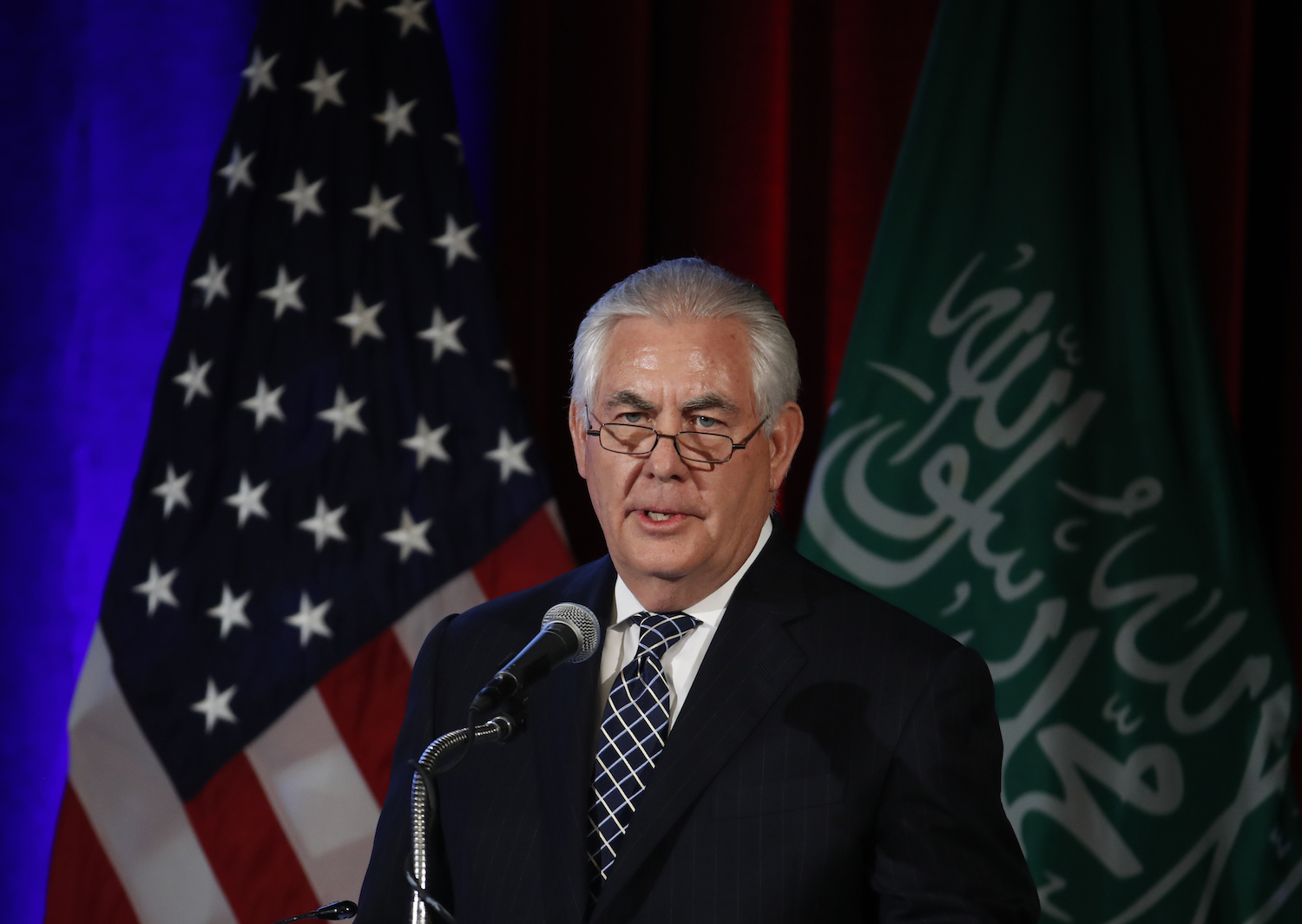
The foreign policy challenges facing President Trump and his secretary of state, Rex Tillerson, are mounting fast as they approach 100 days in office. Apart from the civil war in Syria and a newly tense relationship with Russia, they have to deal with a missile-rattling regime in North Korea, the threat at home and abroad from radical Islamic terrorism, and potential trade battles with just about the entire non-Anglo-Saxon world.
There is yet another challenge, one not so visible to the public, that should be near the top of Secretary Tillerson’s to-do list: reform of the State Department. Only with an effective State Department can the secretary and his loyal corps of employees play a leading role in helping the president address the nation’s foreign policy challenges.
Recommended Stories

On his first day in office, the secretary praised the “accumulated knowledge and experience” of State’s 75,000 employees. The former oil executive is right. Foggy Bottom sits atop the world’s largest proven reserve of diplomatic capabilities, spanning political affairs, economic analysis, press relations and cultural promotion. Now Secretary Tillerson’s challenge is to figure out how to extract this knowledge and refine it into foreign policy insights. These reforms will not be simple: the extraction will require deploying new technologies at State, and the refining will require both a comprehensive restructure of the organization and re-think of its policy-making processes.
The current means of capturing and disseminating knowledge at State is the diplomatic cable: multi-thousand-word missives from overseas missions to Washington, where those cables are meant to inform policy-making. This way of working captures only a fraction of the State Department’s knowledge and a lot of potential insights are lost in the process. To improve knowledge extraction, State will have to change its approach to information management by deploying classified versions of innovative technology platforms (e.g., wikis, knowledge management software, or real-time collaboration software) that can help State’s employees worldwide find, leverage and build on their colleagues’ knowledge.
To take advantage of these new technologies, State will need a smaller organization to speed up decision-making and the refinement of knowledge into insights that inform foreign policy. Even State’s sprawling organization chart does not begin to convey the complexity the Department has taken on in recent decades. The solutions to this complexity are the same as would apply to any private sector corporation hobbled by its own weight: cut layers top to bottom, push accountability farther down in the organization and orient the entire Department around a defined set of key priorities.
Along with new technologies to extract knowledge and a smaller organization to spread it faster, State will need to develop refined foreign policy “products” that are viable in an age of instant communication. What might a new foreign policy product look like? The key is to retain the intellectual rigor of the diplomatic cable while adding new flexibility. One potential approach would be to re-orient part of State’s foreign policy formulation process around scenario analysis. State could produce bespoke analyses, for example, on options for increasing leverage over China by giving greater attention to Taiwan. This is just one of scores of potential policy initiatives that could be gamed out uniquely well by State teams and presented, through the chain of command, up to the President. Given the President’s love of negotiating, he is likely to value a proactive menu of policy options, each with potential consequences laid out, to choose from.
The early signs from Secretary Tillerson are promising for a transformation of State. When the administration’s proposed budget cuts were announced last month, he talked of a “genuine opportunity to set a new course.” As a former CEO, he understands a lower budget must be about more than cutting costs; it must be catalyst for real reform, for making the State Department effective and, in so doing, re-establishing its key role in US foreign policy formulation. If this happens, the budget cut will not be a death sentence, but the beginning of a revitalization of the State Department and of American diplomacy. State’s employees and the American people deserve no less.
William H. Avery served in the State Department during the Administrations of Bill Clinton and George W. Bush.
If you would like to write an op-ed for the Washington Examiner, please read our guidelines on submissions.
