

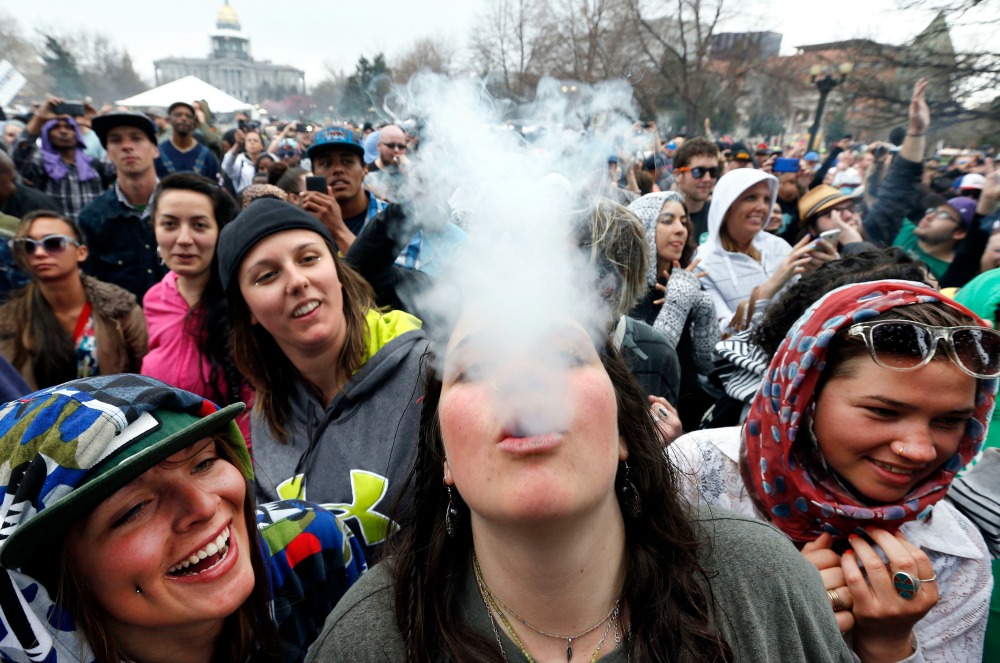
While the presidential candidates in both parties differ greatly on whether marijuana should be legalized for recreational use, most of them agree to not let state laws allowing pot go up in smoke.
Colorado, Washington, Oregon, Alaska and the District of Columbia have legalized the consumption of marijuana for personal use. The presidential candidates for both parties say they want to preserve the state laws even if they have reservations about nationwide legalization.
Stay informed.Stay ahead.
Join Washington Examiner for unlimited access to the news, analysis, and commentary that matter most.
Already a member? Log in
The state laws have put the federal government in an awkward spot, as marijuana is illegal under federal law. The Justice Department has essentially turned a blind eye to the discrepancy, opting not to crack down on marijuana smokers in the states that have legalized it. However, banks and marijuana businesses are having trouble with federal banking regulations that forbid them from taking in profits from drug sales, since pot sales are illegal under federal law.
Most of the candidates are in favor of essentially ignoring the state laws since they say they don’t want to infringe on states’ rights. However, there are stark differences between the parties when it comes to federal legalization.
“If the citizens of Colorado decide they want to go down that road, that is their prerogative. I don’t agree with it, but that is their right,” Sen. Ted Cruz, R-Texas, said during a speech in 2015 at the Conservative Political Action Conference.
GOP front-runner Donald Trump also has said he would defer to states on marijuana laws.
“In terms of marijuana and legalization, I think that should be a state issue, state-by-state,” Trump told the Washington Post last fall during a Nevada event.
Ohio Gov. John Kasich has been outspoken against the legalization of marijuana, fighting a ballot initiative in Ohio that failed last year.
“There was a statewide initiative to legalize marijuana and we oppose it, and the thing got destroyed,” spokesman Rob Nichols told the Washington Examiner.
Nichols, however, didn’t comment on how a President Kasich would handle states that already have marijuana laws.
Democrats are generally calling for more action on the federal level, but don’t explicitly call for nationwide legalization.
Both Hillary Clinton and Bernie Sanders want to change marijuana from a schedule I to a schedule II controlled substance under the federal law. Schedule II is reserved for drugs that have a high potential for abuse but can be used in medical treatment. Examples of schedule II drugs include painkillers such as Oxycontin and Percocet.
Marijuana is in schedule I, which means it has no medical use and has a high abuse potential. Marijuana is on the same list as peyote, LSD, heroin and ecstasy.
Moving to schedule II would “permit it to be the basis for medical research,” Clinton said during a January radio interview. She also said she was in favor of keeping legalization laws intact.
“I think that states are the laboratories of democracy, and four states have already taken action to legalize, and it will be important that other states and the federal government take account of how that’s being done, what we learn from what they’re doing,” she said during the interview.
Pot advocates are bullish on their prospects for 2016, saying that it would be hard for the next administration to roll back gains in the movement.
“We now have clear majority voter support for outright legalization in poll after poll,” said Tom Angell, director of project oversight and communications for the pro-legalization group Marijuana Majority. “Moving forward, it will be very hard for prohibitionists in the Justice Department, White House or outside the government to roll back our gains.”
He said that, of course, any candidate could change his or her mind on the issue of the states’ rights, “especially if the next attorney general feels more strongly about the issue than his or her boss does.”
More states could be added to the list of states where pot is legal.
This year, about 20 state legislatures are considering legalization bills that are new or carried over from the previous legislative session, according to data from the National Conference of State Legislatures.
One state is on the cusp of legalizing marijuana in the coming months. Vermont’s Senate approved a marijuana legalization bill in late February, and it now goes to the state House for final approval.
If Vermont approves the bill, it would become the first state to legalize marijuana through its legislature. The other four states and the District of Columbia have approved it through ballot measures.
State laws don’t have immunity from the courts, but such laws did dodge a major bullet last month.
The Supreme Court declined to take up a lawsuit from Nebraska and Oklahoma challenging Colorado’s pot law. The states that share a border with Colorado unsuccessfully argued that the law has increased marijuana trafficking into their states.
Colorado’s law prohibits taking marijuana across state lines and forbids consumption in airports.
Angell said efforts to legalize marijuana dodged a major bullet with that decision.
“The notion of the Supreme Court standing in the way could have cast a dark shadow on the marijuana ballot measures voters will consider this November,” he said. “But the justices correctly decided that this lawsuit is without merit and that states should be able to move forward with implementing voter-approved legalization laws even if their neighbors don’t like it.”
