

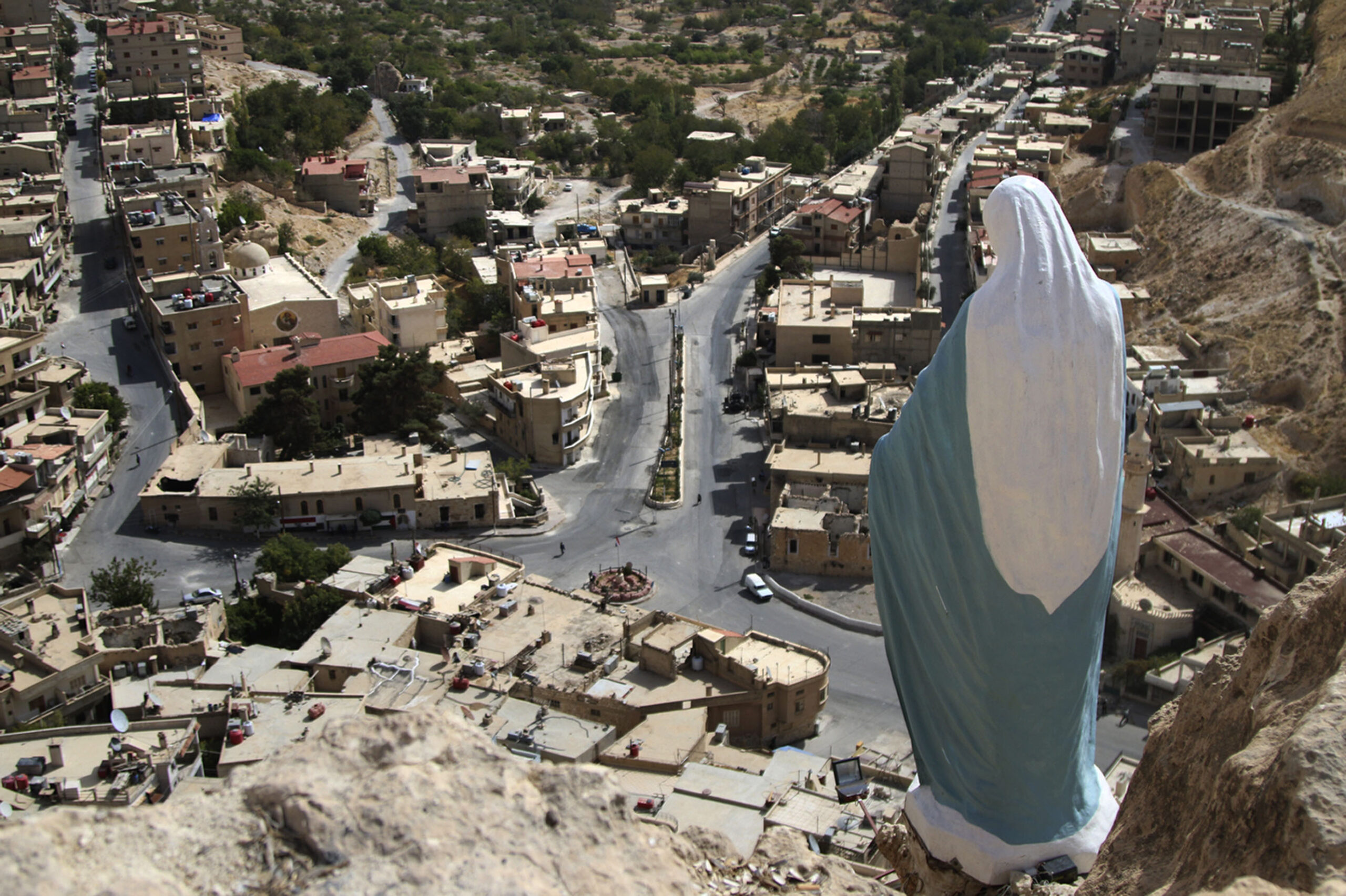
To President Obama, the case for accepting Syrian refugees is purely that they are victims, no more dangerous than tourists. To reject them, he says, would be a “betrayal of our values.”
His administration has exceeded its goal of bringing in 10,000 Syrian refugees this fiscal year — so far, the U.S. has taken 11,491.
Recommended Stories

State Department data show that more than 98 percent of those are Sunni Muslims. Just 0.46 percent, 54 people, are Christians. Since the Syrian civil war began in 2011, just 102 of the 13,364 Syrian refugees admitted have been Christian. Christians account for a much higher percentage than that of the Syrian population.
Why is the U.S. taking so few? The administration says it doesn’t impose a religious test on refugees, but that cannot be true because refugee status is sometimes granted because of religious persecution.
Christians have faced the most extreme persecution at the hands of Muslims in Syria. In March, the State Department finally declared the Islamic State’s mass slaughter a genocide of Christians and other religious minorities.
There are three things Washington can do to help Syria’s Christians. First, the State Department can bring over more who desire resettlement in the West. (Doing so is unlikely to stoke much concern that Islamists are in their midst.)
Most refugees are referred to State by the U.N., which identifies them in camps in neighboring Middle Eastern countries. But Christians are scarce at those camps because they continue to be targeted there by Muslim extremists. Many therefore end up living with families or private charities. The U.S. and U.N. must do more to identify Christians living outside refugee camps as possible candidates for resettlement.
Syrian and Iraqi Christians who want to leave should be allowed to do so. But many Christian leaders caution against a mass exodus. The eradication of Christianity and other minority religions from the Middle East is what the Islamic State’s ethnic cleansing is for, and we should not help them achieve it.
Second, more effort should be made to accommodate those who wish to remain in their ancestral homelands. This is why leaders of the Christian communities there, as well as representatives of other religious minorities, are calling for the creation of a semi-autonomous province in the Nineveh Plain in Northern Iraq. The Nineveh Plain has been the homeland of Assyrian, Syriac and Chaldean Christians as well as the Yazidis for centuries.
Rep. Jeff Fortenberry, R-Neb., recently introduced a congressional resolution endorsing the idea, which involves the creation of an interim safe zone in the region that would eventually become a new province. But creation of a haven for Christians runs the risk of further Balkanizing an already divided region. Such a proposal requires a close and cautious examination.
Christianity is part of the DNA of the Middle East, predating Islam by centuries. Its presence lets ordinary Muslims know that Christians are not people to fear or hate. Throughout the region, Catholic nuns and sisters run hospitals and schools that serve poor Muslims. It is through these types of encounters that Christians act as a bulwark against Muslim extremism and the fostering of local terrorism.
When the State Department made its genocide declaration, it emphasized that the designation would be meaningless if the world didn’t act to end the atrocities. Which raises the third thing that can be done to help Syria’s religious minorities: Defeat the Islamic State. It’s the only sure way to end the genocide and the refugee crisis.
