
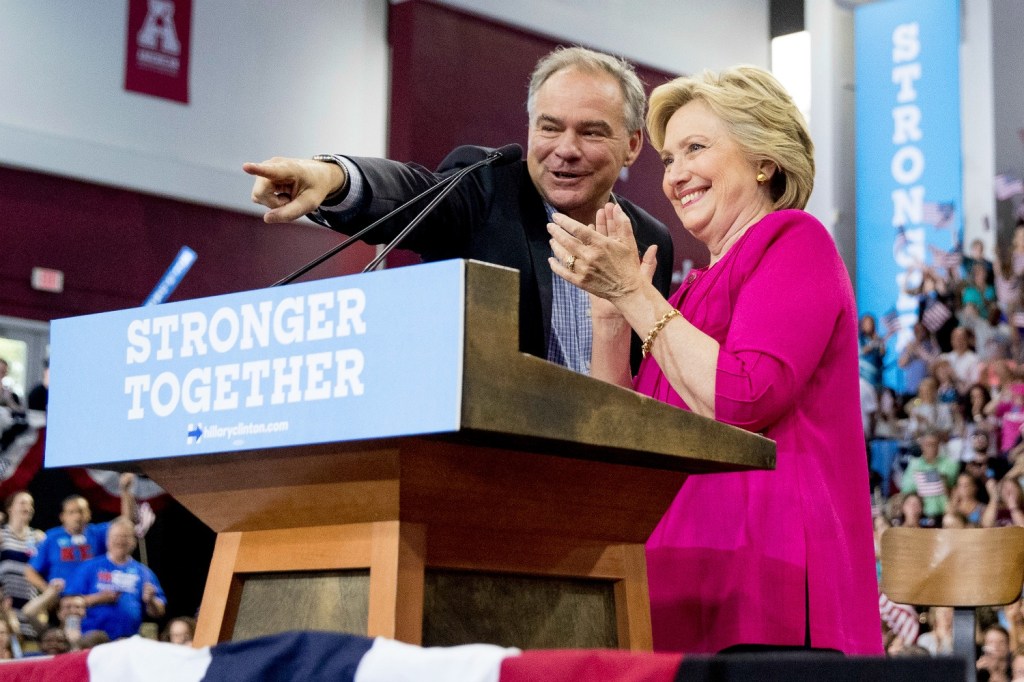
Hillary Clinton may not be done rolling out proposals for middle-class tax relief.
The Democrat has released a grab bag of planned tax breaks aimed at specific middle-class expenses, platform running mate Sen. Tim Kaine touted Tuesday night during the vice presidential debate as targeted relief for the middle class.
Recommended Stories


Yet the campaign suggested earlier in the year that Clinton would propose a more comprehensive middle-class tax cut. Although some tax watchers have begun to wonder whether that plan is coming, the campaign said Wednesday that it might.
The campaign has “been building on our proposals and clarifying them as the campaign progresses,” Clinton spokesman Donte Donald told the Washington Examiner. “So, I’m sure we will discuss this more but just not sure when.”
Although it may be a work in progress, the middle-class tax relief has been a talking point for the Clinton campaign.
In Tuesday night’s vice presidential debate, Kaine accused the Trump-Pence campaign of planning to raise taxes on the middle class and boasted that he and Clinton have “a tax plan that targets tax relief to middle-class individuals.”
Outside analyses of the Clinton tax proposal have found that the tax increases she has proposed to finance new spending projects would mostly fall on high-income earners. For example, an analysis conducted by the nonpartisan Tax Policy Center in March found that more than three-quarters of the tax increases would fall on the top 1 percent of income earners.
That study, however, found that Clinton’s tax plan wouldn’t reduce taxes for people lower on the income spectrum.
At the time, the Tax Policy Center said the campaign had told them that they planned to roll out other proposals to cut middle-class taxes.
Since then, the campaign has introduced, in speeches and other points along the way, several tax breaks aimed at specific costs that middle-class families might incur.
The breaks are spelled out in a Sept. 26 fact sheet published on Clinton’s campaign site.
Among the breaks:
? An expanded child tax credit. The campaign hasn’t specified how the current credit might be enlarged or by how much.
? A refundable credit of up to $5,000 a family to defray out-of-pocket health care costs.
? Bigger subsidies for premiums on Obamacare exchanges. The subsidies are administered through the tax system.
? A break of up to $1,200 for caregiving costs for family members.
Those breaks, however, do not amount to the tax rate reductions or other broad middle-class tax cuts that some analysts had expected.
Richard Auxier, a tax scholar with the Tax Policy Center, said his understanding was that the promised tax relief plan was separate from the various tax credits introduced by the Clinton campaign in recent months.
The campaign hasn’t shied away from introducing major policy proposals late in the campaign.
In late September, Clinton proposed several new increases in inheritance taxes, including raising the estate tax rate to 65 percent on billion-dollar estates.
Those tax hikes were announced as offsets to make up for the lost revenue from several new Clinton proposals, including the bigger child tax credit, highlighted in an outside estimate of the effects of Clinton’s tax-and-spending plans on the debt.
Given that the campaign has sought to offset new spending or lost revenues, future middle-class tax cut proposals would need to be paired with deficit-reducing measures elsewhere in the budget.