

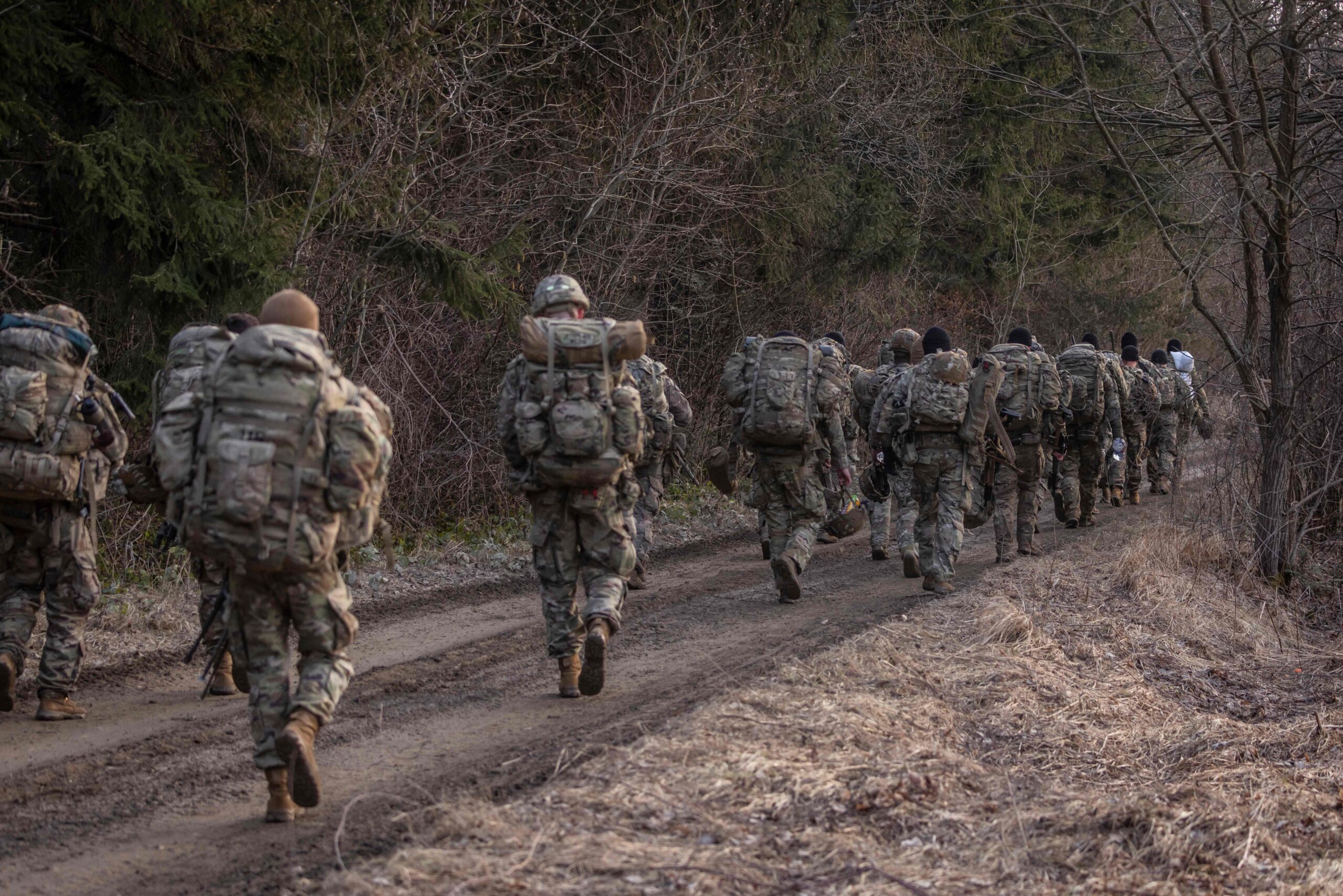
WHAT AMERICANS THINK ABOUT GOING TO WAR. With the Russian invasion of Ukraine now in its second week, it’s possible to get a glimpse of what Americans think about the war, and especially what they think the U.S. role, if any, should be.
The bottom line: Americans still oppose the United States going to war with Russia. A recent Economist/YouGov poll asked whether it would be a good idea or a bad idea to send American soldiers to Ukraine to fight Russian soldiers. Just 19% of those surveyed thought it was a good idea. Fifty-four percent thought it was a bad idea, and 28% of them were not sure.
Recommended Stories

A recent Reuters/Ipsos poll found a large majority, 71%, supported the U.S. sending weapons to Ukraine. But when asked whether “the United States should send troops to Ukraine to help defend Ukraine from a Russian invasion,” another majority, 63%, opposed the idea, versus 37% who supported it.
Subscribe today to the Washington Examiner magazine that will keep you up to date with what’s going on in Washington. SUBSCRIBE NOW: Just $1.00 an issue!
The results are in line with what President Joe Biden said in his State of the Union address. “Let me be clear: Our forces are not engaged and will not engage in the conflict with Russian forces in Ukraine,” the president declared. “Our forces are not going to Europe to fight [in] Ukraine but to defend our NATO allies in the event that Putin decides to keep moving west.” Although a significant number of Americans believe Biden is not doing enough to help Ukraine, they appear to be with him on the fundamental concern of keeping U.S. troops out of it.
But the polls cited above were finished a few days ago, and it’s possible public opinion is moving quickly in one direction or another. If that is happening, it will certainly be influenced by the intensive coverage the Ukraine war is receiving on television. Look at this from FiveThirtyEight:
According to multiple studies, one thing that can make Americans care more about foreign affairs is heavy media coverage of a given issue. And the media is heavily covering the war in Ukraine right now. According to closed-captioning data from the Internet Archive’s Television News Archive, from Feb. 22-28, the three major cable-news networks (CNN, Fox News, and MSNBC) mentioned Ukraine in an average of 2,478 15-second clips per day. On Feb. 24, the day after Russia started its invasion, Ukraine was mentioned in a whopping 3,095 clips. To put this in perspective, during January, the word “COVID” was mentioned in an average of only 482 clips per day.
The amount of coverage has unfortunately done little to cut through the traditional fog of war. Sometimes it is very difficult for viewers and readers to figure out just what is happening in the conflict. The intensity of the coverage and discussion also assure that Americans will be hearing some intemperate voices along with just-the-facts reporting. For example, a Russian attack around a large nuclear power plant caused a Twitter-wide freakout on Thursday night, leading a top U.S. lawmaker, Republican Sen. Lindsey Graham, to call publicly for Russians to assassinate President Vladimir Putin.
“Is there a Brutus in Russia?” Graham tweeted. “Is there a more successful Colonel Stauffenberg in the Russian military? The only way this ends is for somebody in Russia to take this guy out. You would be doing your country — and the world — a great service.”
Cooler heads immediately pointed out that while it might be expected that U.S. officials would discuss such things in private, Graham had just allowed Russia to say, accurately, that a senior U.S. lawmaker is openly advocating Putin’s assassination. That certainly does not help the president as he tries to get through this crisis.
Of course, it’s important to remember that this is all in reaction to Russian escalation. Putin’s widening invasion is driving everything here. But the wall-to-wall coverage is creating an echo chamber in favor of increasing involvement that plays on Americans’ basic view of the U.S. role in the world. The Washington Examiner’s Tim Carney recently tweeted, “I think many Americans really have internalized the role of the U.S. as the global cop (even though most Americans hate this), and so it is unsettling to watch a smaller good guy fend for himself against a larger aggressor while Team America is on the sidelines.”
All that pushes the U.S. toward greater involvement. “The pressure on Biden to intervene is increasing,” Politico’s Playbook noted Friday morning. “The discipline to prevent escalation that leads to a NATO-Russian war and to remain firm about his no-boots-on-the-ground pledge is being tested every day.”
Playbook noted that Biden’s “first test” of greater U.S. involvement will be a no-fly zone. When Republican Rep. Adam Kinzinger first called for a no-fly zone, the idea was quickly knocked down by experts, former officials, and Biden administration officials such as Defense Secretary Lloyd Austin. Such a policy could lead to American planes shooting down Russian planes — in other words, war.
Now, Politico says the “unified opposition” to a no-fly zone “has started to crack.” Expect impassioned debate to continue in the coming days as Russia keeps advancing and the political conversation on TV becomes even more intense and emotional. What will that mean for public opinion? Right now, the public is firmly against the U.S. fighting in Ukraine. Who knows what could happen if that begins to change?
For a deeper dive into many of the topics covered in the Daily Memo, please listen to my podcast, The Byron York Show — available on the Ricochet Audio Network and everywhere else podcasts can be found. You can use this link to subscribe.
