

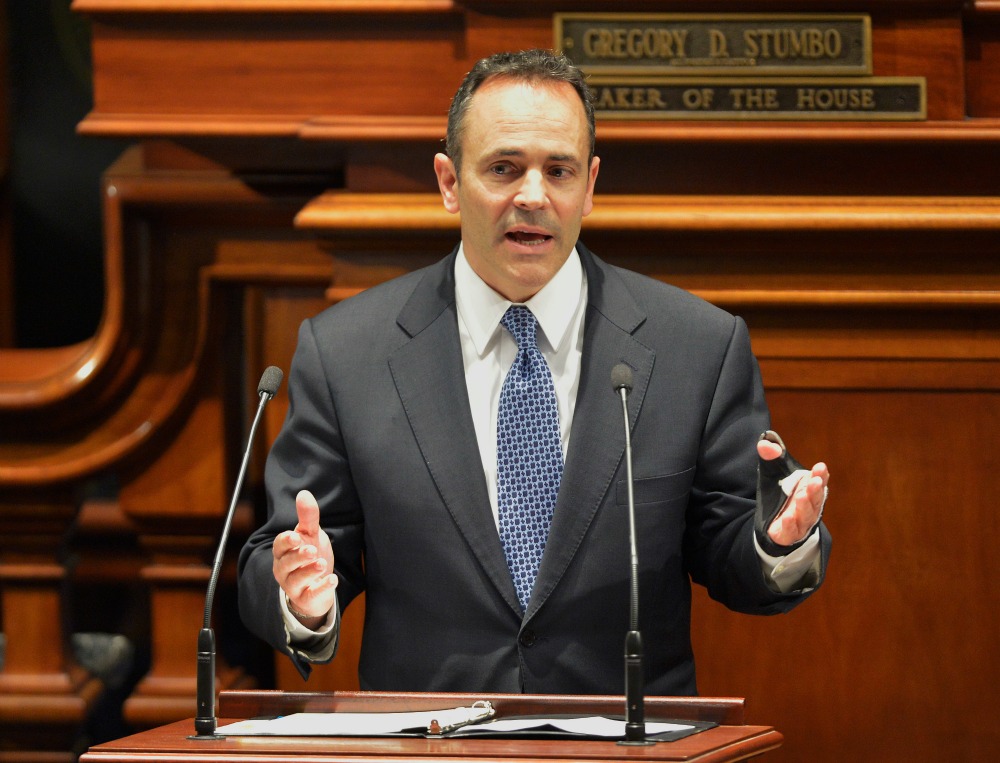
Kentucky Gov. Matt Bevin is Exhibit A when it comes to how politicking Obamacare is vastly different than actually managing it.
The state’s newly elected Republican governor, a Tea Party favorite, ran last year on a platform of rolling back Kentucky’s Medicaid expansion under the Affordable Care Act and dismantling its online marketplace, called Kynect.
Recommended Stories


Now, Bevin is moving forward with plans to ditch the exchange, but last month announced a budget proposal that would continue funding for Medicaid as the program currently stands and wouldn’t make any revisions to it until next year at the earliest.
Politically, it would have been difficult for Bevin to win the governor’s race without promising to undermine President Obama’s healthcare law, as polls have shown nearly six in 10 Kentuckians have an unfavorable opinion of the measure.
But rolling back the Medicaid expansion would take away insurance plans from more than 400,000 residents newly eligible under expanded income qualifications — about 9 percent of Kentucky’s population. Ditching Kynect, while it’s a popular website, won’t necessarily deprive people of coverage because they will still be able to visit healthcare.gov to get it.
“I think the fact of the matter is pulling down a Medicaid expansion once it’s up is really, really hard,” said Matt Salo, executive director of the National Association of Medicaid Directors. “It’s hard politically, it’s hard fiscally, it’s really hard to do.
“I think when you kind of go from the campaign promise to, ‘OK, now I have to govern,’ you realize a lot of those things,” Salo added.
And Bevin wouldn’t just anger hundreds of thousands of low-income Kentuckians by repealing Medicaid expansion. He would have to deal with frustrated healthcare providers, too. Kentucky hospitals have seen a dramatic reduction in their uncompensated care, which fell to $766 million in 2014 from $1.9 billion the previous year, according to an economic impact report commissioned by former Gov. Steve Beshear.
If Bevin were to follow through on his indications during the campaign that he would ditch expanded Medicaid, many Kentuckians would continue visiting the emergency room to get the care they need. But no longer would anyone be paying their bills.
“Not only are you telling several hundred thousand people, ‘you don’t have insurance,’ you’re also making a major decision on the behalf of Fortune 500 companies, hospitals,” Salo said. “You’re completely shifting their business model.”
Bevin’s softening on the issue, despite his firm opposition to Obamacare, is an example of how hard it is to turn back government benefits once they’re in place. States have rolled back their Medicaid programs only a handful of times. In the 1990s, Tennessee abandoned an attempt at managed care after it fizzled and in the early 2000s, Maine cut back an attempt at expansion.
Plus, the healthcare law has had a drastic effect in Kentucky, more than nearly any other state. A Gallup poll released Thursday found that the state has experienced a nearly 13 percent drop in its uninsured rate since 2013, a reduction matched only in Arkansas. Many of the newly insured are getting their coverage through Medicaid.
For now, Tea Party activists who helped get Bevin elected are giving him a pass on the Medicaid issue.
“Really he hasn’t gone back on his promise,” said Frank Simon, a Tea Party leader in the state. “He’s going to keep it going for now, but in the future he’s trying to figure out ways of testing people to see if they’re really low-income or not and a lot of important, obvious, logical policies that have to be put in place to deal with this problem.”
Scott Jennings, a Republican strategist who has worked for Senate Majority Leader Mitch McConnell’s campaigns, said he thinks Bevin is making the right political calculation on Medicaid.
“I think it’s more complex than saying we’re going to roll it back or not roll it back,” Jennings said. “I think there are more complex considerations.”
Conservatives and Republicans are, however, applauding Bevin for following through with another promise he made: to trash Kynect. That action presents fewer political risks than rolling back Medicaid expansion, as it won’t necessarily cost people their coverage.
While relieved that Medicaid is staying as is for now, healthcare advocates in Kentucky are nonetheless frustrated Bevin is about to dismantle the state-run website, turning over all functions to healthcare.gov.
Emily Beauregard, executive director of Kentucky Voices for Health, argues that it will disrupt the enrollment process for those on Medicaid, because Kynect is the website they use. Once the website is gone, Medicaid officials will need to set up alternative methods to sign up low-income Kentuckians.
“Fully funding Medicaid while dismantling Kynect has the potential for limiting coverage to those who need it the most,” Beauregard said. “Kynect and healthcare.gov don’t serve the same purpose for Kentuckians … This is what I’ve been trying to get across to people.”
