

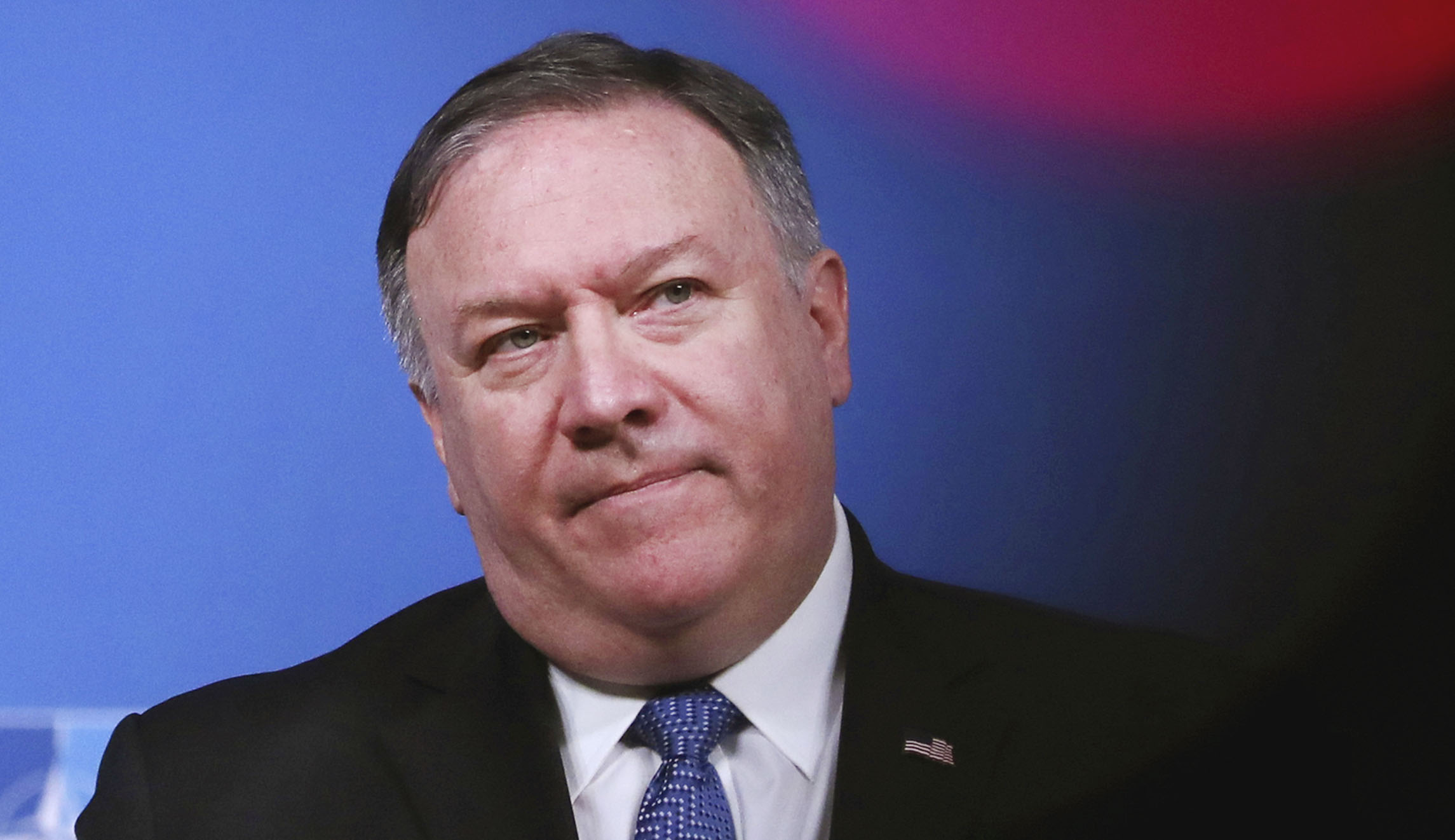
Secretary of State Mike Pompeo urged United Nations members on Wednesday to maintain an arms embargo against Iran that is scheduled to lapse in 2020 and warned that everyone’s safety is at risk if it’s allowed to expire.
“We risk the security of our people if Iran continues stocking up on ballistic missiles,” Pompeo told the United Nations Security Council in New York. “The council must address these malign activities. It cannot reward Iran by lifting the arms embargo.”
Recommended Stories


Pompeo delivered that message in person as he called for the U.N. to deny Iran some of the non-nuclear benefits pledged in the 2015 nuclear deal. His address was an effort to convince world leaders to impose additional sanctions pressure on Iran, despite their broader belief that the nuclear pact is a success, by highlighting illicit Iranian activity that European supporters of the pact have condemned.
“Our goodwill gestures have been futile — futile in correcting the Iranian regime’s reckless missile activity and it’s destructive behaviors,” Pompeo said.
U.N. Security Council resolution 2231 endorsed the nuclear deal, known as the Joint Comprehensive Plan of Action, and “calls upon Iran not to undertake any activity related to ballistic missiles designed to be capable of delivering nuclear weapons.” But Pompeo said Iran has violated that resolution already.
Pompeo’s presentation received a mixed response at the council, as Western European supporters of the deal remain troubled by both the U.S. withdrawal from the pact and Iran’s ballistic missile launches. Russia took a more aggressive line in lambasting President Trump’s attempt to “torpedo the deal” while defending Iranian missile launches by stressing that they aren’t necessarily part of a nuclear program.
“Overall, missile launches in general are not bad and any proof showing that they may have a nuclear component are absent,” Vasily Nebenzia, the Russian envoy to the Security Council, said in response to Pompeo. “Russia advocates preserving the JCPOA.”
That was too accommodating of Iran, even for Western European supporters of the pact. “The point about ballistic missile proliferation is not solely about nuclear missiles, notwithstanding that there is a link with nuclear capability,” Karen Pierce, the British representative at the Security Council, said in advance of Nebenzia’s speech. “Any conventional payload would cause extensive harm to civilians and infrastructure.”
Pierce also rejected the idea that U.N.’s condemnation of Iran’s ballistic missile tests is “not binding” and thus the tests are unworthy of Security Council attention.
“The call upon Iran to comply with the request not to undertake any activity related to ballistic missiles designed to be capable of delivering nuclear weapons has a clear purpose,” she said. “Tendentious arguments, which seek to diminish the council’s voice on this, serve only to undermine the council’s prerogative and authority and to encourage other states to disregard the resolutions of the Security Council.”
Still, Pompeo encountered broad Western opposition to the U.S. withdrawal from the deal. “For us, the nonproliferation benefits of the JCPOA,” the European Union’s Serge Christiane told the Security Council. “The JCPOA has significantly held back the Iranian nuclear program and ensures Iran does not acquire material or equipment to develop a nuclear weapon.”
The top U.S. diplomat defended the withdrawal in language that might pressure allies to aid a crack down on Iran’s ballistic missile program.
“It is self evident why we [exited the pact], based on the very conversation that we’re having here today,” Pompeo said. “The JCPOA has — without a doubt — to date, shielded the Islamic Republic of Iran without accountability to the risks it presents to the world.”
