

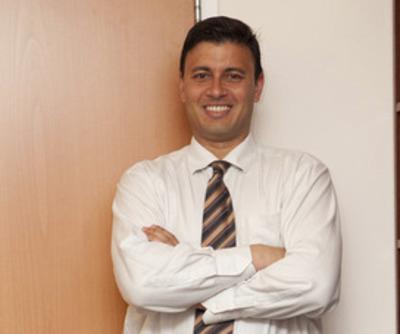
In 1844, in what was then Persia, a young man took the title of “the Bab,” announcing that the time of promised peace had come and that a messenger was on his way. Six years later the Bab was executed and 20,000 of his followers massacred. But the messenger, called Baha’u’llah, arrived in 1863 and founded the Baha’i faith, which now has about five million followers in more than 200 countries, making it the second-most widespread religion next to Christianity. Shastri Purushotma is a leader of the D.C. Baha’i community of about 350 members; he also works for the national governing body of the Baha’i faith, advocating for human rights worldwide. Do you consider yourself to be of a specific faith?
Recommended Stories



On the one hand, Baha’is believe all religions come from the same source, so to be a Baha’i is also to be a Jew and a Christian and a Muslim all at the same time. But at the same time, it is a separate religion. One way to look at it is Christians believe in the Jewish Old Testament, and yet they are separate. … And because all religions come from the same source in the Baha’i faith, it’s very unifying. There’s no need for religious conflict.
How did you become a Baha’i?
I grew up on my father’s side with a Hindu background, and then on my mother’s side, Christian. In becoming a Baha’i it was a natural way to respect both religions, as I saw they came from the same source.
The Baha’i faith is so new compared to the world’s other major religions. Does that ever cause you to doubt its veracity?
There’s no such thing as automatically growing up a Baha’i. Even if you’re in a Baha’i family you still have to decide whether it’s true or not. A very strong principle in the faith is individual investigation of the truth. If I were I living 150 years after the birth of Christ, I would have to investigate just like I would the Baha’i message. There’s also a certain privilege in being part of it so early, just like an early Christian might have felt.
Tell me more about persecution of Baha’is in Iran.
Because it is kind of a revolutionary message, that the promised time has come and the human race has the possibility to be at peace, it is especially revolutionary in Iran. So there’s official persecution of the Baha’i faith by the Iranian government, which is led by the clergy. The Baha’i community is the largest religion minority in Iran, and it’s extremely popular, so it is a threat to clergy who worry their followers might be part of this new religion. Right now the members of the Baha’i leadership group in Iran are sentenced to 20 years in prison, and there are more than 100 Baha’is in prison in Iran. So my job is to let the State Department and Congress know about what’s going on and advocate on behalf of Baha’is.
What does daily practice of the Baha’i faith look like?
Every day you say one prayer. Bahai’s normally read from the scriptures. Baha’u’llah wrote almost 100 books. But Baha’is will also read from the Old Testament, New Testament, Koran, because it’s all from the same God.
If you believe all religions are one, what do you make of contradictions between faiths?
Typically the contradictions tend to be about social issues having to do with the time in history when that religion came. So for example, 3,000 years ago in Israel it was very dangerous to eat pork, with the bacteria and no refrigeration and that sort of thing. So it would make sense to have very strong laws not to eat pork. There are other things like 2,000 years ago we didn’t have the Internet or the ability to fly everywhere, so there was less emphasis for the entire human race to be at peace at that time. But now because of the sudden change in technology we do need more practical teachings on how to bring peace.
At your core, what is one of your defining beliefs?
One is that it’s just very exciting to be alive right now, at this time in history. I could have been some peasant alive 1,000 years ago in some village, and my world would have been very limited. And obviously there is a lot of inequity going on in the world right now, but there’s so much potential to develop yourself and contribute to human history. And it’s really the Baha’i teachings that give me this excitement to be alive in the world now.
– Liz Essley
