

Oil giant Alaska could find itself on the ropes if it doesn’t find a way to exploit its huge natural gas wealth in time to compete with rivals aiming for the Asian energy market.
On a Wednesday call with reporters, Margo Thorning, senior vice president and chief economist with free-market think tank American Council for Capital Formation, compared Alaska to the American auto industry in the 1970s, detailing the council’s new report on the challenges and opportunities Alaska faces.
Recommended Stories


The report is part of the group’s “campaign” to push for the timely approval of liquefied natural gas export projects.
The report points out that Alaska’s once great supplies of oil are in decline, which, compounded by record low oil prices, could put the nation’s only Arctic state in a tailspin if it doesn’t look for new markets to tap, like natural gas.
Thorning said Alaska is well aware of the problems it faces from the global oil glut, which has created a $3.5 billion deficit in the state. Alaska has relied on the price of petroleum to keep it afloat for decades, but with oil prices not expected to go up for years, it faces serious challenges.
“When I look at Alaska and the challenges [it faces] … I think of Michigan in 1970s” when it was sidelined by competition from Japan, Thorning said. Back then, the Big 3 — Ford, GM and Chrysler — “didn’t realize that they were in a global market,” and have been playing catch-up ever since.
Thorning said the situation is even more dire for Alaska than it was for the Detroit autos, because Alaska’s economy is much less diversified.
However, Thorning’s report is not pessimistic, it’s more of a wake-up call for the state. It said Alaska should stay the course on an existing project it has had underway for years with several of the largest oil companies, instead of pursuing an alternative project that may be cheaper, but lacks the certainty and expertise.
The state’s administration chose to pursue another project last year, which the report said could send the wrong signal to buyers.
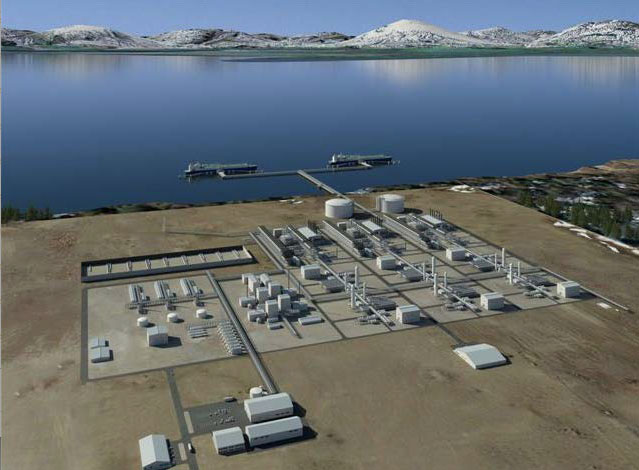
The report said Alaska should keep its original plan, which calls for a pipeline to connect drilling operations on the North Slope to ports 800 miles away. The project, called “AlaskaLNG,” would be the largest of its kind in the world, with an estimated cost of $45-65 billion.
But the administration, faced with a growing deficit, wants to explore a cheaper option. Analysts say this is the wrong move to make.
“Analysts believe the state’s decision to pursue a competing pipeline may jeopardize progress on AlaskaLNG by increasing the uncertainty about whether and when the project will go forward,” according to the report.
Thorning told reporters the increased uncertainty of two competing projects will make customers skittish and limit contracts to purchase the fuel.
This gets back to her automaker comparison, when Detroit was caught off guard by foreign competitors. If uncertainty scares off the buyers, rivals will easily swoop in to push the state out of the market, Thorning said.
The report said the market for natural gas is expected to grow in the next few years, forcing countries like Qatar, Australia and Canada to begin ramping up new capacity.
Australia, already a huge exporter of coal and gas to Asia, has a number of new gas projects in the queue, which could supplant Alaskan supplies easily. Other natural gas giants, such as Qatar, are also ramping up capacity that could sideline Alaska.
The Energy Information Administration said others are jumping into the fray to tap the growing market for natural gas and other fossil fuels. An Aug. 4 analysis by the agency showed Algeria, which is the largest gas producer in Africa, making major investments in its production capacity to tap the European market. Iran will offer new competition to Alaska, and India said Wednesday it is considering buying gas from the Persian Gulf state if the nuclear deal with six world powers holds.
Thorning’s report said over the next five years, many of America’s energy rivals “are expected to supply almost half of the world’s [liquefied natural gas].” But supplies from North America and other regions “could, if adequately developed, meet that demand thereafter.”
“Global competition, fluctuations in the price of oil and unforeseen political developments conspire to limit the guarantee of success,” the report said. “However, among the greatest threats Alaska faces [is] missing this opportunity by pursuing two projects in competition with each other while ignoring the global competition for LNG market.”
