
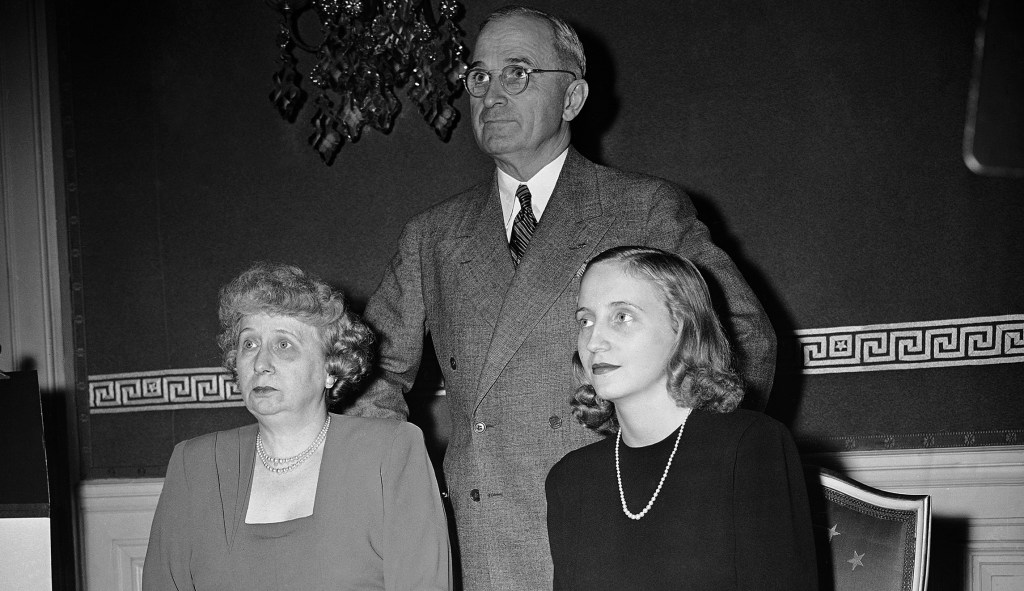
Christmas 1945 was a time of joyous homecomings. World War II was finally over. Uncle Sam was discharging service members as fast as he could. Most were welcomed home with open arms and warm embraces — except for their commander in chief. This is what happened when he decided to head home for the holiday.
Harry and Bess Truman’s marriage was one of the presidency’s greatest love stories. Truman fell in love with Elizabeth Wallace the first time he saw her at age six in 1890. She loved him with equal fervor.
Recommended Stories

But the Trumans were navigating a bumpy stretch of road in December 1945. President Franklin Roosevelt’s unexpected death eight months earlier had thrust them into the White House, a place they hadn’t sought or wanted.
Bess hated the hassles, headaches, and frustrations of being first lady. She disliked Washington’s social scene. She especially resented the large circle of advisers that now came between her and her husband, eating into their scarce private time and inadvertently putting distance between them. The White House was not the place for her.
The week before Christmas she gathered her 21-year-old daughter Margaret, hopped on a passenger train, and hurried back to their beloved Victorian house in Independence, Mo. If Harry chose to remain in Washington with pressing affairs of state, that was fine with her. Bess was going home for the holidays, presidency or not.
Harry, Bess, and Margaret were an extremely close-knit threesome. They genuinely enjoyed each other’s company. Without them, Harry was unbelievably lonely in the empty White House.
Just then, a blast of wintry weather roared across the country. Five inches of snow fell on Washington on the 19th, and the lousy weather stuck around through the holidays.
Christmas morning dawned with freezing rain, sleet, and ice. National Airport was closed to all commercial flights. What little ground travel could get through was a tangled mess.
At that very moment, Truman decided to fly home to see his wife and daughter.
Truman spoke with the pilot of his personal plane, the Sacred Cow. The trip would be risky in such rough conditions, Truman was told, but it could be made. Bad weather or not, Truman was going home, doggone it. With great trepidation, the presidential plane took off.
It must have been a white knuckle flight for the men in the cockpit. They had to fly lower than usual and go slow to keep ice from forming on the wings. When the Sacred Cow finally touched down in Kansas City, it was an hour late. When the president arrived at his home at 219 North Delaware, the reception was as cold as the weather.
Bess was livid. Truman had not only risked his own life but also those of the flight crew and Secret Service agents who accompanied him. Far from being a touching gesture, the trip had infuriated her.
Reaction among the press was equally harsh. The New York Times called it “one of the most hazardous ‘sentimental journeys’ ever undertaken” by a head of government.
Truman eventually tucked his tail between his legs and headed back to Washington. There he scrawled a letter to Bess on White House stationary. Truman wasn’t one to indulge in pity parties, but this time he came close. He wrote:
Truman never sent that letter. It was found among his personal papers after his death.
Bess Truman calmed down in time. She eventually learned to tolerate life in the White House, though she she never embraced it. Their love lasted until Harry’s death the day after Christmas 1972.
President Harry Truman was hardly the first husband ever disappointed by his wife’s reaction to something he did. His reckless trip home is a reminder that while the presidency is an institution, the people involved in it are all too human.
J. Mark Powell (@JMarkPowell) is a contributor to the Washington Examiner’s Beltway Confidential blog. He is a former broadcast journalist and government communicator. His weekly offbeat look at our forgotten past, “Holy Cow! History,” can be read at jmarkpowell.com.