

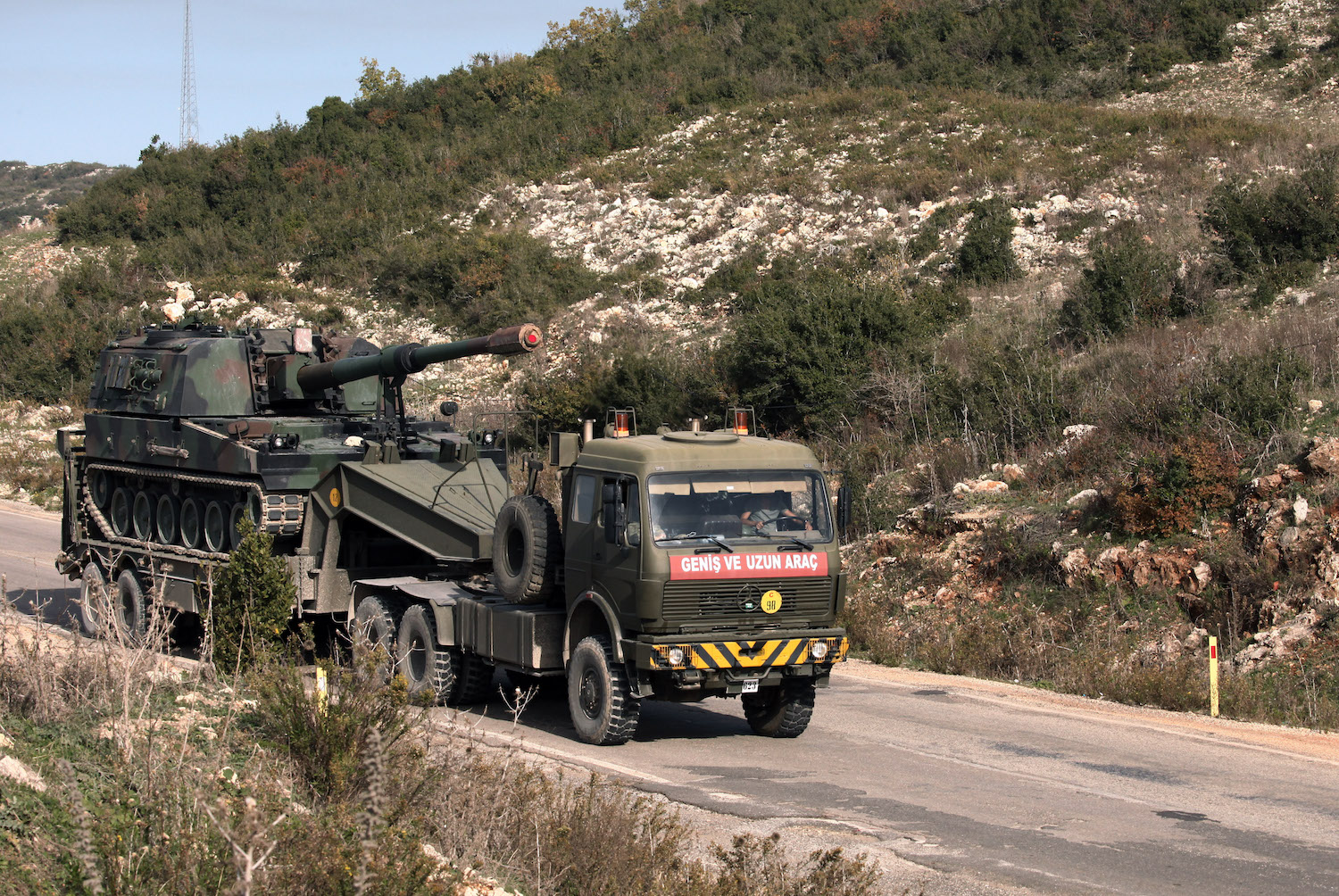
U.S.-backed forces in Syria might be in danger of attack from Russia or even NATO ally Turkey, according to a top American general.
“That’s the question,” Air Force Gen. “Hawk” Carlisle replied Friday when asked if he’s worried about Russia attacking U.S.-backed forces after the American-led coalition recaptures Raqqa and other Islamic State strongholds in Syria.
Recommended Stories


“What about the Turks and the Kurds? I mean, it’s the same discussion, right?” Carlisle, the head of Air Combat Command, said during a breakfast meeting with reporters. “And so, yeah, I don’t know the answer to that — as we take ISIS out — what the Russian intention is, what the Syrian regime intention is, what the Turkish intention is, what the Iraq intention is with respect to their sectarian challenges with the Kurds and the Sunnis.”
A Turkish attack on U.S.-backed forces could mark a dramatic escalation of tensions between the United States and a NATO ally, particularly if it happened in conjunction with Russian military action. Such a development is conceivable nonetheless because of the tangled web of ethnic, sectarian and political rivalries that makes the Syrian civil war one of the most complex crises in the world.
The U.S. has assembled a coalition of Syrian Kurds and moderate Arab fighters to liberate territory taken by ISIS. Turkey regards some of the Syrian Kurds as a terrorist group allied with Turkish Kurds who have carried out an insurgency against Ankara for decades. And Russian President Vladimir Putin has not hesitated to attack U.S.-backed groups fighting Syrian President Bashar Assad, on the theory that they, too, are “terrorists” comparable to ISIS.
“Militarily, as a guy wearing a uniform, we’re going to beat ISIS,” Carlisle said. “We’re going to take them out. I know we are, and we can. The question is, then what? And that is a question that’s not a military question. That’s a United States whole-of-government question of what happens next.”
Carlisle’s comments echo several Republican and Democratic lawmakers who worry that the expulsion of ISIS from major cities in Iraq and Syria will inaugurate a new phase of Russian and Iranian aggression in the Middle East.
“I do think there will be some collusion between Russia and Iran,” New York Rep. Eliot Engel, the top Democrat on the House Foreign Affairs Committee, told the Washington Examiner. “I worry about it.”
The success of that “collusion” will depend, in part, on the manner in which the U.S. defeats ISIS. Defense Secretary Jim Mattis is scheduled to provide President Trump with “a full range of options” for a counter-ISIS strategy on Monday. Among those options is increased military deployments to Syria.
“We’ve been given a task to go to the president with options to accelerate the defeat of ISIS specifically, but obviously other violent extremist groups as well,” Marine Gen. Joseph Dunford, who chairs the Joint Chiefs of Staff, said Thursday. “So we’re going to go to him with a full range of options from which he can choose.”
Increased military deployments are sure to be controversial in Congress, even if Trump never attempts to initiate the kind of large-scale invasion of Iraq that George W. Bush ordered in 2003. Congress never passed new legislation authorizing then-President Obama to use force against ISIS in large part because lawmakers couldn’t agree on what, if any, restrictions on ground troops should be included in the authorization.
“[Destroying ISIS in Syria] doesn’t solve the problem in the Middle East, right?” Carlisle said. “Sectarian violence inside of Iraq — what governance is Iraq going to be able to generate in that country? What is the Turk-Kurd situation going to look like? What is going to happen in Syria? What is the future of Syria? What is the influence that Russia is trying to gain? What is the influence that Iran is trying to gain? So all those are questions that obviously again I think that as we continue this fight against ISIS. … That is, in my opinion, the dialogue that we as a nation have to have.”
