
Frank Sinatra, a popular singer across several decades, once emphatically crooned: “Love and marriage … Love and marriage … Go together like a horse and carriage …”
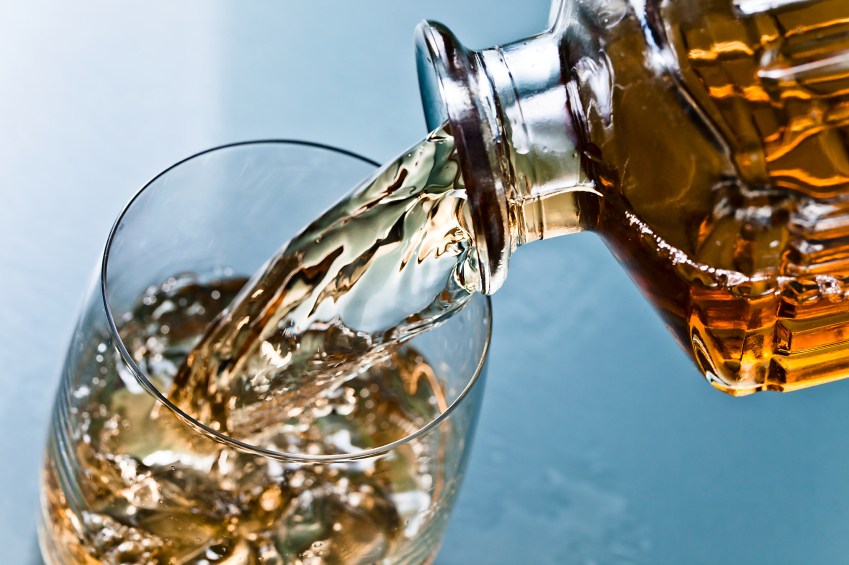
Perhaps that’s true. But at the risk of making a strained analogy, consider that — across several centuries — booze and the American political process, if not exactly a matrimonial match made in heaven, certainly qualify as unwavering sweethearts (especially if one throws out the Prohibition years).
Recommended Stories

In fact, alcohol as part of the political scene predates the nation; George Washington, while still a British subject, ran for a seat in Virginia’s House of Burgesses in the 1750s and wooed his would-be constituents with gallons of rum, wine, and beer in an effort to obtain their support. He won by a landslide.
Even some presidents who drank lightly understood that an occasional alcohol-laced fete would increase their chances of a successful election campaign. James K. Polk — who was merely an occasional sipper — lubricated his run for Tennessee governor in 1838 “with the generous juice of the grape, whiskey, and cognac,” according to reports of the day.
In case people think alcohol-fueled election campaigns are more a thing of the past (such as the “Log Cabin and Hard Cider” campaign of William Henry Harrison in 1840), consider that George W. Bush brashly tried to help his chances with a keg party when he ran for a U.S. congressional seat in 1978. Volunteers placed a “Bush Bash” advertisement in a Texas Tech student newspaper, essentially offering free beer to anyone wishing to attend.
Because alcohol can sometimes be a double-edged sword in a political campaign, one would be amiss not to mention that Bush’s opponent, Kent Hance, launched an ingenious counterattack; he copied the “Bush Bash” ad, got hold of a mailing list containing several thousand members of the Church of Christ, and insisted that Bush’s “beer for votes” offer exposed a flaw in his opponent’s character. The letter noted: “Mr. Bush has used some of his vast sums of money in an attempt, evidently, to persuade young college students to vote for him by offering free alcohol. … ”
Hance insinuated that the beer bash also showed that the Texas roots of the Bushes were somewhat tenuous, instructing a reporter that “Maybe it’s a cool thing to do at Harvard and Yale.” (This was not entirely unfounded political rhetoric; George H.W. Bush once admitted that when he first moved to Texas he wasn’t sure what chicken fried steak was.)
It should be noted that this particular election was the last one George W. Bush ever lost. And besides, soon after his 40th birthday, Bush himself gave up drinking for good, despite years of vigorously pursuing (in his words) “the three B’s — beer, bourbon, and B&B,” a blend of brandy and Benedictine liqueur. At least on a national scale, his refusal to continue drinking seemingly did not hurt his political stock.
Most politicians try to walk a middle line. One does not necessarily want to be portrayed as a teetotaler (especially if this perception has smug, “holier than thou” overtones to it), but a true loose cannon who is continuously intoxicated (think Toronto Mayor Rob Ford) will likely have a short political life, if not a short life on Earth.
Nevertheless, most modern political candidates embrace the value of what I call the “drinking photo op” — i.e., Ronald Reagan or Barack Obama hoisting a pint of beer on St. Patrick’s Day or at a professional sporting event. It seems like a very American pursuit and allows the politico to appear as “one of the people” to reach the voting animal that Sarah Palin affectionately refers to as “Joe Six-Pack.”
Obviously, 2012 Republican candidate Mitt Romney — devoted to his Mormon faith — did not have the “drinking photo op” in his playbook. All the more reason, perhaps, that Rep. Paul Ryan — Romney’s running mate — was quick to point out at his party’s convention that his Wisconsin roots were well watered with “a Leine’s [Leinenkugel beer, a popular brew from Chippewa Falls]), a little Spotted Cow [a highly touted microbrew from the Badger State], and some Miller.”
Political libations may come in more highbrow presentations these days (think expensive California wines at $10,000 meet-the-candidate dinners), but John Barleycorn in one form or another is never very far from the political process.
With Tuesday’s midterm elections upon us, consider, too, that the victory toasts and the equally traditional drowning of sorrows are the only truly inevitable results.
Or as Ol’ Blue Eyes himself might have sung it: “This I tell you, brother … You can’t have one without the other.”
Mark Will-Weber is a journalist and author of the recently released Mint Juleps with Teddy Roosevelt: The Complete History of Presidential Drinking. Thinking of submitting an op-ed to the Washington Examiner? Be sure to read our guidelines on submissions for editorials, available at this link.