

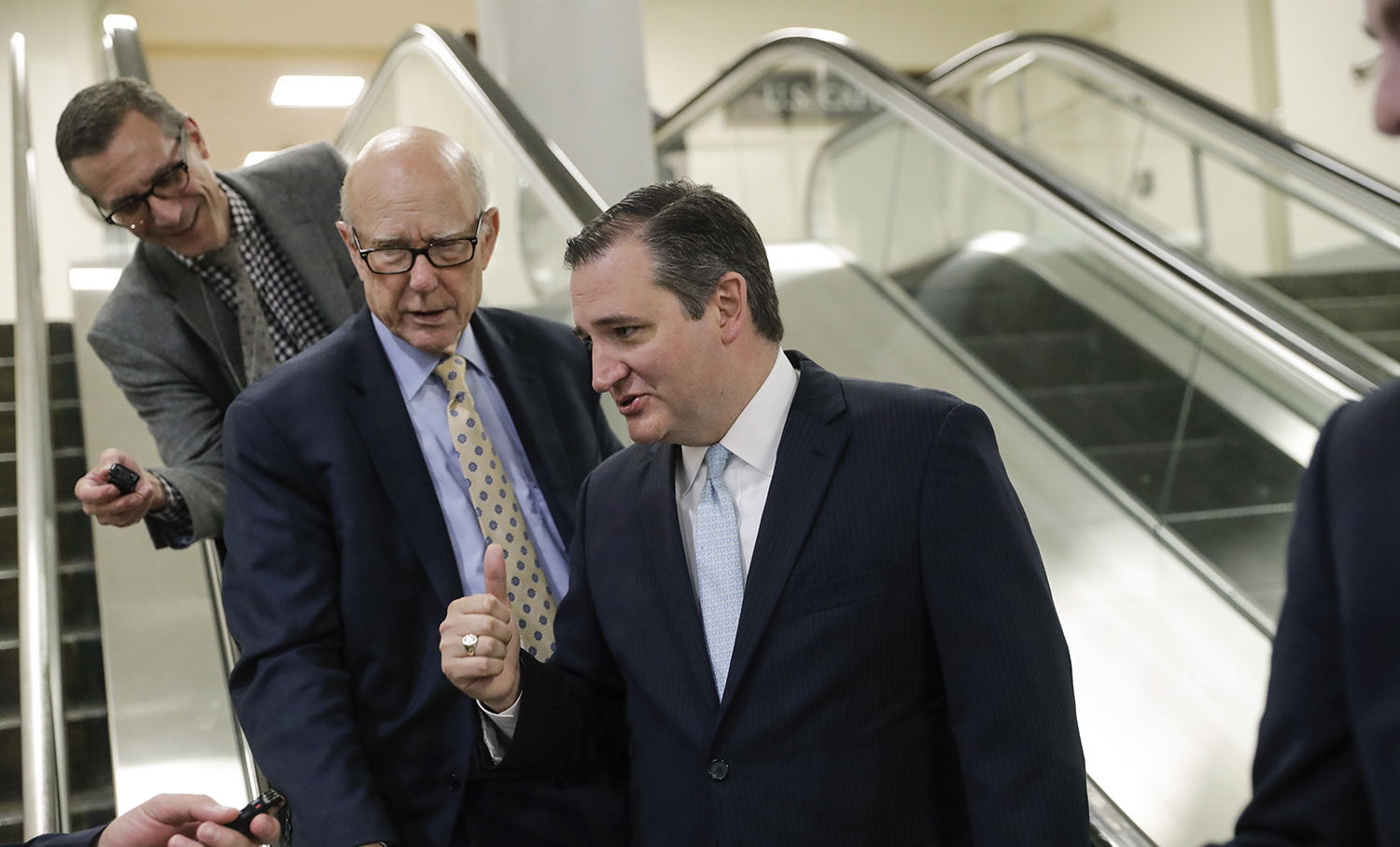
After returning to Capitol Hill Monday following a 10-day recess, Republican senators did not appear to rule out a compromise on healthcare, even as deep division remain within their party.
Several senators voiced support for the Consumer Freedom Act, an amendment sponsored by Republican Sens. Ted Cruz of Texas and Mike Lee of Utah that would allow health insurance companies to offer less expensive plans that do not include Obamacare’s essential health benefits as long as they provide at least one plan that includes them.
Recommended Stories


It’s not clear if the amendment will be part of the final healthcare legislation, and critics of the proposal say that it would leave only costly plans for people with the highest-cost medical needs, making coverage out of reach for people with pre-existing illnesses.
Senators did not speculate on when they might come to an agreement on the bill. Senate Majority Leader Mitch McConnell, R-Ky., said Monday that Republicans “will continue working” on a healthcare bill but did not schedule a vote. He warned during the July 4th recess that Republicans would need to work with Democrats to stabilize the Obamacare exchanges if they are unable to pass a bill that would repeal and replace portions of the law.
Sen. Susan Collins, R-Maine, a key centrist vote who has said she believes Republicans should work with Democrats on crafting a bill, said provisions to cover pre-existing illnesses were important to her, as were many other healthcare provisions.
“I have a lot of concerns about Sen. Cruz’s amendment,” she said. “It would erode protections for people with pre-existing conditions, and it is simply not the answer. I think it would cause premiums to go up for a lot of people.”
Another centrist who has opposed the bill, Sen. Dean Heller, R-Nev., said that Republicans were making progress, but declined to elaborate on which provisions were gaining consensus.
“There is a lot of discussions going on and a lot of moving parts,” he said. “Everybody is playing fair and nobody is taking cheap shots in our conference.”
Republicans are advancing the bill through reconciliation, a measure that has specific budget and spending conditions applied to it and that needs only 50 votes for passage, assuming a tie-breaking vote by Vice President Mike Pence. Republicans have only a narrow margin because Democrats will not vote for a bill that repeals Obamacare, and the GOP can lose only two votes.
Republicans have largely been unable to agree on a healthcare bill, with different factions of the party concerned about different effects on patients. Centrists are worried about projections from the Congressional Budget Office showing that the healthcare bill would cause 22 million more people would be uninsured by 2026 than under current law and about cuts to Medicaid. Though additional funding has been added to the bill, it may not be enough to get their backing.
Conservatives, meanwhile, are concerned that the bill doesn’t do enough to reduce premiums. Some senators said they hoped that the Cruz amendment would bring consensus. Still, if a new score from the CBO were to projects difficulties in accessing coverage for people with pre-existing conditions, centrists would be likely to continue opposing the bill. Others appeared open to seeing how the proposal would play out.
“Very interesting approach certainly worthy of consideration, but right now about anything is,” Sen. Pat Roberts, R-Kansas, said of the Cruz amendment.
Sen. David Perdue, R-Ga., said he remained hopeful that Republicans in the Senate could come to an agreement.
“I support Sen. Cruz,” Perdue said. “I think it’s the right thing to do. There are some questions about pre-existing conditions, but I really think that can be solved.”
Adding more federal funding to a stability fund was one possibility, he said, but he stressed that he did not think people who didn’t want health insurance plans to contain a wide range of benefits should have to buy it. “What I’m saying is, if you don’t need it you shouldn’t have to buy it,” he said. Sen. Ron Johnson, R-Wis., a conservative, noted that people who are middle-class and relatively healthy are paying a significant amount in health insurance premiums because they do not qualify for subsidies. He raised the possibility of protecting people with pre-existing conditions through using federal funding for high-risk pools.
“Obamacare’s architecture proved forcing a small percentage of the population to fund all of that doesn’t work,” he said. “It collapses the markets and that is what we are witnessing today.”
Sen. Mike Rounds, R-S.D., said he had spoken with Cruz about the amendment and he suggested he would be open to it, but stressed that he wanted to make sure the provision would still be able to guarantee coverage to people with pre-existing illnesses.
“I told [Cruz] I would support it as long as there are provisions built into it so that there is a specific ratio between the least expensive plan and the most expensive plan,” Rounds said. “If they cut the price on one pool they have to cut the price on the most expensive plan as well.”
Rounds has previously suggested delaying a vote on healthcare by staying to work over the August recess, a suggestion he made again Monday.
“We’re talking about impacting real lives here,” Rounds said. “And this is something that we have got to get the message out to people that we are not taking away coverage for pre-existing conditions. What we are trying to do is make this sustainable for the next generation.”
* Robert King contributed to this report.
• Correction: A previous version of this story incorrectly attributed quotes about the healthcare bill to Sen. Johnny Isakson, R-Ga. The comments were made by Sen. David Perdue, R-Ga.
