

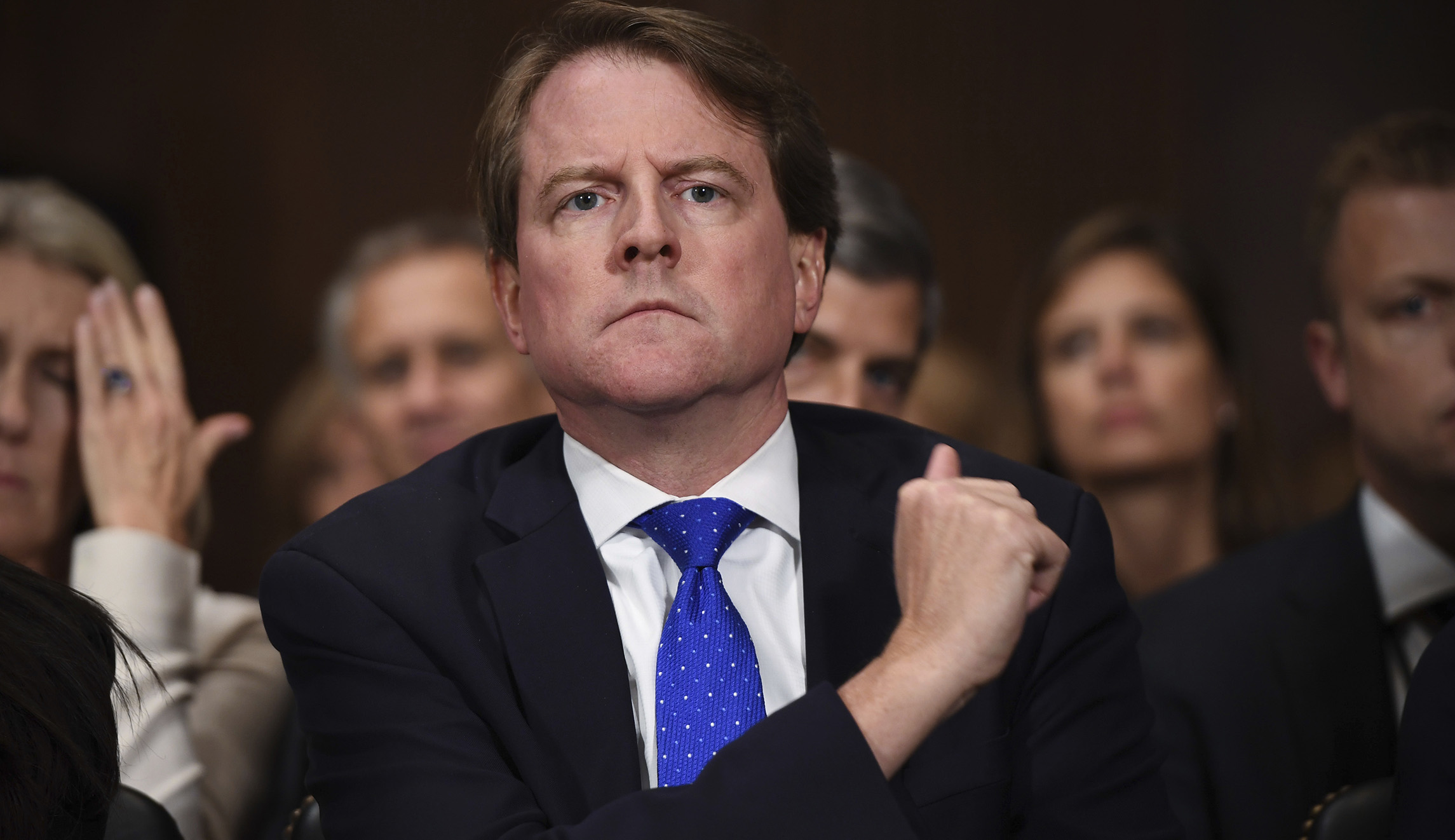
A federal judge ruled former White House counsel Don McGahn must testify before Congress.
The ruling on Monday by U.S. District Judge Ketanji Brown Jackson is a victory for House Democrats, who have faced resistance from the White House, which has used the same “absolute immunity” argument to prevent McGahn from testifying to prevent other former officials from speaking out against President Trump in the impeachment proceedings.
Recommended Stories


“This Court holds that individuals who have been subpoenaed for testimony by an authorized committee of Congress must appear for testimony in response to that subpoena — i.e., they cannot ignore or defy congressional compulsory process, by order of the President or otherwise,” Jackson said in a 120-page opinion.
“Don McGahn will comply with Judge Jackson’s decision unless it is stayed pending appeal,” McGahn’s lawyer William Burck told the Washington Examiner. “The DOJ is handling this case, so you will need to ask them whether they intend to seek a stay.”
Justice Department spokeswoman Kerri Kupec told the Washington Examiner, “We will appeal the decision” to the U.S. Court of Appeals for the D.C. Circuit.
McGahn, who left the White House in October 2018, was subpoenaed by the House Judiciary Committee to testify in April, predating the impeachment effort related to Trump allegedly pressuring Ukraine to investigate his political rivals. Democrats sued McGahn in August, claiming to need his testimony on special counsel Robert Mueller’s report on the Russia investigation, particularly 10 instances of possible obstruction of justice that Mueller outlined in his report.
Trump asked McGahn to help fire Mueller, but McGahn said he would resign rather than do so. When Mueller’s office asked him about allegations that Trump had pressured him to fire the special counsel, “McGahn responded that he would not refute the press accounts because they were accurate in reporting on the President’s effort to have the Special Counsel removed,” according to Mueller’s 448-page report.
Calling McGahn the “most important witness, other than the President, to the key events that are the focus of the Judiciary Committee’s investigation,” Democrats argued in October that he had “no valid interest in defying the Committee’s subpoena.”
The Justice Department countered that “there is no constitutional or statutory basis for a Committee of the House of Representatives to take on the role of enforcing its subpoenas in the federal courts,” leaning heavily on an Office of Legal Counsel opinion, which states that current and former top aides to the president, such as McGahn, are absolutely immune from being compelled to testify in front of Congress if ordered by the president not to appear.
Jackson, an appointee of President Barack Obama, strongly rejected the Justice Department’s arguments about shielding McGahn from testifying.
“When DOJ insists that Presidents can lawfully prevent their senior-level aides from responding to compelled congressional process and that neither the federal courts nor Congress has the power to do anything about it, DOJ promotes a conception of separation-of-powers principles that gets these constitutional commands exactly backwards,” Jackson said on Monday. “In reality, it is a core tenet of this Nation’s founding that the powers of a monarch must be split between the branches of the government to prevent tyranny.”
The judge ruled that Congress “has the constitutionally vested responsibility to conduct investigations of suspected abuses of power within the government, and to act to curb those improprieties, if required” and said the Justice Department’s position arguing for “unreviewable absolute testimonial immunity on separation-of-powers grounds — essentially, that the Constitution’s scheme countenances unassailable Executive branch authority — is baseless.”
As precedent, Jackson pointed to a 2007 incident involving former Bush White House counsel Harriet Miers, who was subpoenaed by the House Judiciary Committee to answer questions about the DOJ’s decision to request resignations from a number of U.S. Attorneys. U.S. District Court Judge John Bates ruled in 2008 that Miers was “not immune from compelled congressional process.”
The judge made it clear that Monday’s ruling dealt only with McGahn’s obligation to appear before the committee, saying McGahn could still invoke executive privilege where appropriate when questioned.
“What is at issue in this case is solely whether senior-level presidential aides, such as McGahn, are legally required to respond to a subpoena that a committee of Congress has issued, by appearing before the committee for testimony despite any presidential directive prohibiting such a response,” Jackson ruled. “The Court distinguishes this issue from the very different question of whether the specific information that high-level presidential aides may be asked to provide in the context of such questioning can be withheld from the committee on the basis of a valid privilege.”
The McGahn case has been closely watched because the Trump administration has used the same “absolute immunity” claim to block potential witnesses from testifying in the impeachment proceedings being run by the Democrat-led House. Trump has dubbed the impeachment effort a “coup.”
Among the current and former Trump administration officials who have resisted congressional subpoenas in the impeachment case are Secretary of State Mike Pompeo, acting chief of staff Mick Mulvaney, and former national security adviser John Bolton.
“I am pleased the court has recognized that the Trump Administration has no grounds to withhold critical witness testimony from the House during its impeachment inquiry. Don McGahn is a central witness to allegations that President Trump obstructed Special Counsel Mueller’s investigation, and the Administration’s claim that officials can claim ‘absolute immunity’ from Congressional subpoenas has no basis in law, as the court recognized today,” House Judiciary Committee Chairman Jerry Nadler said in a statement Monday.
“Now that the court has ruled, I expect him to follow his legal obligations and promptly appear before the Committee,” the New York Democrat added.
Earlier in the day, House Intelligence Committee Chairman Adam Schiff revealed in a letter to colleagues that he is drafting a report the House Judiciary Committee would use to move articles of impeachment against Trump.
The report is expected to center on testimony provided over the past two months about Trump’s efforts to get Ukrainian government officials to investigate former Vice President Joe Biden. Schiff said he would deliver the report to the Judiciary Committee when lawmakers return the week of Dec. 2.
Schiff said Democrats will “catalog” Trump’s refusal to comply with House-issued subpoenas, “which will allow the committee to consider whether an article of impeachment based on obstruction of Congress is warranted along with an article or articles based on this underlying conduct or other presidential misconduct.”
If the House approves articles of impeachment, the case will move to the Senate for a trial. A two-thirds majority is needed to remove Trump from office.
