

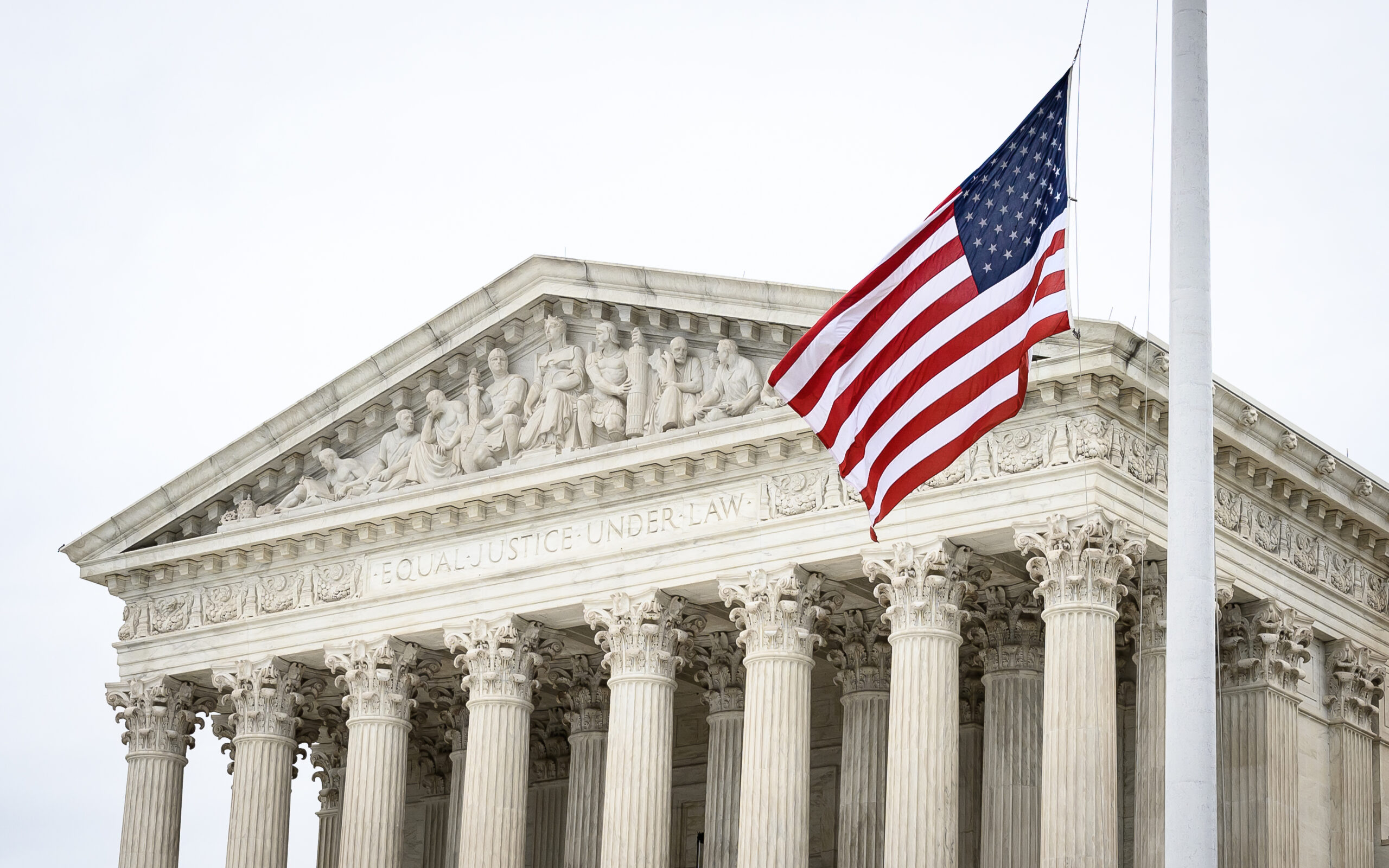
The Supreme Court on Tuesday heard arguments in a case asking justices to test whether criminal charges can be brought against a defendant in federal court after they have already been prosecuted in a Court of Indian Offenses.
Justices considered an appeal from Merle Denezpi, a Navajo tribal member who was initially tried and convicted of domestic violence in a Court of Indian Offenses, also known as CFR courts, and subsequently in a federal district court. Denezpi challenged the second prosecution on double jeopardy grounds, arguing that the Fifth Amendment of the Constitution protects from being twice-prosecuted for the same offenses.
Recommended Stories


Justice Neil Gorsuch, one of two justices who dissented in a 2019 case ruling that a petitioner was subject to consecutive federal and state prosecutions for the same crime, asked Tuesday whether the government acknowledged what he described as the “Bartkus exception” stemming from the 1959 case that established the dual sovereign exception of the double jeopardy clause.
SUPREME COURT AGREES TO HEAR CASE OVER LIMITS ON OKLAHOMA TRIBAL AUTHORITY
In 2017, Denezpi pleaded guilty to assault in a CFR court of the Ute Mountain Ute Agency and was released on time served. He was indicted months later by a federal grand jury in Colorado for the same incident and was sentenced to 30 years in prison.
Attorneys for Denezpi wrote in a court brief that the “Double Jeopardy Clause plainly bars a single sovereign from prosecuting the same defendant twice for substantively identical criminal offenses.”
“Though there may be nominally two separate sovereigns involved, even in those circumstances, sometimes, double jeopardy can be implicated,” Gorsuch added Tuesday.
Arguing for the Justice Department, Assistant to the Solicitor General Erica Ross said Tuesday that the highest court has recognized that “violating the law of one sovereign is not the same offense as violating the law of another” for nearly “two centuries,” adding that it is “because they derive their power to prescribe conduct from different sources of authority.”
CLICK HERE TO READ MORE FROM THE WASHINGTON EXAMINER
The United States argues that because the prosecution of Denezpi was under the independent sovereignty of the Ute Mountain Ute Tribe, his prosecution for federal law violations in federal court did not violate his double jeopardy rights.
“If Petitioner had been convicted of his tribal offense into tribally-operated court, his double jeopardy claim would fail,” Ross contended, referring to the administration’s standpoint that Congress’s creation of CFR courts merely “provided the forum” for tribes to exercise power until a tribal court could be established, according to a court brief.
