

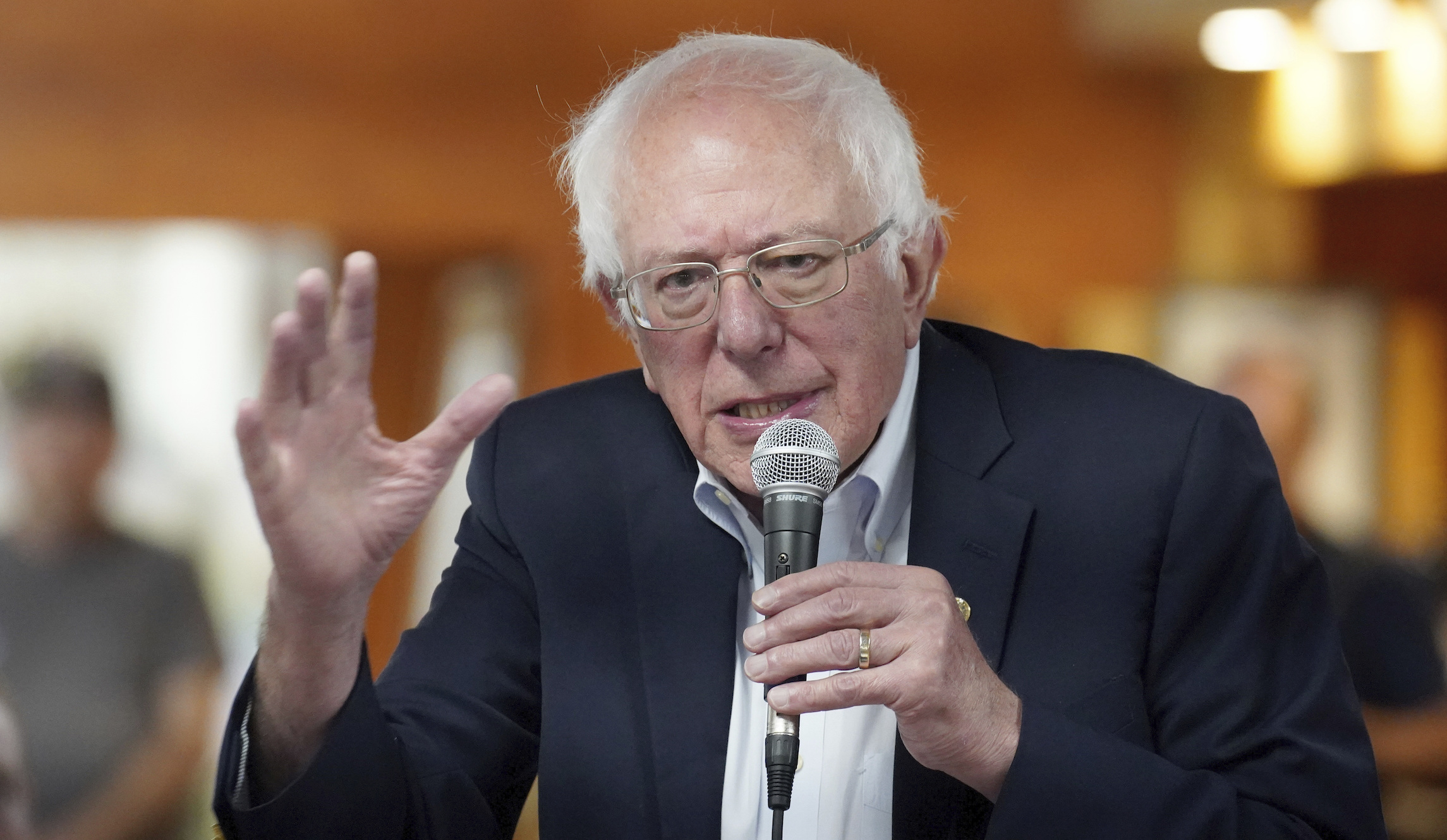
Pundits wrote off Sen. Bernie Sanders’s campaign back in October after his heart attack evoked the risks of nominating a candidate who would turn 80 during the first year of his presidency.
But since then, Sanders has made a remarkable comeback — and not just in terms of his health. Having climbed to second place nationally and raised a whopping $34.5 million in the fourth quarter, he now finds himself leading in New Hampshire and tied for first place in Iowa, according to the latest CBS/YouGov poll.
Recommended Stories



Perhaps Joe Biden, who enjoys much stronger support among black voters, is still in a better position to win the Democratic nomination. But Sanders’s candidacy is for real, and that means he must be taken seriously.
Were a major political party to nominate an avowed socialist as its candidate for the White House, it would be a monumental event in the nation’s history. Sanders is not merely an amusing old crank but rather an advocate for truly dangerous ideas that have caused great violence, suffering, and deprivation of freedom throughout the world. And although he has mostly stopped apologizing for communist tyrants, his policy recommendations evince the same lack of judgment he showed in the days when he did so routinely.
Even as a mere mayor in the 1980s, Sanders made a point of inserting himself into international affairs to make excuses for communist dictators. This includes the late Fidel Castro, whom Sanders routinely praised and defended. Today, even Castro’s death has not ended the country’s pointless regime or its continued, senseless repression of Cubans, who are barred even from accessing the internet. Despite what Sanders and other apologists say, this lack of openness is not just a defect of that regime similar to the defects of capitalism. Rather, the repression and lack of openness are communism’s defining features.
In 1985, Sanders became, by his own reckoning, the highest-ranking elected U.S. official to visit Managua and celebrate the anniversary of Nicaragua’s authoritarian Marxist regime. Participants at a rally he attended cheered, “Here, there, everywhere, the Yankee will die!” By that time, Sanders was in denial about the Sandinistas’ documented atrocities, which had been mentioned in several U.S. publications, including a Time magazine feature on Jan. 24, 1983. Insider testimony and other evidence detailed the Sandinistas’ thousands of rapes, routine disappearances of citizens, and persecution of indigenous populations who were forcibly relocated or forced to flee the country by the thousands.
Yet Sanders would insist that Nicaragua’s Marxist dictatorship was the victim of a White House and media conspiracy. “When you read the New York Times,” he said, referring to their reporting at the time on Nicaragua, “the real truth is not being told.”
Today, Sanders no longer points to Nicaragua or Cuba as models, and he acknowledges that “the Soviet Union was an authoritarian dictatorship,” saying, “that’s what I believed then, and that’s what I believe the case to be today.”
Even at the time he visited the USSR on his honeymoon in 1988 amid Mikhail Gorbachev’s liberalization, Sanders admitted that its system was undemocratic and forbade dissent. He also acknowledged that it had produced subpar outcomes in housing and healthcare.
Yet he praised the Soviet system anyway, pointing out that the Soviets at least provided housing and healthcare for free. Apparently, he was unable to connect these dots. Quality housing and healthcare cost money. Any system that relies on the government to depress prices artificially — to frustrate market signals about what things are worth and to give people something for nothing — will be characterized by corner-cutting and shoddy, subpar outcomes.
This helps illustrate Sanders’s backward ideas about economics, ideas that have prompted him to praise bread lines as a sign of societal compassion and to condemn excessive consumer choices of deodorant as a sign of misplaced priorities.
This brings us to Sanders’s $34 trillion socialized health insurance plan. It would eliminate all private insurance and offer free government coverage in its stead, with no deductibles, premiums, or copays — plus dental and vision benefits. This is far more ambitious than even Canada’s single-payer system, as two-thirds of Canadians purchase supplemental private insurance to offer benefits not covered by their public system, including prescription drugs and dental and vision coverage.
Sanders’s system won’t work. And it will cost even more than $34 trillion unless doctors and providers simply agree to work for less.
Sanders has a raft of big plans, and on every issue, he has staked out a position as far to his left as possible. This includes a $4.35 trillion wealth tax (significantly larger than that proposed by Elizabeth Warren) and the abrupt elimination of all $1.6 trillion of student debt.
Americans may not be clamoring for socialism, but right now, Sanders has a chance of winning a major party’s nomination, and in a two-party system, each major party candidate starts off with a decent chance of winning. His emergence should not be dismissed as an idle threat.
[Read more: Bernie Sanders, 78 and a heart attack survivor, keeping health details under wraps]
