
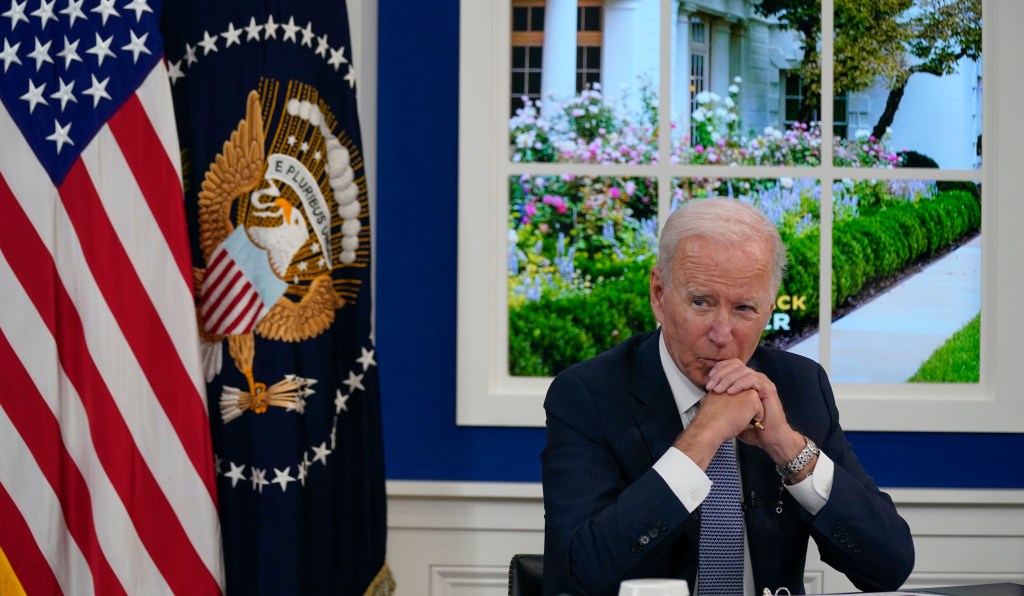
President Joe Biden’s evolving position on the filibuster temporarily opened the door for Senate Democrats to change the chamber’s rules so they could raise or suspend the country’s debt ceiling without Republicans or reconciliation.
But with centrist Democrats, such as West Virginia’s Joe Manchin and Arizona’s Kyrsten Sinema, publicly against filibuster reform, Biden can support tinkering with the Senate’s majority rules procedures without much political pressure to act on it unless his party performs well in next year’s midterm elections.
Recommended Stories

‘UNIFIER’ BIDEN LEADS AN INCREASINGLY DIVIDED COUNTRY AND PARTY
Biden alluded to a narrow filibuster “carve-out” that would allow Democrats to avoid the need for 60 votes to end debate in the Senate and hold a vote on raising or suspending the debt ceiling so the Treasury Department can continue borrowing money to pay off its loans.
“That’s a real possibility,” the president told reporters after he returned to the White House following a day promoting his spending agenda in Michigan. Manchin opposes the idea.
Biden’s comments prompted concerns that modifying the Senate’s filibuster could set a dangerous precedent. Critics contended that if Democrats were prepared to chip away at the filibuster, which protects minority rights, for the debt ceiling, what would stop them from doing the same for other legislative priorities. Adjustments for executive branch confirmations now apply to all appointments, for example.
“This debt limit situation may be the most extreme case. If ever there were things for which you’d want to make an exception, preventing the U.S. from default would seem to be among them,” one senior Democratic Senate aide told the Washington Examiner.
But fellow Democratic strategist Jim Manley also pointed to Manchin and Sinema, among “a handful” of others, despite “a whole bunch of senators” backing the exemption.
“Without all 50 senators are on board, it won’t work procedurally,” he said.
Republican strategist Cesar Conda predicted that Democrats will not adapt the filibuster for the debt ceiling because they have other options on the table. In response to the filibuster flap, Senate Minority Leader Mitch McConnell offered Democrats a compromise Thursday not to oppose a streamlined budget procedure known as “reconciliation” that addressed the debt ceiling or a stand-alone bill that would postpone discussion until December.
Reconciliation only requires a simple majority, which Democrats have if Vice President Kamala Harris casts a tiebreaking vote, but it involves a lengthy amendment process. The Senate parliamentarian has also approved the debt ceiling language being included in the budget measure.
“The dam will break on ending the filibuster on other issues where they don’t have the votes, such as voting rights, the Green New Deal, immigration, etc., which is what the Democrats really want,” Conda said. “This isn’t really about lifting the debt limit. It’s about passing their extreme left-wing agenda.”
“But this will ultimately backfire on them when Republicans regain the majority,” the onetime aide to former Vice President Dick Cheney and Sen. Marco Rubio added.
Manchin reaffirmed Wednesday that he had been “very, very clear” where he stood on the filibuster.
“Nothing changes,” the senator told reporters, before insisting, “We are not going to default as a country.”
Biden revised his opinion regarding the filibuster during the 2020 campaign.
“Ending the filibuster is a very dangerous move,” he told reporters in Iowa in 2019.
More than a decade earlier, when then-President George W. Bush and Republicans controlled an evenly divided Senate, Biden repeated that dismantling the filibuster would upset “the constitutional design, and it disservices the country.”
“Senators would start thinking about changing other rules when they became ‘inconvenient,’” Biden said in 2005. “Altering Senate rules to help in one political fight or another could become standard operating procedure, which, in my view, would be disastrous.”
Biden did foreshadow last summer that his filibuster stance could shift depending on whether Republicans were “obstreperous.” The president’s remarks came after he told the New York Times’s editorial board that he hoped he could “reach consensus” on “things like cancer and healthcare … without changing the filibuster rule.”
Two months after his inauguration, Biden endorsed a return to the so-called talking filibuster, allowing senators to delay legislation by taking up time by speaking on the Senate floor. But that weakened form of the filibuster, made famous by the 1939 movie Mr. Smith Goes to Washington, was nixed because it was so effective at blocking proposals.
“I am. That’s what it was supposed to be,” the president said in March. “Democracy’s having a hard time functioning.”
McConnell has warned that the Senate will become a “scorched-earth” chamber if Democrats overhaul the filibuster.
“None of us have served one minute in a Senate that was completely drained of comity, and this is an institution that requires unanimous consent to turn the lights on before noon,” he said in March.
Filibuster furor dates back to the 1940s when liberal senators pushed to abolish it because southern counterparts relied on it “almost exclusively” to “kill civil rights bills,” according to presidential historian Brian Rosenwald.
“Filibusters really were relatively narrowly used until at least the 1970s when dual tracking gets created and a new generation of senators start deploying it more,” he said. “That’s when you see the first threat of what today we call the nuclear option.”
For Rosenwald, an author and University of Pennsylvania scholar, the filibuster then exploded under former President Bill Clinton, but a supermajority was not important until the last 30 years.
“These procedural norms don’t work well for the deep polarization we have today between the parties,” he said.
“It increases incentives to use every tactic possible to obstruct and makes the Senate nearly unworkable, even on something like the debt ceiling where probably 90-95% of the senators say this needs to pass,” he added. “You’ve got people who preach about functional governance and then are filibustering the debt ceiling increase.”
CLICK HERE TO READ MORE FROM THE WASHINGTON EXAMINER
The filibuster debate has combusted as 4 in 10 voters tell pollsters that Biden has accomplished less than they expected since taking office, according to a Politico/Morning Consult survey.