

Subscribe today to the Washington Examiner magazine and get Washington Briefing: politics and policy stories that will keep you up to date with what’s going on in Washington. SUBSCRIBE NOW: Just $1.00 an issue!
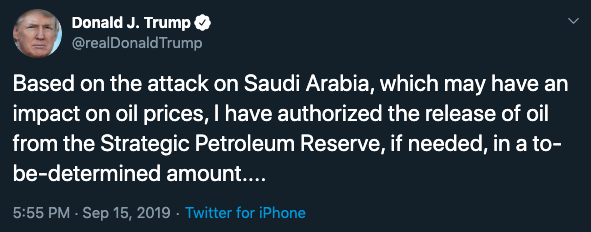
TRUMP’S VULNERABILITY TO OIL ATTACK ON SAUDI ARABIA: President Trump is reacting to the attacks on Saudi Arabia’s oil infrastructure over the weekend in two different ways.
He is clearly worried U.S. oil and gas prices could soar, acting quickly to authorize the release of oil from America’s Strategic Petroleum Reserve, “if needed.”
“Trump’s personal sensitivity has everything to do with the election map he has to fill in,” Kevin Book, managing director for research at ClearView Energy, told Josh. “He knows low oil and gas prices are essential to winning support for lower-income and middle-income voters.”
But Trump is also urging calm, and downplaying U.S. vulnerability to the loss of nearly 6 million barrels of oil per day — about 5% of the world’s daily crude oil production — from the world’s largest oil exporter, Saudi Arabia.
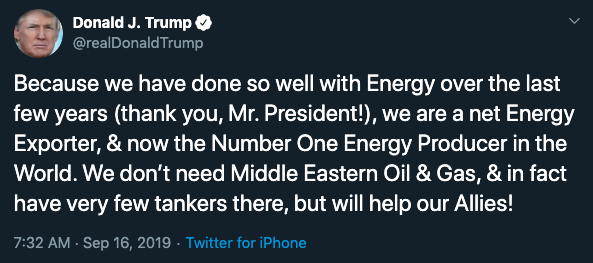
Trump’s reactions demonstrate that while the U.S. is more resilient and energy secure because of its newfound status as the world’s largest producer of oil and gas, prices at home remain tied to the global market. The U.S. is the world’s largest oil consumer.
“The oil market is global: it doesn’t matter where barrels are produced, where an outage takes place, or whether we have any imports at all from the country where the outage is,” Jim Krane, energy geopolitics fellow at Rice University’s Baker Institute, told Josh. “Even if U.S. imports from Saudi Arabia were zero, the loss of almost 6 million barrels per day will affect oil prices in the U.S. It’s just a fact of life.”
The impact so far: As markets opened for the first time since the attacks, the price of Brent crude, the global benchmark, rose as much as 18% — to $70.98 per barrel — before settling down after Trump’s announcement about releasing U.S. emergency supplies.
That was the biggest oil price spike since the 1991 Iraqi invasion of Kuwait ahead of the Gulf War, Reuters reported.
Long-term consequences are unclear: Oil market watchers say the long-term impact depends on how long it takes Saudi Arabia to repair damage to Abqaiq, the kingdom’s largest facility for processing crude oil that it exports around the world. But the immediate impacts would have been worse if not for the help of U.S. shale, which contributed to the lowest gas prices in three years for American drivers on Labor Day this year.
“Luckily for oil consumers and importers, the world is awash in crude oil right now mostly because of the U.S.,” Krane said. “That’s the main reason the price spikes haven’t been nearly as bad as they would have been.”
Shortcomings of shale: U.S. shale production, however, takes up to a year to respond to price changes, experts note, and is based on decisions of individual companies, not the government — unlike in Saudi Arabia.
U.S. light sweet oil is also not a “perfect substitute,” for medium sour oil produced by Saudi Arabia, Book says. So while the U.S. is on the cusp of being a net energy exporter (it’s not there yet on an annual basis, as Trump claims), it is not a “swing supplier” that can instantly change the fortunes of a global market.
“The U.S. can be big supplier and big exporter and still be vulnerable to global prices,” Book said.
Welcome to Daily on Energy, written by Washington Examiner Energy and Environment Writer Josh Siegel (@SiegelScribe) and Abby Smith (@AbbySmithDC). Email [email protected] for tips, suggestions, calendar items, and anything else. If a friend sent this to you and you’d like to sign up, click here. If signing up doesn’t work, shoot us an email, and we’ll add you to our list.
AMERICAN PETROLEUM INSTITUTE LAUNCHES AD CAMPAIGN TO SELL INDUSTRY’S EFFORTS TO REDUCE EMISSIONS: The American Petroleum Institute is launching an advertising campaign to sell the oil and gas industry’s contributions to reducing emissions.
API will show two ads, entitled “Noise” and “We’re On It,” on broadcast and cable news, through digital media and radio, and also in airports and with outdoor billboards throughout Washington and New York.
They are timed to “provide balance to the energy debate as Congress returns and the presidential primary continues,” Ben Marter, an API spokesman, told Josh.
Marter said API is spending “seven figures” on the ads.
Along with the ads, API plans to produce reports and digital content aiming to combat proposals by Democrats to phase out oil and gas, including pledges to ban fracking.
CLIMATE FORUM WON’T HAVE TOP CANDIDATES: Climate change may be one of the top issues Democratic primary voters want to see candidates discuss—but that isn’t stopping a handful of candidates from skipping out on this week’s climate forum hosted by MSNBC.
Five candidates — including frontrunners former Vice President Joe Biden and Senator Elizabeth Warren of Massachusetts — have told the forum’s organizers they won’t attend, according to the Washington Post. Also planning to skip the forum: Senators Kamala Harris of California and Amy Klobuchar of Minnesota, and former Congressman Beto O’Rourke of Texas.
MSNBC’s forum won’t be seven hours back-to-back. Instead, the network is hosting the forum over two days, Sept. 19 and 20, and it will feature hour-long conversations with the candidates. In addition to the Democratic candidates, former Massachusetts Governor Bill Weld, who is challenging Trump for the Republican nomination, will join the forum.
The forum is co-hosted by Georgetown’s Institute of Politics and Public Service, Our Daily Planet, and New York Magazine.
WHAT DO AMERICANS REALLY THINK ABOUT CLIMATE CHANGE? Polls increasingly show that more Americans are paying attention to climate change and more are agreeing with mainstream climate science. But a new CBS News survey serves as a reminder that view isn’t uniform, especially across party lines.
The partisan divide on the urgency of climate change is wide: Perhaps the best example is this datapoint from the CBS survey: Eight out of 10 Democrats say people need to be taking action to address climate change immediately, while more than half of Republicans say action can be taken later or not at all. Just a quarter of Republicans surveyed agreed with Democrats about the urgency of climate change.
In addition, many more Democrats — 72% — believe the U.S. should lead the world in addressing climate change, versus just 23% of Republicans. Most Republicans say the U.S. should either only take action if other countries are also committed to addressing climate change or not take part in global climate agreements.
And on the science: While 74% of Democrats say almost all scientists agree that humans are the main cause of climate change, 71% of Republicans say there’s still disagreement among scientists about humans’ role.
There is some agreement: Not surprisingly, the majority surveyed from both parties support clean energy and conservation. For example, 82% of those polled back more fuel-efficient vehicles and 81% favor more renewable energy.
Internationally, the U.S. ranks low in acknowledging climate change: Another poll from YouGov, however, shows the U.S. ranks fourth lowest out of 28 countries surveyed in the percentage of people agreeing climate change is occurring and humans have a role. Just Sweden, Saudi Arabia, and Norway have lower percentages, according to the survey.
KAMALA HARRIS WANTS INSPECTOR GENERAL PROBE INTO DOJ ANTITRUST INVESTIGATION INTO AUTOMAKERS: Harris requested Friday that the Justice Department’s inspector general investigate the agency for opening an antitrust investigation into whether four automakers broke federal competition laws when collaborating with California officials on vehicle-emissions standards.
Harris, a former California attorney general, said the Justice Department’s probe of Ford, BMW, Honda, and Volkswagen “raises serious questions about whether federal law enforcement is being used to coerce four automakers to abandon their efforts to make cleaner, less-polluting vehicles.”
“It also raises questions about whether the machinery of the Justice Department is being used for partisan political purposes,” Harris said in a letter to Michael Horowitz, the Justice Department inspector general.
Ford, BMW, Honda, and Volkswagen announced in July that they’d worked together alongside California to pursue stricter fuel-efficiency standards very close to Obama-era standards and tougher than what the Trump administration desires.
AOC BOOSTS GREEN NEW DEAL PARTNER ED MARKEY WITH ENDORSEMENT: House progressive superstar Alexandria Ocasio-Cortez endorsed Ed Markey on Friday in a Massachusetts Democratic primary that could pit the incumbent senator against a congressman with a famous name, Joe Kennedy III.
Markey is shoring up support ahead of a potential faceoff with the politically powerful Kennedy dynasty, the Washington Examiner’s Susan Ferrechio reports. Kennedy, 38, is a grandson of the late Robert F. Kennedy and, like Markey, a progressive Democrat.
Markey, 73, is the lead Senate sponsor of the Green New Deal, which Ocasio-Cortez introduced in the House this year. He is seeking a second term in November 2020.
AUGUST WAS HOT: This August tied as the second-hottest August on record, according to data released Monday morning by scientists at the National Oceanic and Atmospheric Administration. All five of the hottest Augusts have occurred since 2014, NOAA said.
The Rundown
Bloomberg White House plans biofuel quota boost to offset refinery waivers
New York Times In coal country, when the mines shut down, the women went to work
Quartz One of India’s largest coal-mining states says it will not build new coal power plants
Wall Street Journal: PG&E reaches $11 billion settlement with insurers over deadly wildfires
Washington Post: An oil pipeline expansion is dividing Canada’s indigenous peoples
Calendar
TUESDAY | SEPTEMBER 17
7 a.m. to 6 p.m (central time). Westin Houston Memorial City, Houston, Texas. The Center for Offshore Safety hosts its Seventh Annual Forum.
9:30 a.m. 366 Dirksen. The Senate and Energy and Natural Resources Committee holds a hearing on examining “the sourcing and use of minerals needed for clean energy technologies.”
WEDNESDAY | SEPTEMBER 18
10 a.m. 2123 Rayburn. The House Energy and Commerce Climate Change Subcommittee holds a hearing on reducing industrial greenhouse gas pollution.
10 a.m. 2172 Rayburn. The House Foreign Affairs Subcommittee on Europe, Eurasia, Energy, and the Environment and the House Select Committee on the Climate Crisis hold a joint hearing on “voices leading the next generation on the global climate crisis.”
THURSDAY | SEPTEMBER 19
10 a.m. 2318 Rayburn. EPA Administrator Andrew Wheeler testifies in a hearing before the House Science Committee.
