

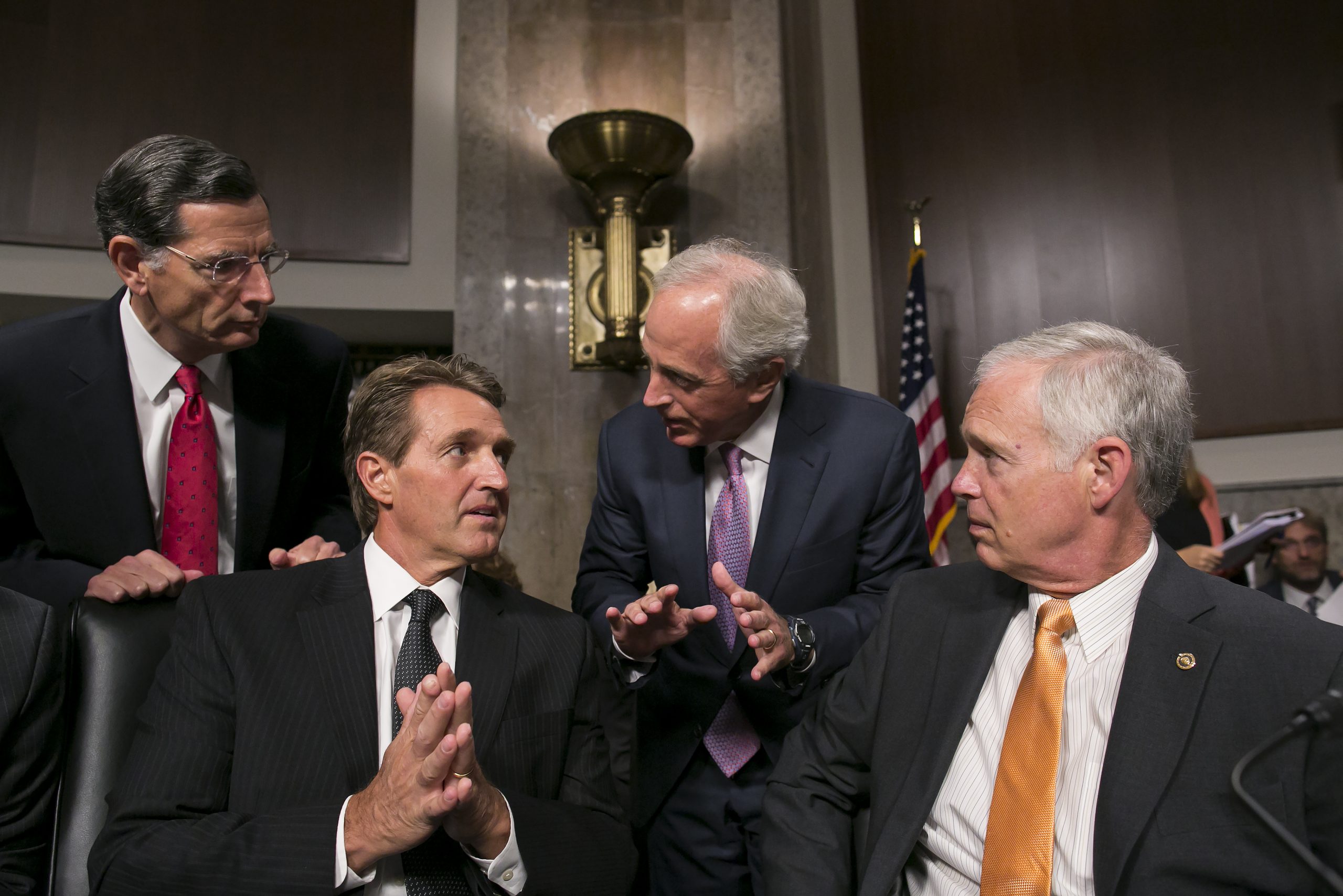
President Trump could see the next year of his life made extraordinarily difficult by Republican lawmakers who have chosen to retire rather than seek re-election in the frenzied political environment his presidency has helped create.
One such lawmaker, Sen. Bob Corker, R-Tenn., has already spent weeks chiding Trump for requiring the supervision levels of an “adult day care.” And another, Sen. Jeff Flake, R-Ariz., announced his early retirement on Oct. 24 with a speech that called on fellow Republicans to reject the president’s behavior and fight an erosion of GOP values.
Recommended Stories



“I do think it’s bad news for Trump. There are now two conservative senators who are going to spend the next 14 months standing up to him,” said Alex Conant, former adviser to Sen. Marco Rubio, R-Fla.
Republicans in the House have also begun to surrender in the face of potentially fierce re-election battles in the Trump era.
Rep. Pat Tiberi, R-Ohio, announced on Oct. 19 that he not only planned to forego re-election, but also intended to resign from Congress in a matter of months. Rep. Charlie Dent, R-Pa., announced in September that he would not seek another term as a conservative primary challenger prepared to mount a bid for his seat. Rep. Dave Trott, R-Mich., said in September that he would leave open a seat Democrats were already hoping to challenge.
Republicans who choose not to run again in 2018 could feel more free to speak ill of a president who remains popular in their home states.
For example, Corker mostly withheld pointed criticism of Trump before he announced on Sept. 26 that he would leave the Senate after 2018.
Trump won Tennessee, Corker’s home state, by 26 points in 2016, and his approval ratings in Tennessee have remained relatively high even as they stay low nationwide. A Morning Consult poll found Trump enjoyed a 53 percent approval rating there in September.
But Corker tore into Trump once he shed the restrictions that come with worrying about a re-election race.
“Sometimes I feel like he’s on a reality show of some kind, you know, when he’s talking about these big foreign policy issues,” Corker told the New York Times in early October. “And, you know, he doesn’t realize that, you know, that we could be headed towards World War III with the kind of comments that he’s making.”
Within weeks, Corker had escalated his criticism.
The Tennessee Republican said Trump “debases” the country with his conduct and told CNN on Oct. 24 that Trump has “proven himself unable to rise to the occasion” of becoming commander in chief.
Ford O’Connell, a GOP strategist, said the greatest challenge for Trump may not be the insults leveled by retiring Republicans, but the votes of those lawmakers.
“I think the biggest problem could be conceivably whether or not they choose to block tax reform or other legislative items,” O’Connell said.
Neither Corker nor Flake have the same incentives as their fellow GOP lawmakers, between now and Nov. 2018, to fall in line behind Trump as their party works to pass tax reform, repeal Obamacare, cobble together an immigration package that legislates DACA protections and keeps the government open past the holidays.
The margin of error for Republicans, with a slim 52-member majority in the Senate, was already too narrow for the GOP’s comfort. It took just one Trump critic, Sen. John McCain, R-Ariz., to sink months of work on a healthcare plan that the president pushed aggressively through the House and Senate.
“This is the party of Donald Trump, and some of them just flat-out can’t accept that,” O’Connell said. “I think they’ve got to move the ball forward even if they don’t like who the quarterback is.”
Flake, who was already considered among the most endangered GOP lawmakers heading into the midterm election, faced smaller risks than other Republicans if he went after Trump too aggressively before announcing his retirement due to Trump’s relatively lackluster popularity in his home state of Arizona. Flake had gone after Trump much more directly before his announcement than did Corker before his own retirement announcement.
Trump won Arizona by just four points in 2016, and his approval rating in Arizona was just 44 percent in September, according to the same Morning Consult poll.
“Mr. President, I rise today to say: Enough,” Flake said during a speech on the Senate floor the day he announced he would not seek re-election. “We must dedicate ourselves to making sure that the anomalous never becomes normal. With respect and humility, I must say that we have fooled ourselves for long enough that a pivot to governing is right around the corner, a return to civility and stability right behind it. We know better than that. By now, we all know better than that.”
Grant Reeher, a political science professor at Syracuse University, said Trump could attempt to contain the criticism from retiring Republicans by moderating his tone and laying off individual attacks on members.
“Some of the criticism is policy-based, but it’s mostly about the president’s style of communication, and how that reflects on the American presidency, and the nation,” Reeher said of the barbs retiring GOP lawmakers have hurled at Trump.
“Where is President Trump on the political damage meter? It’s hard to say. A lot will depend on what happens on the tax bill, and in the mid-term elections,” Reeher said. “If some of the Trump-supporting Republican primary challengers get traction, and at the same time Republican losses overall are consistent with a typical mid-term — and Congress is able to pass a tax bill that the president signs, and the economy continues to grow, then the damage might be more limited.”
