

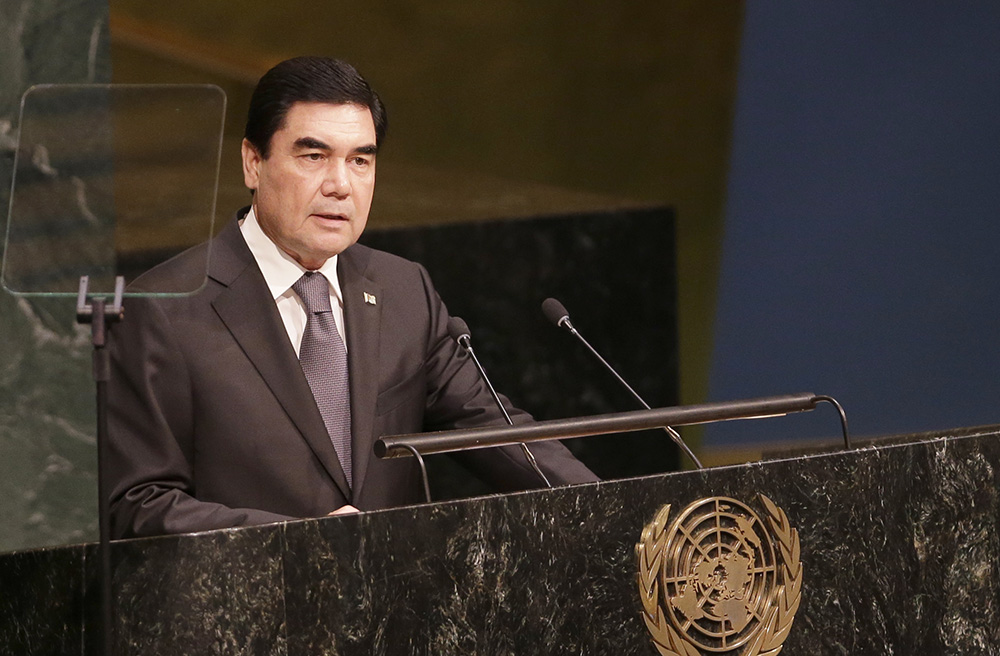
The World Health Organization is under fire for purposefully shielding its work from the press, after wrapping up a two-day meeting on cutting global tobacco use that was hosted by Turkmenistan, a human rights and press freedom pariah.
Some are also noting that the Turkmenistan meeting finished just days before the United Nations, the parent entity of the WHO, is set to celebrate World Press Freedom Day, on May 3.
Recommended Stories


The WHO’s Regional Committee for Europe held the April 27-28 meeting to discuss its “Framework Convention on Tobacco Control.” That framework aims to cut global tobacco use by 30 percent over the next decade, by recommending high taxes and other means of discouraging consumption.
But its decision to host the meeting in Turkmenistan made it virtually impossible for reporters to cover. Reporters Without Borders ranked Turkmenistan 178th out of 180 countries in its 2016 index.
“Journalism can only be practiced clandestinely and when independent journalists are identified, they are liable to be jailed and tortured,” that report said. “The state controls virtually all the media.”
The country is also a human rights hellhole, and the U.S. State Department routinely gives it a failing grade its annual human rights report.
“The most important human rights problems were arbitrary arrest; torture; disregard for civil liberties, including restrictions on freedoms of religion, speech, press, assembly, and movement; and citizens’ inability to change the government through free and fair elections,” State said in its latest report in April.
Despite those problems, the location of this week’s WHO meeting didn’t seem to disturb the Obama administration. State Department officials declined to answer questions about whether they thought the meeting location was appropriate, and indicated that the U.S. would prefer to use diplomacy to get results in Turkmenistan rather than threaten to block the WHO from meeting in the country.
“We regularly and at high levels express concern about media freedom in Turkmenistan,” State told the Washington Examiner.
The Obama administration has some justification for its arms-length opinion. The WHO says the meeting was “organized by WHO/Europe,” and “funded by the Government of Turkmenistan,” and no U.S. officials are participating.
Still, critics note that the U.S. is far and away the largest contributor to the WHO, and that U.S. funding probably helped subsidize the meeting. The U.S. contributes 22 percent of the WHO’s total funding, far ahead of the second biggest contributor, which is Japan, at 10 percent.
“How much did U.S. taxpayers pitch in?” asked David Williams, president of the Taxpayers Protection Alliance. “We don’t know.”
In the meantime, the WHO doesn’t seem fazed at all by Turkmenistan’s record. In fact, the WHO in 2014 praised the country and its president, Gurbanguly Berdimuhamedow, and gave it a “special recognition certificate” for its contribution to “tobacco control.”
To Williams, celebrating Turkmenistan’s stance on tobacco is a non sequitur given the country’s other major problems.
“This is almost like giving North Korea credit for not having any electricity and being green,” he said.
Williams argues that for all the talking points issued by the Obama administration on human rights, the State Department should be making more of an effort to convince the WHO to choose other locations.
So far, however, the WHO remains unconvinced. In late 2014, the same tobacco control group met in Russia to hold a vote that would impose a huge tax on tobacco products. Industry representatives estimated that the tax, if implemented, could as much as triple the price of cigarettes.
But the vote happened in the absence of any U.S. officials, and there is still no official public record of how participants voted.
The final irony for the press is that the WHO, as part of the U.N., will be celebrating World Press Freedom Day on May 3. This year’s theme: “Access to Information and Fundamental Freedoms — This Is Your Right!”
The contrast between the U.N.’s stated goal of press freedom, and decisions like those made by the WHO to host meetings in countries that are hostile to the press, has prompted Drew Johnson, a reporter from the Daily Caller, to circulate a letter demanding that the U.N. live up to its slogans. Johnson was tossed from the WHO’s tobacco meeting in Russia in 2014.
“This World Press Freedom Day, journalists from across the globe call on the U.N. to stop its hypocritical conduct and live up to the principles of press freedom every day of the year, not just on the 3rd of May,” his letter reads.
