

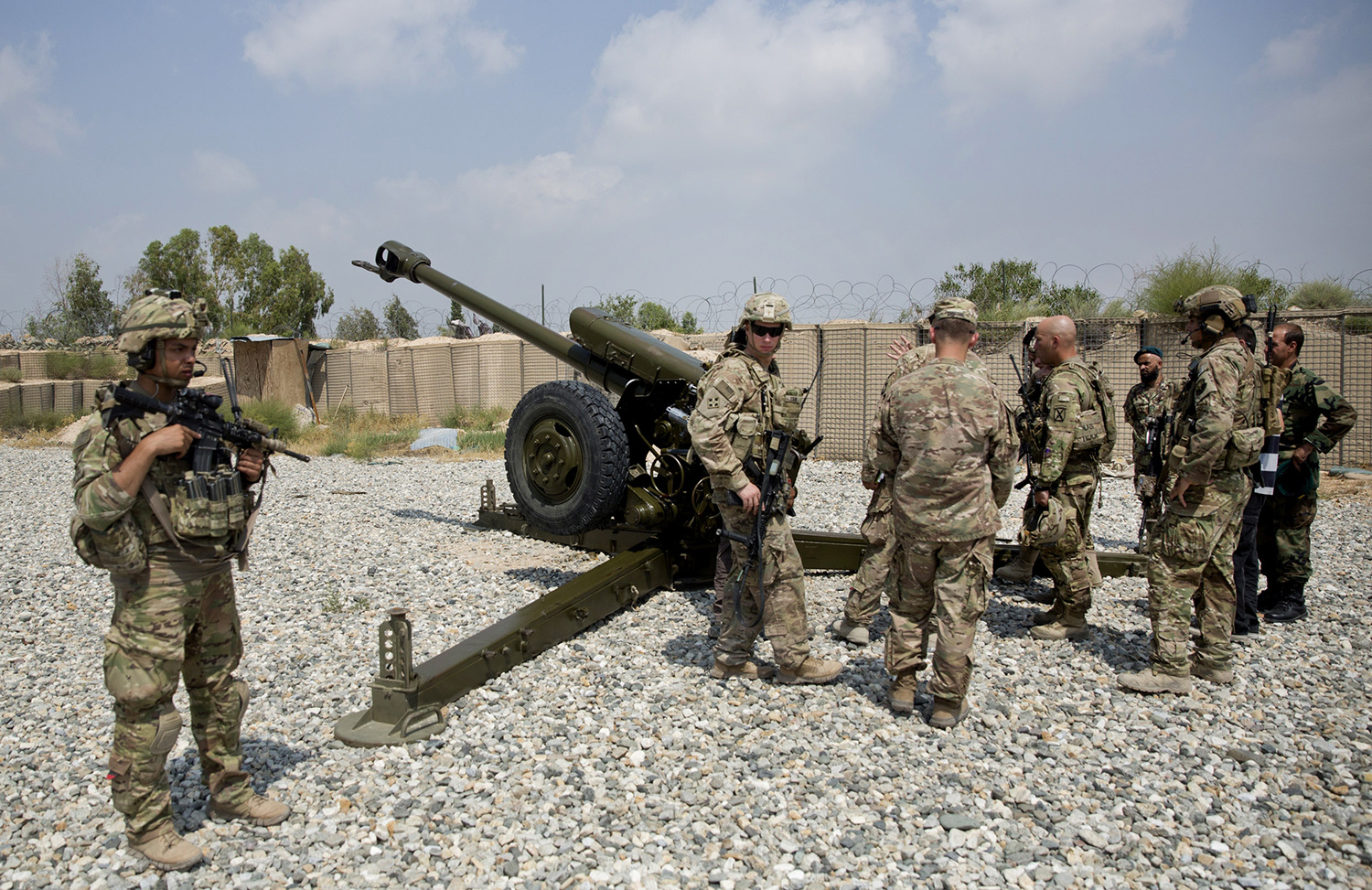
The U.S. will keep 8,400 American troops in Afghanistan through the end of the year, about 3,000 more than had been planned, President Obama announced Wednesday.
Obama made the announcement in the White House one day before departing for a NATO summit in Poland and as the Afghanistan security situation remains “precarious.” Prior to the announcement, the plan had been to drawdown from the current number of 9,800 troops to 5,500 by the end of the year.
Recommended Stories


“The security situation in Afghanistan remains precarious,” he said. “Even as they improve, Afghanistan security forces are still not as strong as they need to be.”
Obama made the statement from the Roosevelt Room with Defense Secretary Ash Carter and the Joint Chiefs Chairman Gen. Joe Dunford.
“Over the past year and a half, 38 Americans, military and civilian, have lost their lives in Afghanistan on behalf of our security,” he said. “We resolve to carry out the mission for which they gave their last full measure of devotion of devotion.
“Afghanistan is not a perfect place. It remains one of the poorest countries in the world,” Obama said. “It is going to take time for them to build up their military. I firmly believe the decision I’m announcing today is the right thing to do, for Afghanistan, the United States and the world.”
A senior administration official said the 8,400 troop level matches the recommendation that came from the Pentagon and was informed by Gen. John Nicholson’s review after he took over as the leader of U.S. and NATO forces in Afghanistan this year. Another official said that the 8,400 force level will allow U.S. troops to advise and assist Afghan forces at the two- and three-star level on a “sustained expeditionary basis” out in the field, something that was found to be an effective training tool during the previous two fighting seasons.
Rep. Mac Thornberry, chairman of the House Armed Services Committee, said more troops need to stay beyond the planned 8,400 level and the administration needs to request more funds to make it happen.
“The precision of the president’s new Afghanistan troop cap would be comical were its consequences not so tragic for our mission and military readiness,” the Texas Republican said in a statement. “It is time that the President level with the American people about what it will really take to achieve our goals in Afghanistan, and how much it will cost. The truth is that many thousands more Americans are performing military functions in Afghanistan — than even the current troop cap authorizes.
“The President refuses to pay for them, and his budget does not have room for the troops he is committing. For all of the bluster about funding troops in harm’s way, it is the President who proposes to extend the vital mission without any resources behind it. The White House must submit a supplemental funding request to accommodate troop levels in Afghanistan immediately.”
Sen. John McCain, R-Ariz., and chairman of the Senate Armed Services Committee, said he welcomes the decision to slow down the drawdown.
“While I believe conditions on the ground warranted retaining the current force level, the decision to retain 8,400 U.S. troops in Afghanistan into next year is certainly preferable to cutting those forces by nearly half,” he said in a statement. “That said, when the President himself describes the security situation in Afghanistan as ‘precarious,’ it is difficult to discern any strategic rationale for withdrawing 1,400 U.S. troops by the end of the year.”
Obama maintains that the U.S. is “no longer engaged in a major ground war in Afghanistan,” noting the “responsible end” with which he concluded combat operations at the close of 2014.
“Compared to the 100,000 troops we once had there, today, fewer than 10,000 remain,” he said. “And compared to their previous mission, helping to lead the fight, our forces are now focused on two narrow missions: training and advising Afghan forces and supporting counterterrorist operations against the remnants of al Qaida as well as other terrorist groups, including ISIL,” he said.
Obama said the U.S.’s 41 partner countries collectively contribute 6,000 troops to the mission. Afghan forces now control “all the major population centers” and provincial capitals, Obama noted.
He called Taliban leader Akhtar Mohammad Mansour’s death in May a “major milestone” but didn’t mention that a U.S. drone strike, rather than Afghan forces, killed him.
Obama said he will not allow Afghanistan to become a terrorist safe haven again and, to that end, he “constantly” reviews the situation there.
“In all these reviews we’re guided by the facts, what’s happening on the ground, to determine what’s working and what needs to be changed,” he said.
Obama described his decision to keep more troops as a reaffirmation of the U.S. commitment to Afghanistan.
“I strongly believe that it is in our national security interest, especially after all the blood and treasure we’ve invested in Afghanistan over the years, that we give our Afghan partners the very best opportunity to succeed,” he said.
The end of his term was also a factor in his decision, he said. “The decision I’m making today ensures that my successor has a solid foundation for continued progress in Afghanistan as well as the flexibility to address the threat of terrorism as it evolves,” he said.
More than 2,200 U.S. troops have died serving in Afghanistan.
Congress will need to find a way to fund the increased troop level requested by the White House. An administration official said the White House will begin discussions with Congress to pay for about 3,000 more troops than planned to stay in the country, noting that lawmakers have always been able to work out how to pay for revisions to the drawdown in the past.
The administration’s budget request for fiscal 2017 asked for about $54 billion in a war chest to be used for overseas operations. It’s unclear how much more the additional troops will cost and how it will be paid for.
The announcement comes just before Obama leaves for Warsaw, where he will discuss the future of Afghanistan, as well as other issues, with other world leaders at the NATO summit. A senior administration official said the announcement will be “very welcomed” by NATO allies and allow for a “more constructive conversation” at the summit, where other allies are expected to announce their commitments to Afghanistan through 2017.
Jacqueline Klimas contributed to this report.
