

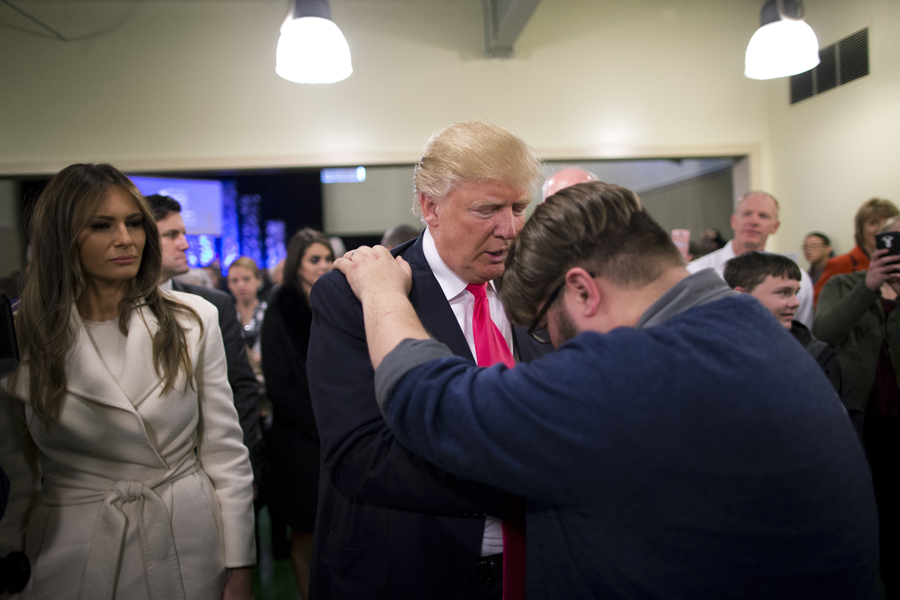
Political pundits have spent the last six weeks trying to explain Donald Trump’s appeal among evangelicals.
Recommended Stories

Trump won a plurality of those voters in three of the first four primary states, and on Super Tuesday he won big in the evangelical-heavy states of Georgia, Virginia, Alabama, Arkansas and Tennessee.
Trump’s success comes despite the fact that he lives a life that can be described as something less than the Christian ideal.
Writing at USA Today recently, David Brody of the Christian Broadcasting Network argues that “many evangelicals who support Trump have decided to put ‘presidential leadership’ and ‘pastoral leadership’ in two distinct boxes.” In other words, as the saying among Christians goes, many evangelicals are voting to elect a commander-in-chief, not a pastor-in-chief.
I have argued that Trump bears some vague similarities to some evangelicals, such as an absolutist worldview that sees things in black and white, right and wrong, good versus evil. And many conservatives support him just because they are tired of a Republican establishment that promises one thing during campaign season and does something totally different after the elections.
But here’s another theory, and it may be the most plausible yet. Writing at the prominent journal First Things, Molly Oshatz argues that Trump’s evangelical support comes mainly from “the barely religious” who nonetheless identify as evangelicals. Using data from the Wall Street Journal, Oshatz finds that only 38 percent of Trump’s supporters worship weekly or more — a percentage that’s much lower than Ted Cruz’s supporters or Ben Carson’s before he bowed out.
The problem, according to Oshatz, is that the media use the term “evangelical” too narrowly — as, she says, “a synonym for deeply, even freakishly religious.” The truth is that not all those who identify as evangelicals are deeply committed to their faith. Oshatz cites a Pew Research Center Poll finding that 42 percent of evangelicals attend church only occasionally, seldom or never. Church attendance is an imperfect proxy for religiosity, but it’s not a bad one.
Oshatz refers to studies showing that the “barely religious” are the most likely to hold extreme views on a variety of issues, including those related to race, and that the nonreligious and devout are the most tolerant, accepting and compassionate.
She writes:
“It certainly makes sense that the nominally religious, who are less rooted in virtues that transcend their own time and place, might be more likely to identify godliness and goodness with the cultural values and identity of their local community. Strong religious commitments and cosmopolitanism can both, albeit for different reasons, engender a welcoming attitude towards the stranger, but lukewarm religion might do the opposite. Trump’s statements regarding Muslims, Mexicans, and David Duke likely sound far more appealing to the lukewarm, especially the marginalized lukewarm, than they do to those whose religion runs hot or cold.”
“Soccer moms” helped propel Bill Clinton to victory in 1996, and “security moms” and “NASCAR dads” were intergral to George W. Bush victories. Perhaps this year’s swing demographic will be the “marginalized lukewarm.”
Daniel Allott is deputy commentary editor for the Washington Examiner
