

In a primary election season that’s normally dominated by politicians shouting policy points, Ben Carson is an oddity.
He’s calm, he’s quiet. He doesn’t fire off zingers in debates, nor does he rattle off statistics. Yet his favorability ratings are off the charts.
Recommended Stories


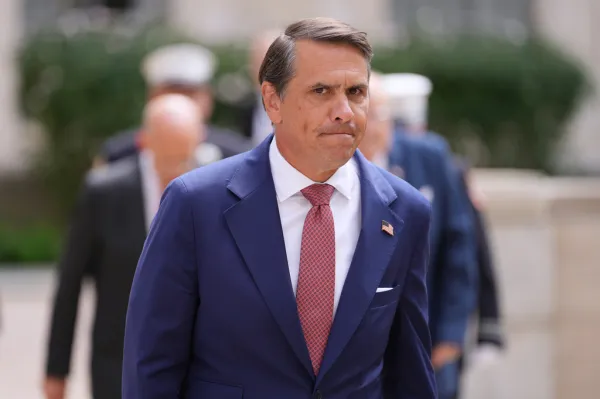
One of the keys to understanding his appeal, political experts say, comes from his background as a doctor. It’s a world that rewards calm demeanor, plain-speaking and making a connection with patients.
Carson said he believes voters will react to his demeanor the way his former patients did during times of stress. Times, he says, where a steady pulse was just as important as a steady hand.
“It isn’t done to gain benefit. It’s just the way I am,” Carson told the Washington Examiner. “I tend to be a very calm, relaxed person. It’s particularly useful for someone that was a pediatric neurosurgeon, because if you’re inside somebody’s head and a blood vessel breaks loose and you panic, they die.”
“Some people say, ‘You need to be more energetic. You need to pound your fist and jump up and down,’ ” Carson said. “But that would be highly unusual for me. It just is not part of who I am.
“It’s important for patients,” Carson said of his demeanor. “Patients want to hear somebody who is soothing. Who is calm. Who takes everything into consideration in terms of making recommendations for what should be done in their care. I think [voters] will respond in that way.”
The demeanor Carson has now made famous has also helped him become the most likable GOP candidate among primary voters. In a recent Quinnipiac poll, Carson held a net favorable rating of +24. By contrast, the two closest Republicans are Sen. Marco Rubio (+14) and Carly Fiorina (+10), while Trump is at -19.
“In a world and a time where many voters think … of crises. Where all these things [are] coming across our doorway, whether it’s terrorism, whether we don’t seem [to be] a dominant player in the world, here’s a guy that arrives on the scene in a very calm way, saying, ‘We got all these problems and, you know, we need to deal with them, and this is how we need to deal with them,’ ” said Matthew Dowd, chief strategist for George W. Bush’s re-election campaign in 2004.
“Whether or not you agree with his answers … I think his demeanor, at a time where the world feels so out of control, so disruptive, it’s almost as if the world is an emergency room and trauma patients are coming in, and people are looking for somebody to tell them, ‘It’s going to be OK, and I have the answer,’ ” said Dowd, now an ABC News political analyst.
The soothing nature of Carson’s demeanor was on display last week when he spoke at Liberty University, where he spoke at length about the issues facing the economy and religious freedom. Notably, his voice never broke stride from his admittedly relaxed delivery.
“Gentleness is metaphorical and transferable. Carson’s calm demeanor makes him seem less dangerous. It also makes him sound presidential: he’s so authoritative that he doesn’t have to yell,” said Dr. Robin Lakoff, a professor of linguistic studies at the University of California. “And it also makes what he says seem true and important, because he doesn’t need to shout.”
“The low voice not only makes him seem modest … it makes him seem trustworthy,” Lakoff said. “And so even when he tosses off bizarre bits of ignorance about slavery and Nazism, we are soothed into the belief that he knows something about them that we don’t know.”
Notably, Carson’s voice has changed its tune only once since he announced his candidacy in May. In a press conference hours after Politico reported that the former neurosurgeon lied about being accepted to West Point, he became visibly “animated,” pointing to his desire to “get my point across.”
Some in the conservative movement, however, believe that Carson’s demeanor is a double-edged sword, with policies and knowledge of the issues being the true drivers in the eyes of voters going forward.
“Ultimately, you could have all the temperament you want. If you’re bad on the issues, nobody cares what your temperament is,” said Steve Deace, an Iowa-based radio host who backs Sen. Ted Cruz. “I think his performance in the debates has gotten worse as the debates have gone on. I thought the [CNBC debate] — I thought it was socially awkward. Not reserved, like awkward. He looked like the moment was too big for him … I think that determines how people receive your demeanor.
“If someone sits down and they know what they are talking about, and they speak to you with a reserved temperament — we call that a bedside manner,” Deace explained. “A doctor who is giving you bad news, but there’s a calming reassurance that he thinks he can fix the problem. If they sit down with that sort of temperament though, and they don’t have all their fact straight. It’s unnerving. It lacks confidence.”
