

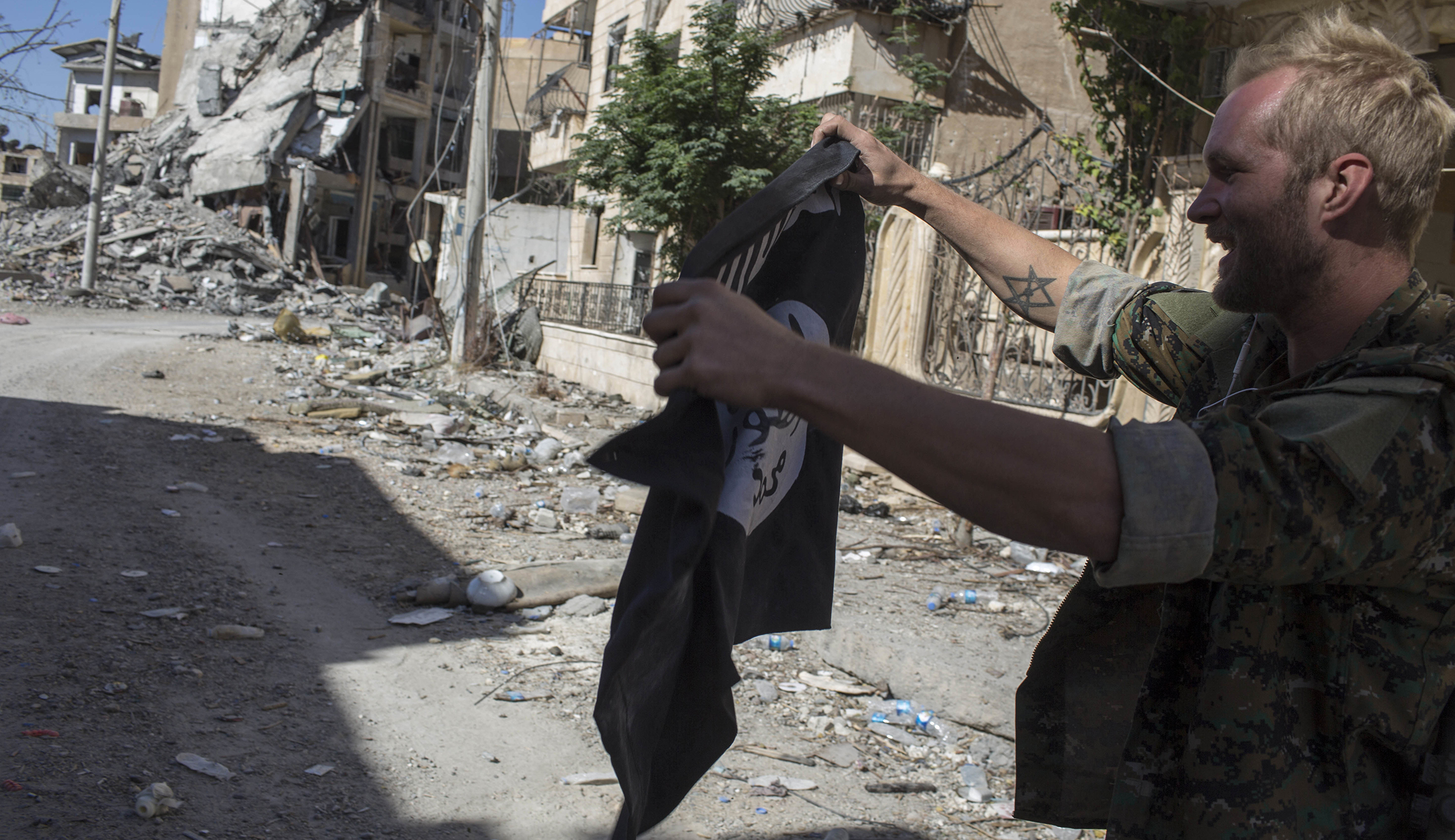
Defeated in its capital city, Raqqa, the Islamic State has suffered a theological hammer blow.
That’s because in pursuing its theologically vested caliphate, or Islamic empire reportedly foretold by Mohammad, ISIS needs a credible territorial base to advance its interests. Much of its appeal to date has been its existence as an honest-to-goodness territorial state.
Recommended Stories


You don’t count as a caliphate if you don’t control territory.
In a July 2014 sermon in Mosul, Iraq, ISIS leader Abu Bakr al-Baghdadi explained why the caliphate’s territorial base was so important to its theological foundation: “Your mujahideen brothers have been rewarded by Allah victory, and he has enabled them to assume power after long years of jihad and patience and fighting the enemies of Allah. He has granted them success and enabled them to achieve their goal, where they have rushed to declare the caliphate and the inauguration of imam. This is the duty of Muslims, which has been lost for centuries, and absent from the reality on the ground, thus it has been neglected by many Muslims.”
A few months later, at the high point of the caliphate’s power, al-Baghdadi told his followers to “celebrate” the “good news” that ISIS had secured new territory in Egypt, Saudi Arabia, and Yemen.
And for the next 2 1/2 years, the growing caliphate allowed ISIS to win increasing fealty from global jihadists and losers seeking a purpose. Appearing ordained in its ability to hold firm against U.S. and allied military power, the caliphate seemed like the place for discontents to be. ISIS’s ability to recruit followers and attract sympathizers is rooted in its control of territory.
Yet, the territorial caliphate is also critical in exemplifying the ability to govern. After all, ISIS doesn’t simply intend to establish a caliphate in the Middle East or Muslim-majority lands, it seeks a global caliphate that provides governance under Sharia law. This ambition explains why ISIS has been so focused on providing legal and administrative services in areas under its control: The group is desperate to show that its plan for a new world is both feasible and realistic.
Fortunately, reality is now proving the death cult wrong. With ISIS losing territory in Syria, Iraq, Libya, and the Philippines, its caliphate is perceived for what it is: an increasingly pathetic patchwork of gangster-run settlements under constant attack.
