

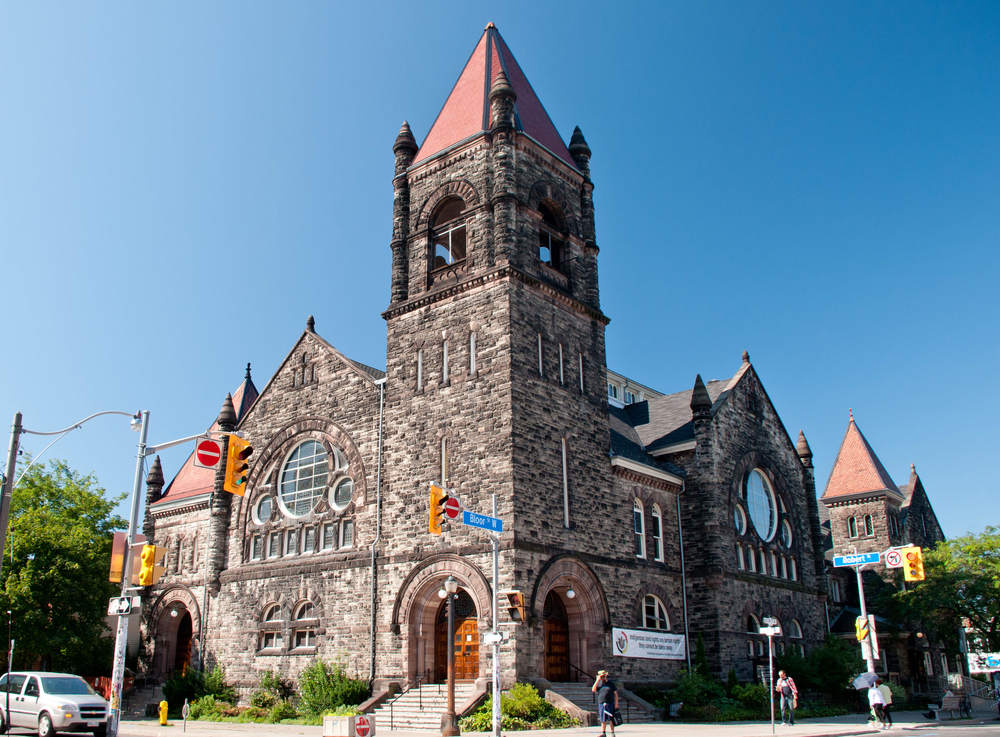
As a young boy in Canada in the 1970s I often accompanied my grandmother to her neighborhood United Church for Sunday service. The United Church is a Canadian invention. In the 1920s some of the largest and oldest Protestant churches in the country, including all the Methodists and the Congregationalists, got together to form a single denomination.
Back then my grandma’s church was packed with young and old alike. It wasn’t unique. The other Mainline Protestant houses of worship in her town—the local Anglican (Episcopalian), Lutheran, and Presbyterian churches—were all filled.
Times change. In Canada, the United States, and the United Kingdom, the Mainline has moved to the sideline. My grandmother’s United church was boarded up and torn down just two years ago. Again, not unique; Mainline Protestant churches across the West are closing every month.
Curious about the root cause of this ongoing exodus of attendees, some colleagues and I launched a study of Mainline Protestant churches. The research is appearing in peer-reviewed journals and the main results are now being reported by the media.
To get to our findings we processed mounds of survey data comparing the traits of more than 1,000 attendees from a selection of growing Mainline Protestant churches—which were difficult to find—to a near equal number of attendees from declining Mainline Protestant churches. We also surveyed and interviewed the clergy who serve them. We found, without exception, the clergy and congregants of the growing Mainline Protestant churches held more firmly to traditional Christian beliefs.
When we used statistical analysis to disentangle which factors are influencing growth, conservative Protestant theology was a significant predictor. Our research stands out because past studies have suggested theology and church growth are not linked. They are.
Like all researchers, my colleagues and I are pleased that our work is getting noticed. However, our worry is that the public will seize on this single, albeit very important, finding from the study and miss some other noteworthy discoveries.
But we point out, in addition to establishing that conservative Protestant doctrine predicts increase, our analysis also showed that two other factors play a significant positive role in church growth: contemporary worship and emphasis on youth programming.
Put simply, churches that adhere to conservative Protestant theology are more likely to grow than those that do not, but their chance of growth increases when they employ drums and guitars in service and connect with youth in multiple ways inside and outside the church.
I can imagine there may be church-goers of a more liberal theological persuasion who read the list of “ingredients” above and wonder: “Can my church just ignore that conservative theology piece but bring in a band for Sunday and start doing more events for kids during the week and expect our pews to fill with people?”
The good news is a strategy like that will likely attract more people to church. The bad news is that the strategy probably won’t keep them. Catchy music and engaging events for youth are enough to make some unaffiliated individuals want to go to a church. But, for a church to actually grow, the attendees must feel they need to go. For a host of reasons centering on their more literal interpretation of the Bible, churches adhering to conservative Protestant doctrine seem better at eliciting that response.
In our published work we theorize that growing churches’ tendency to use strategies like contemporary worship also rises out of conservative doctrine. When you literally believe it’s your mission to “go and make disciples”, you find innovative means to reach that goal.
Unfortunately, there’s more bad news for those looking for the miracle cure to an ailing church. While our study identifies the factors that predict growth, churches with unfriendly congregations or terrible preachers would be unlikely to grow no matter what. Another article my colleagues and I just published in the Canadian Review of Sociology explores this phenomenon and makes that case.
My grandmother’s church was a friendly, lively place. Before it joined the denomination of the United Church in the 1920s, it was an evangelical Methodist church, and it still had that vibe. Occasionally, during the services we attended together, the congregation would harken back to their Methodist roots and sing the gospel song “Gimme that old time religion, it’s good enough for me.”
For my grandmother and her fellow congregants, the “old time religion” may have been enough, but today, for church growth, it’s just a start.
Dr. David Millard Haskell, Wilfrid Laurier University is lead author of “Theology Matters” in the Review of Religious Research, December 2016.
