

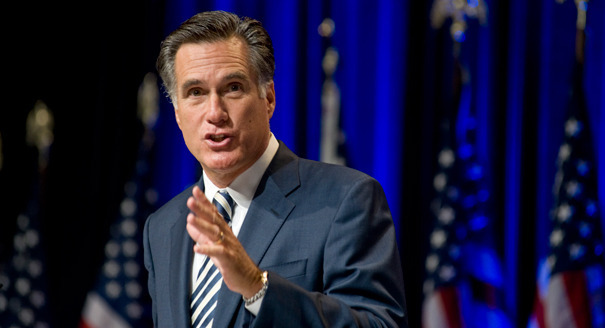
WEST VALLEY CITY, Utah — Mitt Romney on Saturday formally sets out on an improbable journey to Washington, as the one-time Republican presidential nominee takes the stage at the state party convention to offer his vision for national leadership in the U.S. Senate.
Mindful to avoid the appearance that he is using a Senate bid to fulfill unquenched White House ambitions, Romney for weeks has concentrated on Utah issues — downplaying the national implications of a campaign framed from the outset by his past feuding with President Trump.
Recommended Stories



But during an address inside the suburban Salt Lake City arena that served as the main hockey venue for the 2002 Winter Olympics that he successfully helped put together, Romney will flesh out his plans for using a perch on Capitol Hill to influence the future of the Republican Party and the country.
Romney, 71, previewed the speech Friday evening to about 150 supporters who gathered a local high school cafeteria for a meet-and-greet and casual meal of specialty hotdogs, potato chips, and ice cream hosted by the campaign.
“There’s enough division in our country. There’s enough division, actually, in our party around the country, and coming together is something I hope we can accomplish together,” Romney said, in informal remarks.
“One of the things I’m fighting for, I want to take on this national debt problem,” he added. “I salute Mike Lee, by the way, this last spending bill, $1.3 trillion, not even for a year, just for a few months — $1.3 trillion — and he voted no, he said no and he did the right thing, and I would have been right with him.”
Sen. Mike Lee, a favorite of the Republican grassroots in Utah, voted against the $1.3 trillion omnibus spending package negotiated by the White House and Republican leaders in Congress. Signed by Trump in late March, it funds the federal government through the end of September. Many conservatives trashed the legislation.
Romney’s election in the midterm to succeed retiring Republican Sen. Orrin Hatch is virtually a foregone conclusion. Utah is a conservative bastion, so any Democratic opposition in the fall will be nominal, and Romney is poised to win the nomination to represent the GOP in the general election either through a vote of delegates during the daylong Utah Republican Party convention, or in the regular June primary election.
Indeed, Romney could lose at the convention.
Trump isn’t as popular in Utah as he is in other heavily Republican states, with many rank-and-file voters here turned off by his provocative rhetoric and at-times mean-spirited behavior. But the enthusiasm that exists for the president is concentrated among the grassroots activists who, though a minority of Republicans overall, comprise a significant number of convention delegates.
This anti-establishment crowd is suspicious of Romney. The former one-term governor of Massachusetts governed as a centrist in the Bay State, and developed a reputation for flip-flopping on key issues in his two presidential campaigns in 2008 and 2012. But Romney doesn’t have to win them over — or win their votes — to have a successful convention, Republican insiders in Utah say.
“The most important thing for Mitt Romney at the convention is for him to be authentic. He can and should function from a position of strength,” said Boyd Matheson, Lee’s former chief of staff, now the opinion editor at the Deseret News newspaper in Salt Lake City. “He doesn’t need a speech filled with applause lines — he should just have a conversation with the delegates about the future of Utah and the country.”
For years, Utah GOP delegates were the gatekeepers to the Republican nomination for state and federal office. In 2010, Lee, a Tea Party favorite, ousted incumbent Republican Sen. Bob Bennett by defeating him at the convention.
But state law was changed in 2014 providing for a dual track. Candidates can bypass the primary if they win the convention, but can stand for election in the primary regardless as long as they submit the required petitions. That’s exactly what Republican Gov. Gary Herbert did in 2016. After losing the convention, he went on to demolish his GOP challenger in the June primary.
The change in the law also allows candidates to bypass the convention altogether. But Romney wanted to send the message that he intended to work for the nomination and unify the party and discourage the notion that he was using a Utah Senate seat for personal glory. So far, his strategy seems to be working.
“He’s one of us,” said Milan Malkovich, 64, a Romney voter. “You would think that he would be aloof from people. But he’s not. He’s just a common guy. He’s just down to earth and I think that people relate to that.”
