

CARLISLE, Pennsylvania — With the Army War College barracks to his right, and the sprawling rolling mountains of his home town of Cumberland County in central Pennsylvania behind him, Brian Fickel stood in front of the people who mean the most to him, all gathered in a picnic pavilion.
With the American flag beside him and his treasure all around him; his mother, wife, and children all pinned the rank of colonel on his uniform.
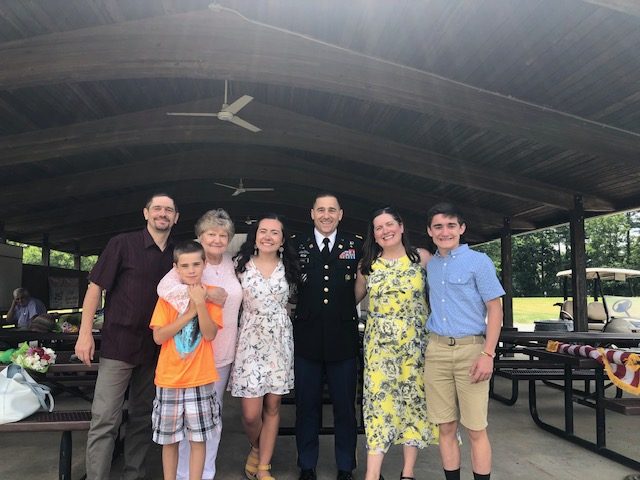
Despite toddlers Sadie and Anna twirling around in their best dresses in the rows between the picnic tables, his pastor, in-laws and brother chattering away, and a handful of soldiers young and old who made a difference in his life exchanging stories, the air grew still as Col. Kevin McAninch asked Fickel to raise his right hand to repeat the officer oath he has taken so many times before:
“I, Brian Fickel, do solemnly swear that I will support and defend the Constitution of the United States against all enemies, foreign and domestic; that I will bear true faith and allegiance to the same; that I take this obligation freely, without any mental reservation or purpose of evasion; and that I will well and faithfully discharge the duties of the office on which I am about to enter. So help me, God.”
Despite all of the emotion of the moment, his voice never cracked or wavered. Despite taking this oath every time he moved up in rank, the words were repeated with the clarity of a man who was honored to be saying them. Despite the fact that service to his country had taken him far from this home so many times before, and will again in the future, there was no longing to set his life path in any other direction than defending his country.
From every possible angle in our lives, whether it is the news, social media, a trip to the grocery store, or a purchase from our favorite website, people are being overwhelmed by a movement of “social justice” that has turned into a woke hysteria scorching the earth of our city streets, fraying history, and leaving us emotionally exhausted.
It is rare in any of those venues to find reminders there are young people in this country who find a way to make us better and stronger and fulfill the promise of our Constitution without destruction, mayhem, and entitlement, but instead with service.
Fickel is a shocking statistic: Less than 0.5% of Americans serve in our country’s military. McAninch says less than 2% of that rise to the rank of colonel.
After taking his oath and receiving accolades from the men and women who helped develop him into a leader, Fickel stood before his family and friends and tried to find the words to show his appreciation for their part in forming who he is:
“Since I was 7 years old, I knew I wanted to be in the Army. I went down to A.P. Hill to see my brother at Boy Scouts camp. I was jealous that he got to go and I didn’t. I wasn’t a Boy Scout yet, I was a Cub Scout. But I remember seeing there was an Apache pilot there standing in front of his helicopter, holding a blood round in his hand. He had this big display board about what Apache is and what the Army is. I loved it all. When I saw that guy, I was just blown away. And I knew that I wanted to do that.”
When he was 17, he wanted to enlist, and his parents would not let him.
“So when I turned 18,” he said, “I enlisted.”
“But today is really about the people that you surround yourself with. When I was in high school, my sixth grade English teacher, my mother-in-law, gave me detention. I was not a stellar performer in school. I was not an overachiever in school. I did not shine. But I surrounded myself with friends who did do well. It was my peer group that really got me into college.”
Fickel pointed to retired Col. Matt Shatzkin, who quietly sat in the back away from the family, calling him the first person that really impacted him professionally.
“I was a captain, and he was a major. He developed me and gave me lifelong skills as an officer,” Fickel said, adding, “Matt developed the highest performing team to date I’ve served on. I think about it all the time. I’ve learned lessons from Matt that carried me through my entire career. Honestly, I wouldn’t be here as colonel today without Matt. I know he’s humble. He’s been an educator, trainer, and developer his whole career. It’s in his DNA. He gets it from his dad.”
He then pointed to his pastor, Wayne Good.
“We haven’t known each other more than a couple years, but he’s done more to develop me spiritually in the last few years than anyone.”
And he thanked former retired Army Gen. Austin Lloyd, the last commander in Iraq who ended his career after his tour leading CENTCOM in 2016. Austin, who was unable to attend, sent a private note to Fickel.
“Haven’t talked a ton about working with Gen. Austin,” said the new colonel. “Worked with him three times. Never sought help with him, never volunteered, he just kept grabbing us up and taking us along. That’s another place where I served on an amazing team around people, every one of those folks had helped in developing me.”
Then Fickel grew quiet as he pointed to his brother Justin. His eyes watered, his voice trembled as both men’s eyes locked.
“My brother is here today,” Fickel said. “He’s an Army employee at Letterkenny Army Depot. He’s the toughest guy I know. He’s a survivor. Last year, he survived two bouts of cancer.” Then, struggling with the next two words, Fickel continued, in reference to how thin Justin got: “eighty pounds.”
In that moment, it was if only the two of them were there.
“We fought every year growing up,” Fickel said, breaking the spell and drawing laughter.
“He had a big G.I. Joe airplane that I was jealous of, and I threw it right at his head. It stuck in the wall. We put a pillow in front of it for about two weeks until we got caught. But he’s the only brother I have, and I love him more than anything, and I learned a lot from you.”
The people gathered here are extraordinary people leading ordinary lives, from his daughter, Rebecca, who makes masks and donates the proceeds to her church while still volunteering at the church camp, working at Sheetz, and attending college, to his son, a middle schooler who just wants to play football, to his wife, Heather, who has been the family’s rock and support system when he was deployed to Iraq, Afghanistan, Korea, dozens of bases, and dozens of other countries.
McAninch tells a short story about their team’s return after a long stretch in Afghanistan, about when Heather and Brian saw each other for the first time in months.
“The look in their eyes when they saw each other,” he said, pausing, “that was magic.”
This is a story, a sliver of a person’s life that won’t make national news, won’t have a provocative headline crafted by a young copy editor to drive clicks; yet the Fickels, Pastor Wayne, Lloyd, and the Cols. McAninch and Shatzkin are a part of the fabric of the story of who all of us are as Americans.
We tend to overlook them because they are not shouting, defacing, or carrying on on social media, but their role in our betterment is just as important.
