

Welcome to Byron York’s Daily Memo newsletter.
Was this email forwarded to you? Sign up here to receive the newsletter.
LET’S HAVE MORE DEBATES! There’s been an odd aftereffect from the Trump-Biden presidential debate. A lot of Biden supporters and their allies in the press are demanding that the first debate be the last debate and that there be no more Trump-Biden faceoffs before the November 3 election.
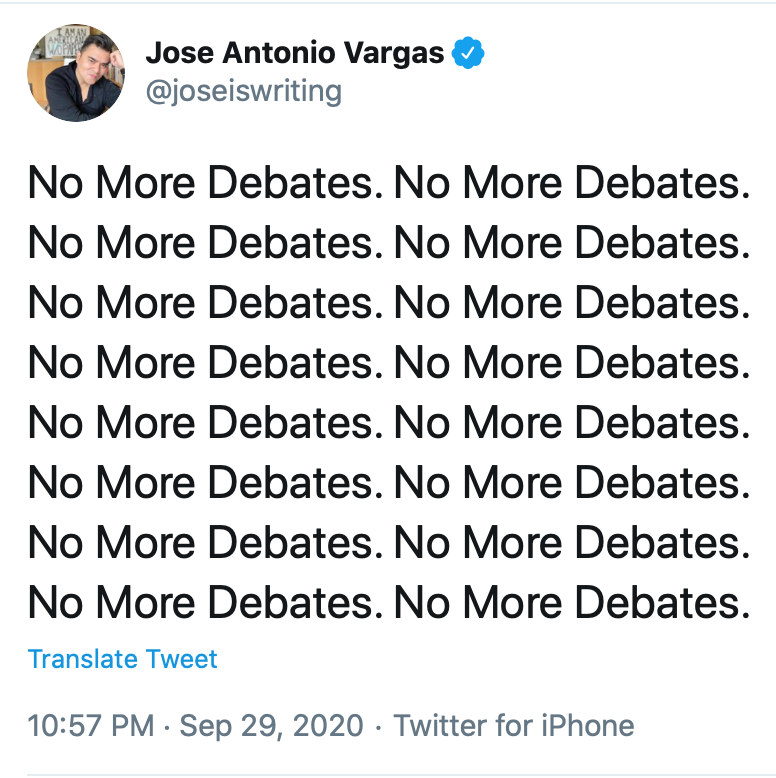
“Cancel the Debates,” was the headline of a piece in The Atlantic, a magazine that has in recent years become a major Resistance clearinghouse. “There is no reason, not one, that Joe Biden should participate in another debate,” tweeted MSNBC’s Joe Scarborough. “No more debates,” said Republican-turned-Democrat Bill Kristol in the NeverTrump website The Bulwark. And so on. There were many more examples, including the former Washington Post reporter who filled a tweet with “No More Debates” repeated 16 times:
So what does it mean? Well, surely some of the no-more-debates voices were sincerely offended by Tuesday’s debate. Before the debate, they were all in favor of the president and his challenger answering questions and defending their positions in a high-pressure, prime-time, nationally-televised debate. But after seeing President Trump repeatedly interrupt Biden, and Biden calling Trump a “clown” and demanding that he “shut up,” they no longer believe voters should see their candidates on the same stage.
Subscribe today to the Washington Examiner magazine that will keep you up to date with what’s going on in Washington. SUBSCRIBE NOW: Just $1.00 an issue!
But others never wanted Biden to debate Trump and are taking the opportunity of Tuesday’s angry confrontation to repeat what they have felt all along — that the 2020 presidential campaign should be debate-free. For example, House Speaker Nancy Pelosi has long urged Biden not to debate Trump — “not that I don’t think [Biden] will be excellent,” she said before the debate.
Kristol also opposed Biden debating Trump. Now, he still opposes debates. But he concedes that the public needs to see more of Biden, and specifically Biden engaging with Trump’s positions. “Biden can have weekly or twice weekly town halls, including with Trump supporters,” Kristol writes. “He can do all manner of interviews and forums. He can make clear he’s happy to engage with the American public in all kinds of ways. But he should not put the nation through another ordeal like [Tuesday’s debate].”
First of all, Biden is not doing all manner of interviews and forums or weekly or twice weekly town halls, including with Trump supporters. The debate on Tuesday was the best opportunity most American voters have had to see Biden in action. Prior to the debate, he has been seen mostly in carefully scripted virtual events or getting the kid-gloves treatment in a forum like the CNN town hall.
And “ordeal”? Surely Americans can handle the occasional unpleasant confrontation on their television screens. As the Wall Street Journal’s Bill McGurn said on Fox News “Special Report” Wednesday night: “I’m not above a raucous debate. The Lincoln-Douglas debates were very, very raucous, and there’s a lot of language in them that we couldn’t print in our paper today, on both sides. It was a different format, but it was very robust. My only complaint is I couldn’t hear sometimes because they’re going over each other. If they can figure that out, I like to see two candidates going at it.”
The real reason some of Biden’s most partisan advocates opposed debates is they feared such extended exposure to the voters might hurt Biden’s chances of winning. They believed he could defeat Trump without them. So why take the risk of Trump besting Biden in debate? For them, it wasn’t really a question of whether the public deserved to see the two candidates together.
In any event, the next debate, scheduled for October 15 in Miami, will be a town hall format. Moderated by C-Span’s Steve Scully, it will feature carefully-selected voters asking the candidates questions. It seems highly likely that Biden and Trump will behave differently with actual voters present than they did in the first debate. In short: They will be nicer to voters than they were to each other.
And who’s to say Tuesday night’s debate wasn’t valuable? Can’t Americans watch the two candidates in action and reach conclusions about them? Doesn’t that happen even if the debate is an angry standoff? If some Trump supporters so disliked the president’s performance that they no longer plan to vote for him — isn’t that the kind of thing that happens after a debate? Voters look at the candidates and make decisions. Likewise, if a voter on the fence about Biden decided not to support him after the debate, isn’t that reasonable, too?
Of course the debates should go on. President Trump says he is ready to go ahead with the debates as planned. The Biden campaign says the former vice president is ready, too. So on to the next debate on October 15, and, after that, the final debate on October 22 in Nashville. Voters need them.
