

Welcome to Byron York’s Daily Memo newsletter.
Was this email forwarded to you? Sign up here to receive the newsletter.
POLARIZATION AND BIDEN’S RATINGS. Some parts of Democratic Twitter go nuts when it is pointed out that President Biden’s 100-day job approval rating is the third-lowest of any president since World War II. (Only Donald Trump and Gerald Ford were lower.) All that matters to the most partisan Democrats, apparently, is that Biden’s approval rating is higher than Trump’s.
But why is Biden’s 100-day rating below so many other presidents? A chart of presidential 100-day ratings compiled by pollster Bill McInturff — he is the Republican half of the team that polls for the Wall Street Journal and NBC News — shows that polarization between the parties has been growing steadily since at least the 1950s. Biden’s rating is a continuation of that phenomenon.
McInturff compared Republican and Democratic approval ratings for each president at the 100-day mark. He took the Republican approval for a Republican president and subtracted the Democratic approval and got the gap between the parties in assessing that Republican president. He did the same for Democrats from the other side.
Subscribe today to the Washington Examiner magazine that will keep you up to date with what’s going on in Washington. SUBSCRIBE NOW: Just $1.00 an issue!
Biden has a 90 percent approval rating from Democrats and a nine percent approval rating from Republicans. That’s an 81-point gap between the parties. Trump had a 86 percent rating from Republicans and a nine percent rating from Democrats — a 77-point gap.
At 100 days, Barack Obama had a 91 percent approval rating among Democrats and a 28 percent rating among Republicans — a 63-point gap. George W. Bush had a 93 percent approval rating among Republicans and a 31 percent rating among Democrats — a 62-point gap. Bill Clinton had an 82 percent approval rating among Democrats and a 25 percent rating among Republicans — a 57-point gap. Here is McInturff’s chart:
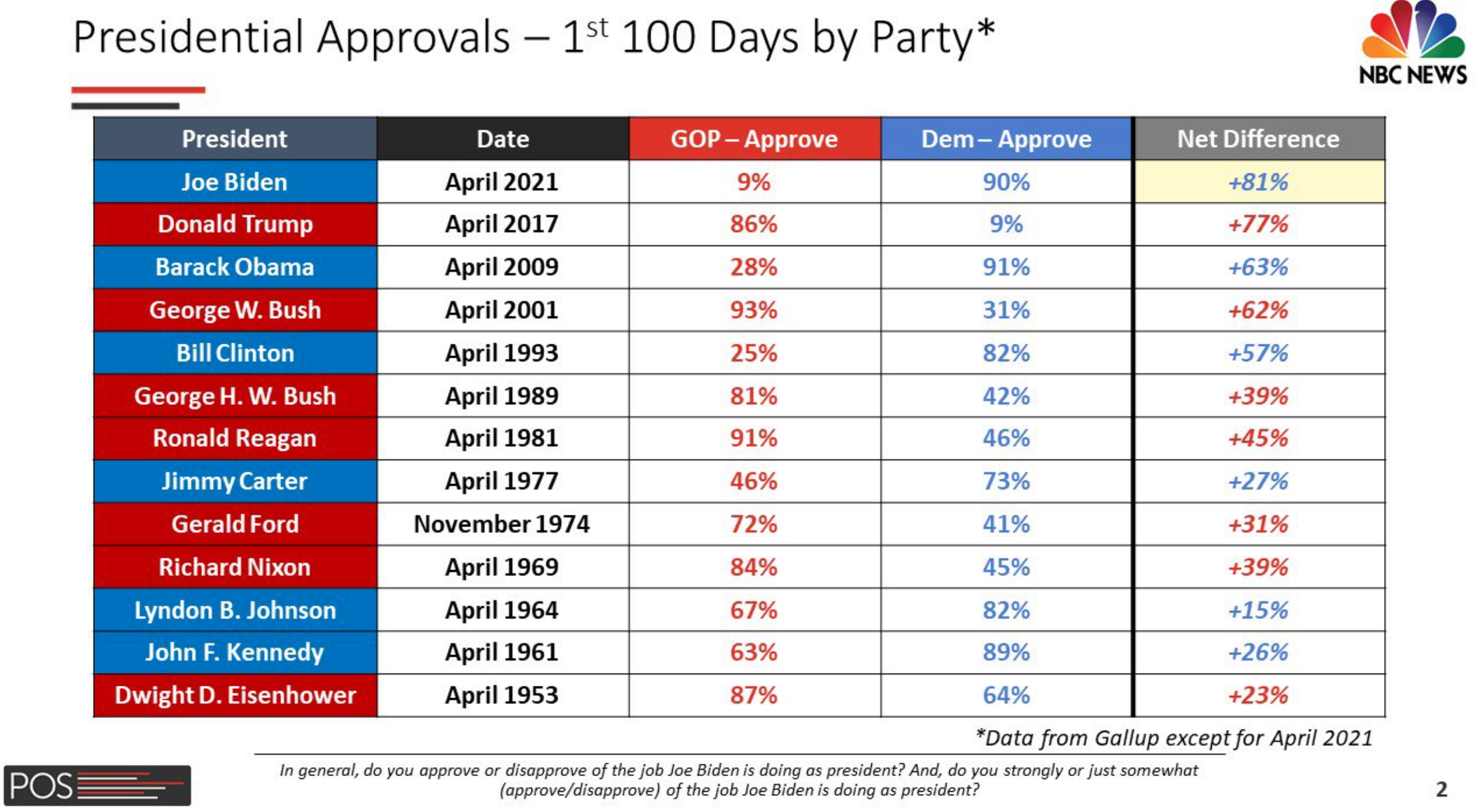
The partisan gap has grown with each new president. Before Clinton, it was smaller, although it did not move in a straight upward line. George H.W. Bush had a 39-point gap. Ronald Reagan had a 45-point gap. Jimmy Carter, 27 points. Gerald Ford, 31 points. Richard Nixon, 39 points. Lyndon Johnson, 15 points. John F. Kennedy, 26 points. Dwight D. Eisenhower, 23 points.
So Biden’s 100-day job approval rating should be seen as the latest in a long line of increasing partisan gaps. And with Biden, the post-100-day gap is likely to grow even larger, because his post-100-day agenda is likely to be more partisan than his concentration on the COVID pandemic in his first 100 days.
One final thing. Some particularly partisan Democrats argue Biden’s big gap is the result of many Republicans not accepting the results of the 2020 election. Undoubtedly there is some of that. But don’t forget that many Democrats did not accept the election of Donald Trump. In April, 2017, at Trump’s 100 days, just nine percent of Democrats supported him. Now, in April, 2021, that same number or Republicans — nine percent — support Biden. After sowing so much doubt about the election of Trump, should Democrats be surprised that some Republicans have taken a similar attitude toward Biden?
For a deeper dive into many of the topics covered in the Daily Memo, please listen to my podcast, The Byron York Show — available on the Ricochet Audio Network and everywhere else podcasts can be found. You can use this link to subscribe.
