

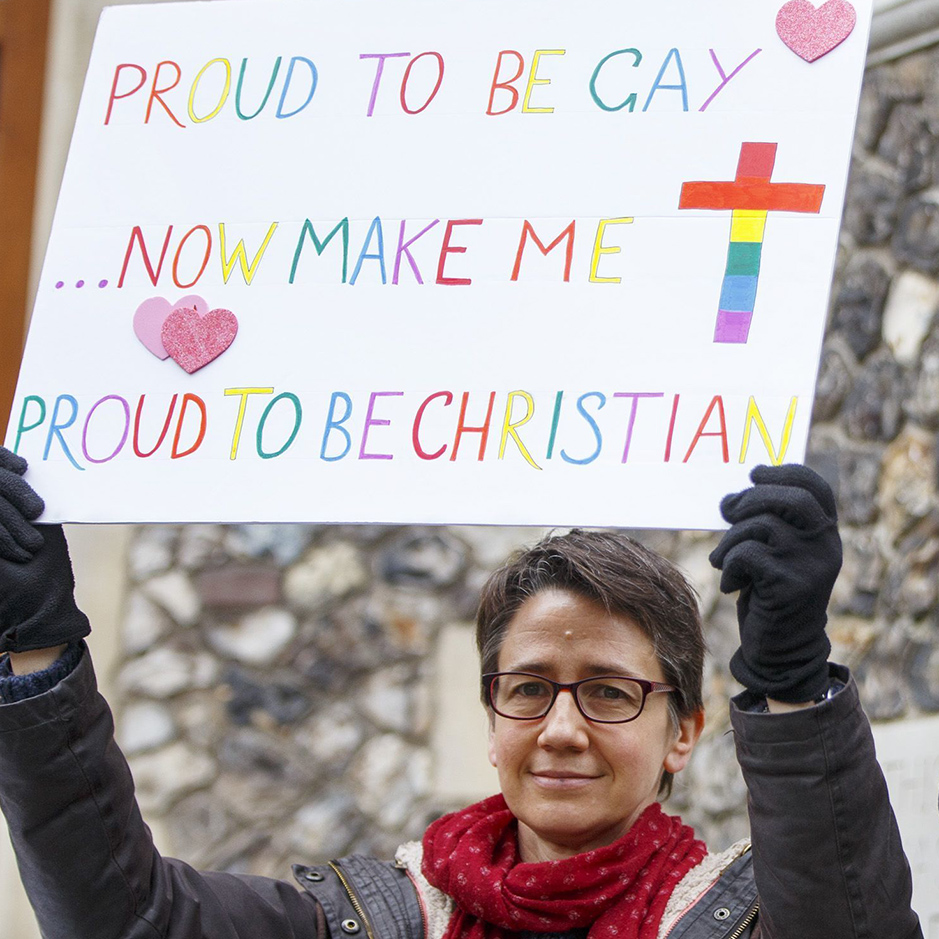
No contemporary political issue is more emotionally fraught: The LGBT lobby, enjoying its new political ascendancy, worries that religious conservatives wish to diminish the self-definition and harm the dignity of the wider LGBT community; meanwhile, religious conservatives, feeling beleaguered, find their deeply held beliefs marginalized and scorned, and stand accused of using religious liberty as a pretense for discrimination against sexual minorities.
Debating Religious Liberty and Discrimination is a new point-counterpoint volume coauthored by John Corvino (on one side) and Ryan T. Anderson and Sherif Girgis (on the other). The book explores the philosophical, historical, and policy dimensions of religious liberty, helping us to better understand what it is, why it matters, and how it ought to be protected. And, in turn, the book’s discussion of discrimination helps us to better understand what it is, when it’s unjust, and when it should be lawful. Policy analysts, ethicists, philosophers, and lawyers will all benefit from this book—as will anyone who wants to think more clearly about the pressing issues of the day.
Corvino, a professor of philosophy at Wayne State University, argues that religious liberty has morphed into religious privilege. Caution is called for when considering religious exemptions from generally applicable laws, Corvino writes, especially when those exemptions could burden “already vulnerable minorities.” Wishing that the federal Religious Freedom Restoration Act relied on “intermediate scrutiny” rather than “strict scrutiny” since the latter level of protection lends itself to potential abuse, Corvino argues for a form of religious liberty that prohibits overt attempts by law to single out religion. Expressing concern about the implications of the Supreme Court’s 2014 Hobby Lobby decision, he argues that “the laws in question” in that case, which required companies providing health insurance to their employees to offer plans covering contraceptives, “don’t directly target fundamental freedoms; instead, they incidentally burden them in pursuit of other, constitutionally legitimate aims.” Elsewhere he writes that “it is by no means clear that the free exercise clause should be interpreted as granting religious exemptions from otherwise neutral laws, rather than merely as prohibiting Congress from passing laws aimed directly at suppressing religious practice.”
Corvino’s arguments are rhetorically powerful, but one comes away desiring more evidence for and specificity about why and when religious liberty ought to give way to claims of nondiscrimination. The reader is left wondering what Corvino would do with religious schools’ tax exemption or whether he believes that Catholic hospitals must perform sex-reassignment surgeries. Many of his arguments hinge upon judgments about “dignitary harm”—that is, “the harm involved in treating people with less than equal moral standing”—which seems unavoidably subjective. Throughout, the reader will observe an appreciable libertarianism in Corvino’s tone, except when it comes to those who disagree with his sexual ethics. And most concerning, Corvino would have us remove the presumption of liberty that religion has historically enjoyed.
Anderson, a policy expert at the Heritage Foundation, and Girgis, a legal scholar now studying philosophy at Princeton, argue on the basis of natural law theory that religious conviction is a “basic good” and therefore demands a robust conception of religious liberty on the grounds that personal integrity with one’s beliefs is central to human flourishing. The state ought not to arbitrarily restrict such a basic good without immense justification for fear of disrupting the “basic ingredients of human thriving.”
In their view, LGBT claims of discrimination fail to meet the necessary thresholds that merit government interventions restricting religious freedom. Anderson and Girgis offer a helpful analysis of discrimination, arguing that what matters is establishing the relevant factors behind it. Not all discrimination is equal. Is it reasonable to require people to see in order to drive a vehicle? Yes. Relevant factors establish that vision is necessary for driving, which discriminates against blind persons. Is it reasonable to deny a transgender person access to a laundromat? No. The need to clean one’s clothes is in no way constitutive of one’s gender identity. “In general, how we define concrete instances of discrimination,” Anderson and Girgis write, “depends on our underlying moral judgments about particular cases”—which is why refusing to perform sex-reassignment surgery is different from refusing to give chemotherapy to a transgender patient, and why declining to arrange flowers for a same-sex wedding is different from declining to arrange “Get Well Soon” flowers for a gay customer. Anderson and Girgis highlight the importance of these distinctions, but Corvino rejects them, and the law generally ignores them—to the peril of civil liberty and the common good.
To Anderson and Girgis, there is “no freestanding right not to be offended.” Responding to the dignitary harm aspect of Corvino’s argument, Anderson and Girgis write that an essential purpose of religious freedom is to offer challenging truths to society—truths that society may not want to hear but may nonetheless need:
Free societies require the possibility of persons being offended, not needlessly, but for the betterment of society or individual human flourishing. But efforts to restrict religious dissent, Anderson and Girgis fear, “will always mute the voice for tomorrow’s reform.” Such an outcome would amount to “backsliding into Puritanism”—a progressive Puritanism, that is, in which dissent from the new orthodoxy is zealously quashed. Anderson and Girgis observe a double standard in our public discourse whereby progressives allow for free speech that inflicts dignitary harm but are unwilling to extend that same allowance to religious practice.
Anderson and Girgis end up showing convincingly why the new wave of laws seeking to codify protections for sexual orientation and gender identity at the local, state, and federal levels amounts to an encroaching threat to religious freedom.
Although Anderson and Girgis make a more comprehensive, philosophical case for defending religious liberty, and so overall have the upper hand in the debate, all three authors deserve praise for tackling this subject in this way. They disagree civilly and engage with one another substantively and thoughtfully. In an age when discussions of religious liberty often devolve into cheap political point-scoring, the fact that elevated debate occurred with both charity and clarity is perhaps the ultimate value of this book. May it be a model to disputants on this and other heated subjects, for years to come.
Andrew T. Walker is director of policy studies at the Ethics and Religious Liberty Commission and author of God and the Transgender Debate.
