

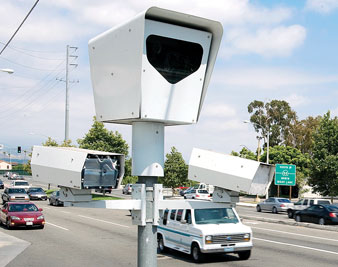
A new poll by Rasmussen shows only 44 percent of Americans think cameras at traffic intersections are a good idea, while another 44 percent don’t think they are a good idea. But those surveyed are much more supportive of surveillance cameras in police cars and in public spaces:
The latest Rasmussen Reports national telephone survey shows that 86% of American Adults believe it’s a good idea for police cars to use surveillance cameras to monitor what happens when officers approach and apprehend suspects. Only 10% don’t like the idea….
A majority (66%) also thinks there should be surveillance cameras in all major public spaces such as train stations, parks and sports stadiums. This idea draws opposition from 23% of adults, while 11% are undecided.
A majority (66%) also thinks there should be surveillance cameras in all major public spaces such as train stations, parks and sports stadiums. This idea draws opposition from 23% of adults, while 11% are undecided.
In the August 1 issue of THE WEEKLY STANDARD, Jonathan V. Last explained how municipalities across the country are dismantling their red light cameras amid widespread public opposition:
Last March the city council in San Bernardino voted 5-0 to kill their red-light camera system. Since the cameras were installed in 2005, the program had brought them little but grief. In 2008, the city was caught shortening the timing of yellow lights in order to gin up more citations. Later that year a California appellate court ruled that the city’s contract with the red-light camera service American Traffic Solutions (ATS) was in violation of state law. And in 2010, a county court ruled that images from red-light cameras were inadmissible hearsay. The cameras were such a debacle for San Bernardino that in the end the city paid ATS $110,000 to get out of a contract that would have kept the cameras in place until 2014.
It sounds like an extraordinary story: a city, in the middle of a recession, paying a vendor to cancel a contract that is supposed to produce revenue. But it turns out that San Bernardino isn’t extraordinary at all. Across California and the rest of the country, cities and towns are dismantling their red-light camera regimes. And it’s this larger story that’s remarkable, because it shows that even at this late date, the people can, from time to time, still hold their governments to account.
Like many cultural plagues, the red-light camera originated in Europe. Invented by a Dutch race-car driver, Maurice Gatsonides, red-light cameras were installed by European municipalities throughout the 1980s to ticket drivers without the necessity of using actual police. In 1993 the sickness crossed the Atlantic, and New York City permanently installed cameras of its own.
It sounds like an extraordinary story: a city, in the middle of a recession, paying a vendor to cancel a contract that is supposed to produce revenue. But it turns out that San Bernardino isn’t extraordinary at all. Across California and the rest of the country, cities and towns are dismantling their red-light camera regimes. And it’s this larger story that’s remarkable, because it shows that even at this late date, the people can, from time to time, still hold their governments to account.
Like many cultural plagues, the red-light camera originated in Europe. Invented by a Dutch race-car driver, Maurice Gatsonides, red-light cameras were installed by European municipalities throughout the 1980s to ticket drivers without the necessity of using actual police. In 1993 the sickness crossed the Atlantic, and New York City permanently installed cameras of its own.
Read the whole thing here.
