

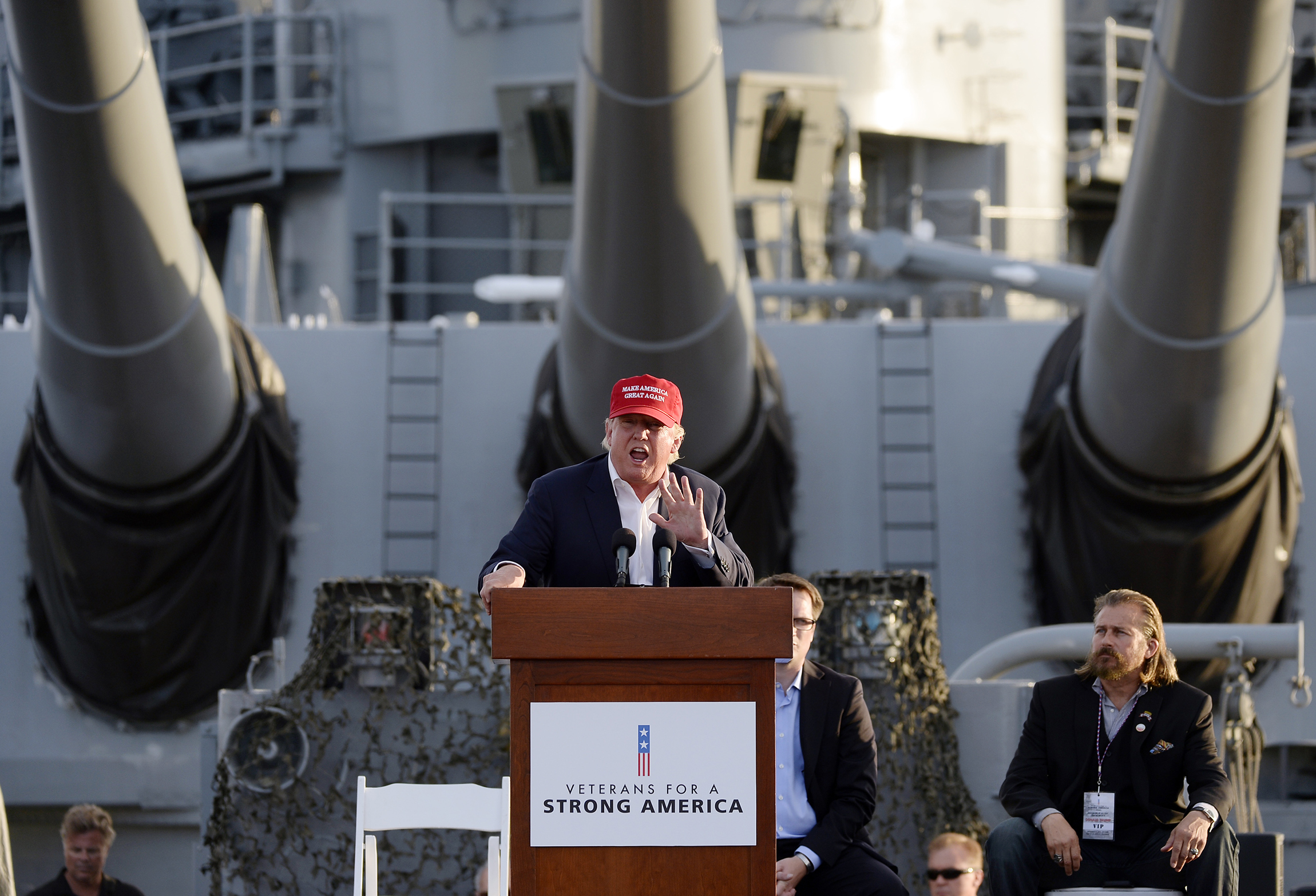
Notably absent from the House Republicans’ foreign policy agenda unveiled Thursday are two phrases: “Donald Trump” and “America First.”
Recommended Stories


The deliberate omission of the presumptive presidential nominee and his foreign policy slogan underscored the sharp divide between Trump and the party he is leading into the fall campaign.
Republican leaders presented the national security blueprint as a stark alternative to President Obama’s leadership. But the proposal trains a bright spotlight on philosophical disagreements with Trump on foreign affairs.
House Republicans still cling to Ronald Reagan’s muscular internationalism. Titled “A Better Way; Our Vision for a Confident America,” the program prioritizes U.S. global leadership; strengthening alliances and using free trade to further Washington’s influence abroad.
Trump’s “America First” foreign policy, which is seen by some as isolationist, questions the value of commitments to traditional allies, is skeptical of free trade agreements, and envisages freeing money for domestic infrastructure spending by diminishing the projection of American power overseas.
For House Republicans, the differences with Trump are uncomfortable.
“It’s easy for first time candidates to make mistakes, and I think Trump will continue to make mistakes, and that’s okay. It’s acceptable for someone who’s not been in this business,” said Rep. Devin Nunes of California, who as Intelligence Committee chairman helped write the House GOP’s foreign policy plan.
House Republicans rolled out the foreign policy agenda Thursday at a discussion at the Council on Foreign Relations moderated by NBC News chief foreign affairs correspondent Andrea Mitchell.
They papered over their differences with Trump, and predicted that the chasm between them would shrink as he learns more about world affairs.
Asked by Mitchell how Trump’s plan to ban Muslims temporarily from entering the country fits their goal of improving homeland security, GOP leaders conceded that they oppose this approach, think it would damaging and hope it will be reconsidered.
“Well, if I — look, and I’ve said this before, you can’t ban an entire race or religion from coming into the country,” said. Rep. Michael McCaul of Texas, Homeland Security Committee chairman, who participated in drawing up the overhaul.
“A better way forward is [this] document to advise our House Republicans,” McCaul added. “And we hope the nominee will read that as well. I’ve always said that we have to be careful in our rhetoric because that can inflame the Muslim community, and can in fact help their recruiting efforts, in some respects.”
Trump’s grasp on the GOP nomination puts GOP officials in an unusual position.
Normally, House Republicans pushing a foreign policy agenda would be criticized by Democrats. Republicans would welcome attacks and use them as an excuse to highlight their view that Obama has failed, and that presumptive Democratic nominee Hillary Clinton would be more of the same.
But in this case, the Democratic National Committee issued a statement drawing attention to House Republicans differences with Trump. “It’s clear that even Republican leaders like [House Speaker] Paul Ryan are afraid of Donald Trump as the leader of the free world,” DNC spokesman Mark Paustenbach said.
Republicans are left having to talk about Trump when they’d prefer to discuss Clinton and what they see as her failure as secretary of state, including the “reset” of relations with Russia; the terrorist attacks on the U.S. consulate in Benghazi, Libya, in which Ambassador Christopher Stevens and three other Americans were murdered; and the nuclear deal with Iran.
Trump’s willingness to pull out of the NATO (the North Atlantic Treaty Organization) has many Republicans particularly concerned, as does his threat to walk away from defense alliances with Japan and South Korea if they don’t pony up more money for protection.
“You don’t dismantle what’s been the most successful alliance system — and not just in NATO,” said Rep. Tom Cole, a veteran Republican lawmaker from Oklahoma. “And I’m not sure if Mr. Trump’s aware of this: It’s cheaper to operate a carrier strike force out of Japan than it is out of California and we don’t do that just as a favor to the South Koreans or the Japanese.”
Trump, 69, a career real estate developer and reality television star, has offered some provocative national security proposals.
He said as president he would be willing to pull the U.S. out of an “obsolete” NATO and threatened to withdraw from the Asia Pacific and let allies Japan and South Korea fend for themselves, even if that means they would choose to develop their own nuclear weapons arsenal.
Trump has said that the U.S. can no longer afford to fulfill its post-World War II role as the guarantor of global economic and military security and said Americans should instead shift foreign expenses into the rebuilding of roads, bridges, airports and other infrastructure.
The Republican’s position is similar to, although more radical than, President Obama’s attempt to reduce U.S. involvement overseas, citing a need to redirect resources to the home front. Trump has been an aggressive critic of the wars in Iraq and Afghanistan championed by President George W. Bush.
“It’s time to shake the rust off of America’s foreign policy. It’s time to invite new voices and new visions into the fold,” Trump said, according to a transcript of the major speech on international affairs that he delivered last month. “Our foreign policy is a complete and total disaster.”
Some common ground exists.
House Republicans are pushing for a military buildup; so is Trump. House Republicans want to beef up border security and put an end to illegal immigration. Immigration enforcement has been Trump’s signature issue.
These areas of agreement are giving congressional Republicans hope that there would less friction between them and a Trump administration than appears at first blush. Even on concerning points of disagreement like Trump’s stated willingness to abandon NATO, Republicans are hopeful that Trump will come around.
“The candidate said some things that weren’t quite right, and I think he’s learned a lot from them,” Nunes said. “But the overall point that Trump’s making on NATO is one that we agree with, and that is that NATO has to put up [more] money” to pay for its share of military responsibilities.
“What Trump is saying, there’s a lot of truth to it,” the Intelligence Committee chairman added. “He’s just not being as artful as somebody whose been in politics for a long time.”
