

Just moments after Republicans released their tax reform framework Wednesday, Democrats settled on a line of attack — the Republican plan, they alleged, would raise taxes on working families at the same time that it provides major tax cuts for the wealthy.
What made the plan vulnerable to attack was a relative lack of detail on the provisions that would affect low-income earners.
Recommended Stories



In Indianapolis, President Trump pledged that the tax overhaul “will cut taxes for the everyday, hardworking Americans, the people that work so long, so hard, and they’ve been forgotten. But they’re not forgotten anymore.”
But those his words, and a stipulation in the tax document that the eventual legislation would make the code more progressive were not sufficient to prevent Democrats from sketching out scenarios in which low- and middle-income families would see tax hikes.
Democratic leaders first claimed that, by eliminating exemptions for individuals and independents and raising the bottom tax bracket from 10 percent to 12 percent, the GOP plan would place a higher tax burden on some families.
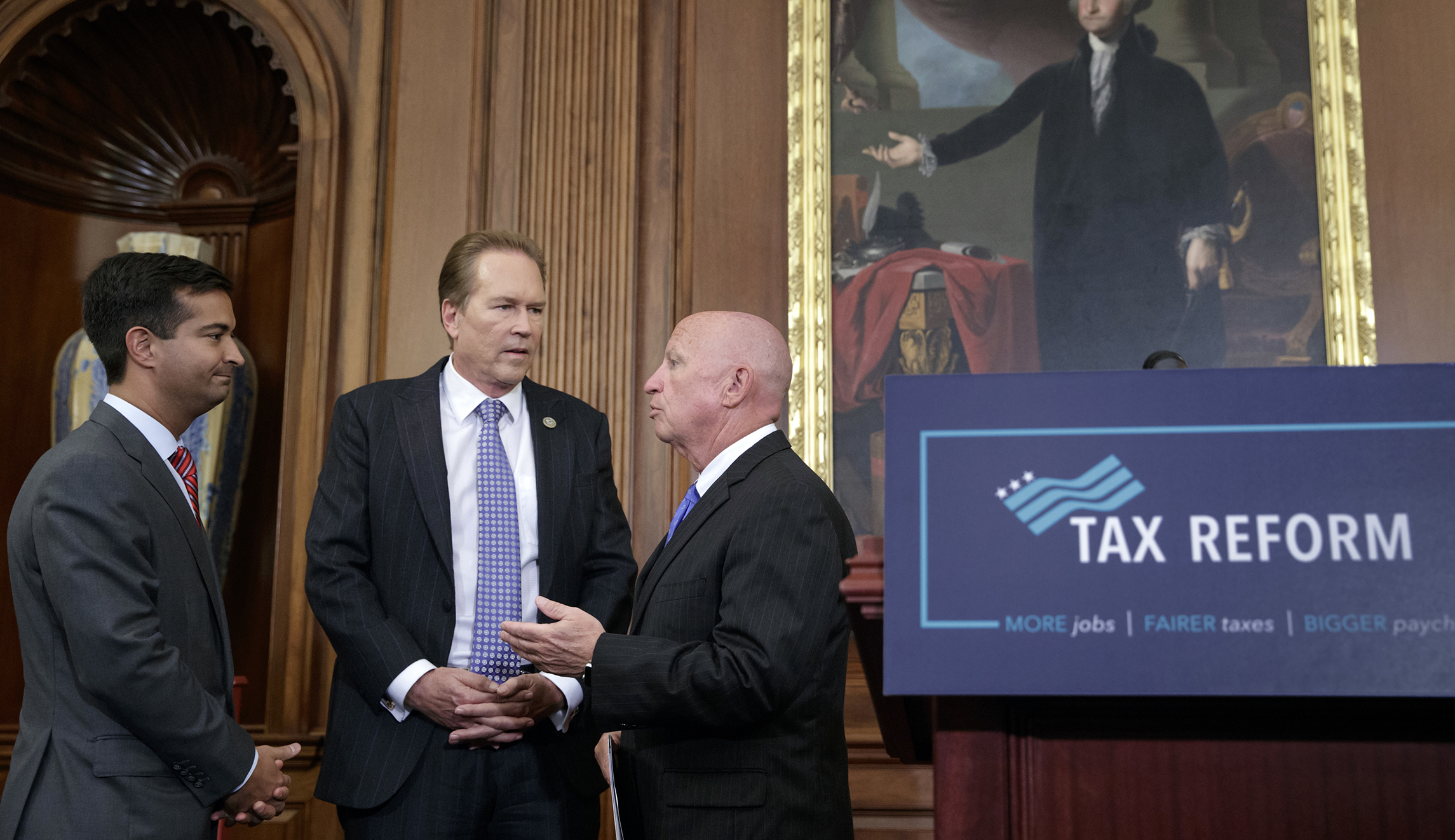
“That’s just nonsense,” responded Kevin Brady, the chairman of the House Ways and Means Committee and one of the members of the Big Six of Republicans who drafted the framework. Instead, he said, people at every income level would see a tax cut.
Brady said it was wrong to see the plan as one that would raise the bottom rate from 10 to 12 percent. Instead, he claimed that today’s 15 percent tax rate would be lowered to 12 percent, and the 10 percent bracket would be lowered to zero, a reference to the framework’s call to nearly double the standard deduction to $24,000 per couple. “The tax elevator goes down at every level,” Brady said.
The problem is that the provisions the GOP has committed to paper, so far, do not necessarily yield that conclusion.
“[T]he end result would likely be close to a wash for many low- and middle-income families,” concluded an analysis from the left-of-center Center on Budget and Policy Priorities released Wednesday.
Depending on other provisions in the ultimate bill, it’s conceivable that some families could face tax increases if Republicans are not careful when writing the bill. Trump’s own campaign tax plan likely would have raised taxes on millions of families, especially single parents, according to an analysis by NYU professor Lily Batchelder.
The basic math is that, under today’s code, families get a standard deduction of $12,700 and exemptions of $4,050 for individuals and dependents. In effect, the first $28,900 of income for a family of four is protected.
Accordingly, around 35 percent of people today have a zero percent income tax rate.
The larger standard deduction proposed by Republicans wouldn’t necessarily help those people. Nor would the promised larger child tax credit, because the framework says that the credits will be nonrefundable, making them useless to people with no tax liability.
Trying to address those possible problems, Sens. Mike Lee of Utah and Marco Rubio of Florida released a statement Wednesday saying that the child tax credit “must be at least doubled” from its current level of $1,000. To ensure that it does benefit people who wouldn’t have income tax liability, they said that it should be applicable against payroll tax liability.
Otherwise, despite the Democratic charges, Republicans projected confidence that their bill will cut taxes at every level.
Pat Toomey of Pennsylvania, a member of the Senate Finance Committee that will be responsible for writing the legislation, said Republicans had many details prepared for legislation that weren’t included in the framework released Wednesday. “It’s going to be a tax cut for lower-income and middle-income people,” he said.
