

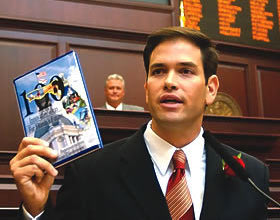
Mark Leibovich’s cover story in Sunday’s Times magazine, on the Florida Senate GOP fight between Marco Rubio and Gov. Charlie Crist, is online:
It is not uncommon for a party out of power to undergo an identity crisis and an internal bloodletting, and it is Crist’s bad luck that his race in 2010 fits the frame of a philosophical debate that has been fulminating in the Republican Party for several months. The race, and the national debate, pits the governing pragmatists against the ideological purists. The purists say that a Republican revival depends on hewing to conservative ideas, resisting compromise and generally taking a dim view of government. Tea Party rallies are filled with such purists, whose populist icons — Sarah Palin, Rush Limbaugh, Fox News’s Glenn Beck — tend to be unburdened by the pressures of governing through a recession.
This is the conventional view, which sees the Florida primary fight as testing the strength of Tea Party politics. True enough. But such a view circumscribes Rubio’s appeal. He is, after all, the protegé of Jeb Bush — a successful governing conservative, but not exactly a populist. And Crist’s record of “governing pragmatism” is not without blotches. What’s more, one man’s “governing pragmatism” is another’s “unprincipled poll-chasing.” Besides, is it impossible to govern successfully while holding on to a set of core values? No, it isn’t.
The Florida primary race is important for many reasons: the result could signal a generational shift in the GOP leadership, it could launch a major star into national politics, and it could herald the fusion of Tea Party enthusiasm with a policy-heavy approach to market-based governance (this is why Rep. Paul Ryan’s endorsement of Rubio is important).
All the races this year will determine the partisan composition of government; but is there another that has such heavy import for the conservative future?
