

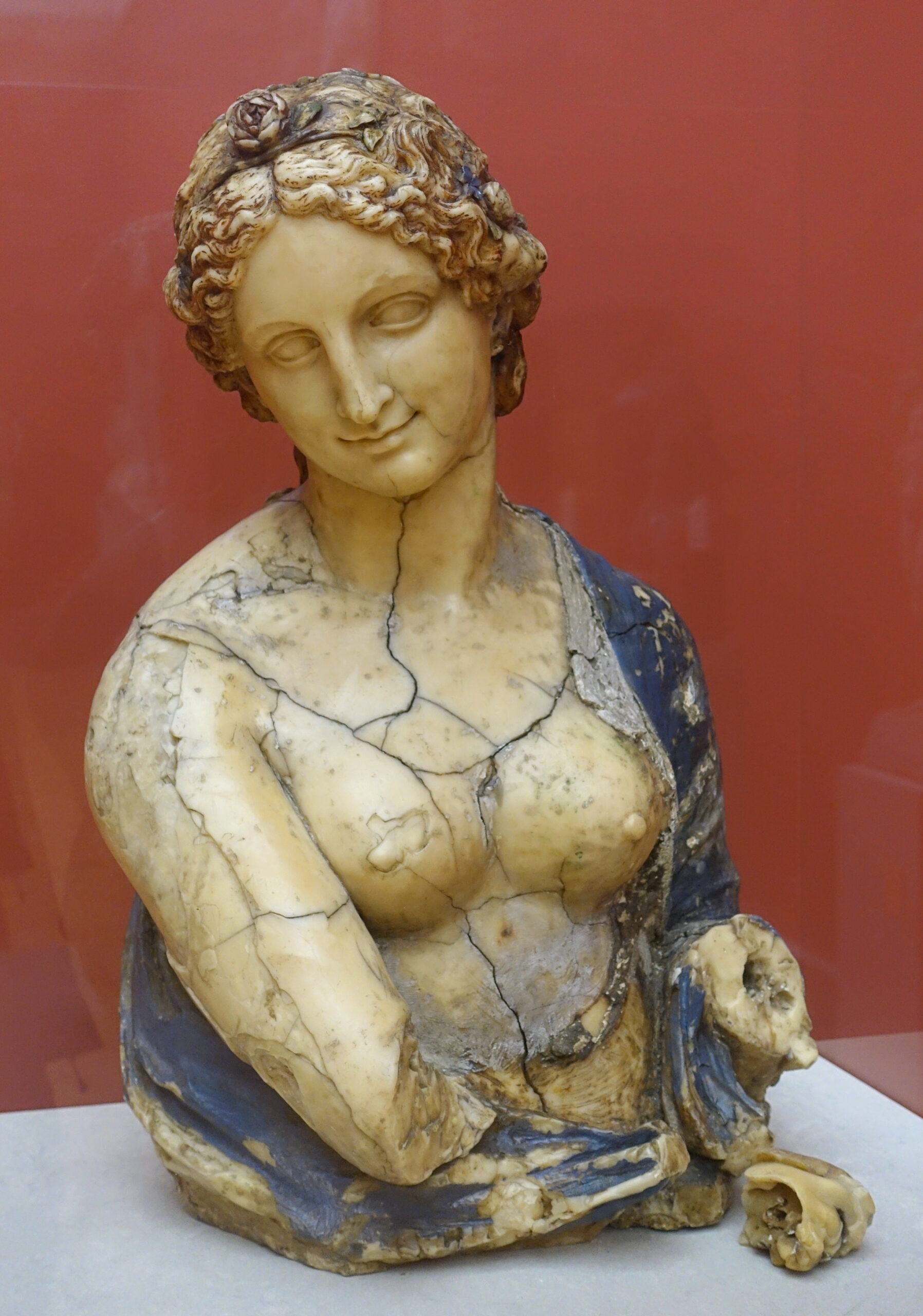
Among many lost treasures of pre-war Berlin’s Bode Museum, a collection of Renaissance sculptures by the likes of Donatello, Luca della Robbia, Andrea del Verrocchio, and Francesco Laurana was just another casualty—until a team of art historians found 59 of the collection in Moscow.
The Art Newspaper reported on May 19:
Since shortly after the Bode burned in 1945, the pilfered sculptures had been gathering dust at the Pushkin State Museum in Moscow. Russia’s state museums still house thousands, some say likely a million, artworks looted from a post-war Germany lain waste and vulnerable. The troves of “trophy art” at the Pushkin and at the Hermitage in St. Petersburg have been open to German art historians and researchers only since 2005. Identifying works damaged by war and wear is slow work made slower by ungainly diplomacy.
The old-world closed door of the Russian art ministry reinforced its iron seal as recently as 1996, amid intensifying international attention to the reparations of Nazi-era looted art. In the particular interest of the Hermitage in St. Petersburg and Moscow’s Pushkin State Museum, a State Duma decree claimed Russian ownership once and for all of the unknown thousands of sculptures and paintings brought to these state museums after the war.
The intention of Stalin’s “Trophy Brigade” was virtually the opposite of the American Roberts Commission, which gathered up Allied nations’ antiquities to ensure their safe return. Red Army soldiers, by contrast, scooped up antiquities and carried them to morally higher ground; those not stolen by individual Soviets went to the museums. Former Trophy Brigadier and memoirist Major Natalia Sokolova wrote, “Now they belonged to the Red Army, the only army in the world that carried on its banners revenge to bandits and peace to freedom-loving people.” The Pergamon Altar and immense Old Masters gallery returned to communist East Germany in the 1960s, but since then, Red trophies have stayed put.
Understandably, the Prussian Cultural Heritage Foundation, which oversees German state museums, hasn’t expressed any particular hope the 59 sculpture will return to the Bode. The state museums happen to be embroiled in another reparations controversy. Back in March, two conceptual artists stealthily 3D-scanned the famous swan-like bust of Egyptian queen Nefertiti—their “concept” being that since the Prussian Cultural Heritage Foundation hadn’t honored Egyptian requests to return Nefertiti to Cairo, Nefertiti should be uploaded and owned by everyone.
The cooperative work of restoring and cataloguing the 59 sculptures is expected to culminate in an exhibition at the Pushkin explicitly honoring their provenance. Since 2005, several other trophies, single paintings, have been publicly identified in the Pushkin—but this recognition of the Bode’s Renaissance sculpture collection is the first of its scale.
