

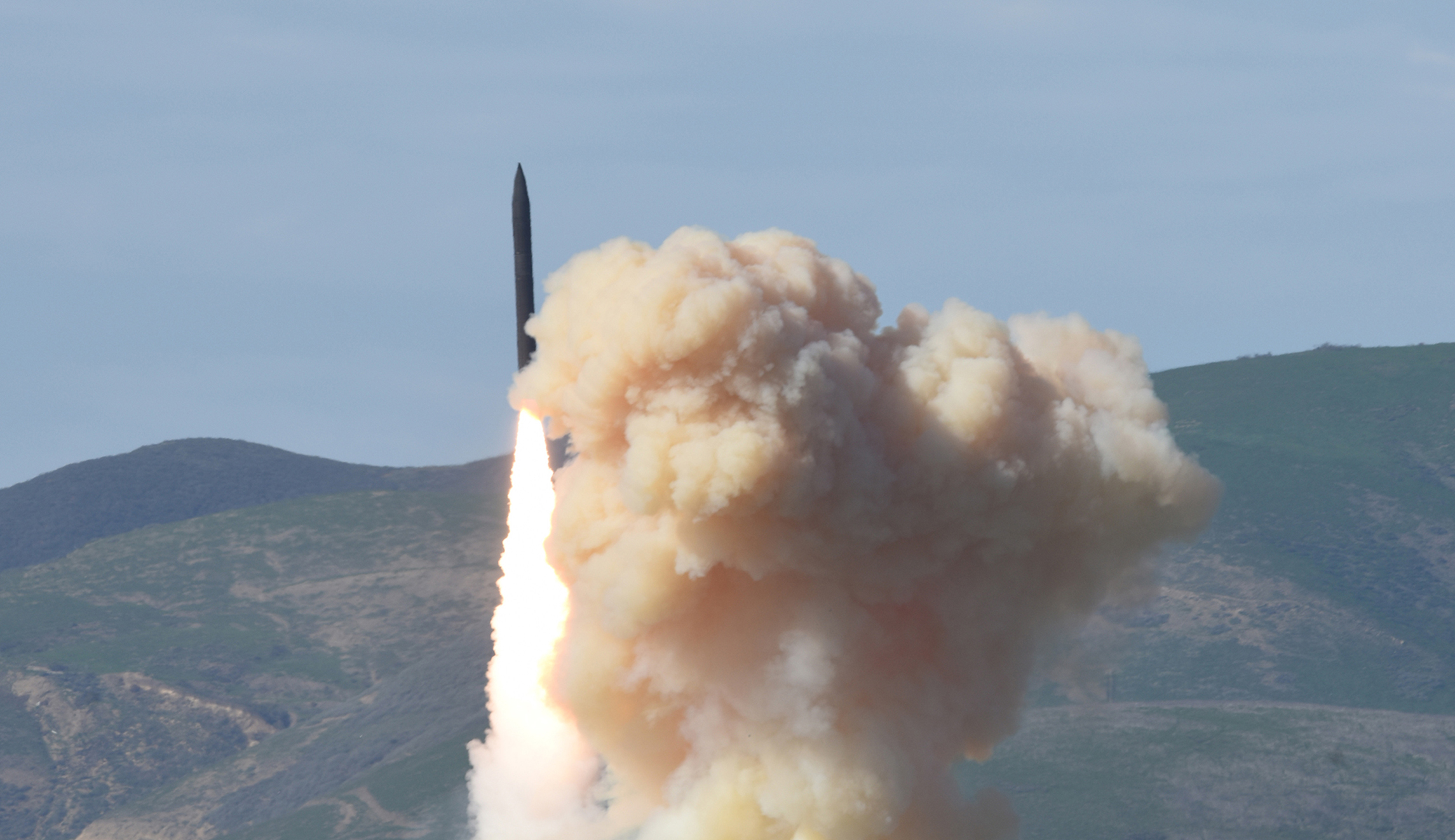
The Pentagon confirmed Friday that the latest missile launch by North Korea was the second test of an intercontinental ballistic missile capable of reaching the United States.
The missile was fired from north central North Korea and traveled about 600 miles before falling in the Sea of Japan.
Recommended Stories



“We assess that this missile was an intercontinental ballistic missile, as had been expected,” Navy Capt. Jeff Davis, a Pentagon spokesman, said in a statement.
After the launch, Joint Chiefs Chairman Gen. Joseph Dunford and Pacific Commander Adm. Harry Harris called Dunford’s South Korea counterpart, Gen. Lee Sun Jin.
“During the call Dunford and Harris expressed the ironclad commitment to the U.S.-Republic of Korea alliance,” Navy Capt. Greg Hicks, Dunford’s spokesman, said. “The three leaders also discussed military response options. Harris joined Dunford in his Pentagon office to make the phone call.”
Meanwhile, the South Korean news agency Yonhap reported that South Korean President Moon Jai-in has approved the deployment of the remaining elements of the American Terminal High Altitude Area Defense missile shield to an South Korean air base.
The deployment has been stalled by a review ordered by Moon.
The initial Pentagon statement omitted a crucial piece of information, namely how high the missile flew.
To qualify as an ICBM, the missile would have to have a range, if fired on a more lateral trajectory, of about 3,400 miles.
The single missile was tracked by the North American Aerospace Defense Command from Mupyong-ni North Korea 10:41 a.m. Washington time, the Pentagon said.
“We are working with our interagency partners on a more detailed assessment,” Davis said.
While the Pentagon would not disclose how high or how long the missile flew, some independent experts suggested the missile reached an altitude 2,300 miles.
“If those numbers are correct, the missile flown on a standard trajectory the missile would have a range 6,500 miles,” wrote David Wright of the Union of Concerned Scientists.
The preliminary data indicate “another successful ICBM launch that flew even higher and longer than the July 4th test,” said Bruce Klingner of the Heritage Foundation. “A greater portion of the United States faces a North Korean nuclear threat. It now appears that a significant portion of the continental United States is within range.”
A test launch on July 4 of a two-stage ICBM surprised the U.S. intelligence community, and caused it to revise its estimate of how soon Pyongyang might be able to threaten the mainland United States with nuclear weapons.
The Washington Post reported this week that the Pentagon’s Defense Intelligence Agency has shaved a full two years off the consensus forecast, concluding North Korea will likely be able to field a reliable, nuclear-capable intercontinental ballistic missile as early as 2018.
That report came on the same day the House Armed Services Committee received a classified briefing on the pace of North Korea’s ICBM development.
“The apparent success of the July 4th test is an alarming development as North Korea accelerates its pursuit of being able to hold the United States at risk with nuclear weapons,” Chairman Mac Thornberry said after the briefing.
Thornberry called for fully funding the nation’s missile defenses. “I have grown increasingly alarmed that North Korea is acting with a greater sense of urgency than we are.”
Meanwhile, Dunford said last weekend that he is ready to present the president with military options, should diplomacy fail to curb North Korean leader Kim Jong Un’s nuclear ambitions.
“It is not unimaginable to have military options to respond to North Korean nuclear capability,” Dunford told the Aspen Security Summit.
“What’s unimaginable to me is allowing a capability that will allow a nuclear weapon to land in Denver, Colorado.” Going to war with North Korea would be “horrific” Dunford said, “a loss of life unlike any we have experienced in our lifetimes.”
But he said as the nation’s top military officer, it’s his job to make sure the president has options for the use of military forces if necessary.
“What we will do is we’ll go to President Trump when the time comes, and we’re obviously in conversations now about what’s in the art of possible,” Dunford said. “We have spoken to him a couple of times. But we’ll go to him at some point with a range of military options.”
