

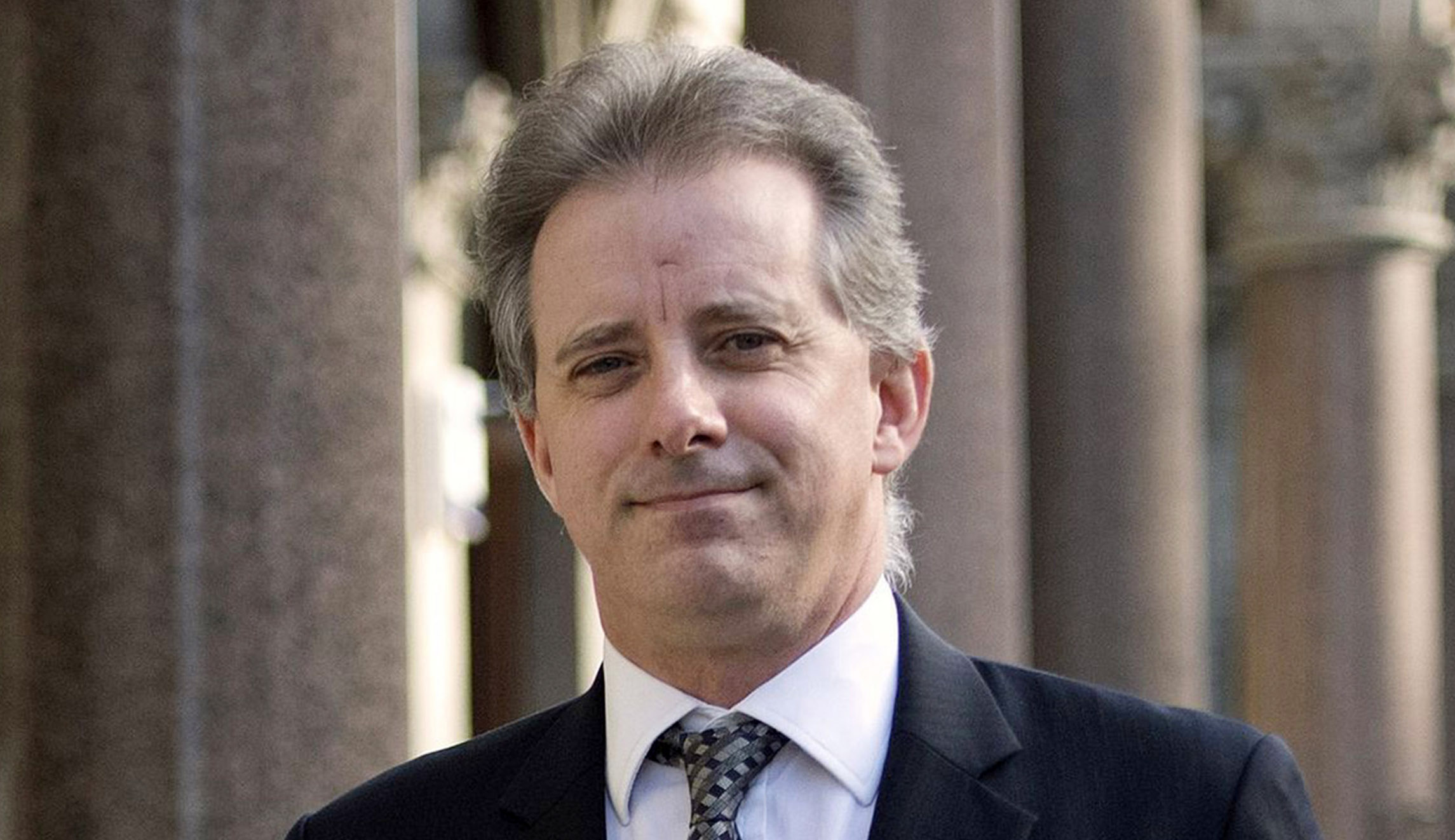
The Justice Department watchdog offered fresh insight into the role played by former British MI6 agent Christopher Steele in the Trump-Russia investigation, revealing the FBI assessed Steele as reliable but prone to poor judgment.
A lightly redacted report released Monday by Inspector General Michael Horowitz criticizes the FBI’s use of a dossier compiled by Steele, which contained unverified claims regarding President Trump and Russia, to obtain Foreign Intelligence Surveillance Act warrants to monitor onetime Trump campaign adviser Carter Page, an American businessman suspected of being a Russian asset.
Recommended Stories


Counter to what some Trump allies have alleged, Horowitz additionally determined that the genesis of the FBI’s counterintelligence investigation into Trump’s campaign, code-named “Crossfire Hurricane,” was unrelated to the dossier.
High-level Justice Department officials initially disapproved of moving ahead with FISA warrants against Page, expressing a need for more evidence that he was potentially working with Russia. Horowitz’s report shows the FBI got the green light after Steele’s research showed Page met with top Russian officials in Moscow in 2016.
As the FBI sought to determine the reliability of Steele’s research, officials met with one of his primary sources in January, March, and May 2017 that “raised significant questions about the reliability of the Steele election reporting,” according to the report.
The FBI also assessed that Steele may have judgment problems but was not prone to making up information, according to Horowitz’s report.
Peter Strzok, the disgraced FBI special agent who led the counterintelligence investigation into Trump’s campaign, told the inspector general that “Steele sometimes followed the ‘shiny object’ without a judgment about whether the shiny thing was really worth pursuing given the risks involved … but that Steele had no history of fabricating, embellishing, or otherwise ‘spinning’ information.”
During a meeting where Strzok briefed his team on information provided by Steele, officials were told that Steele “may have some judgment problems” but that the team could “continue to rely on reports for FISA.”
The inspector general report reveals the FBI also embellished Steele’s standing in the FISA applications.
Bill Priestap, a former top FBI official, and Strzok were told by a former employer of Steele’s that he had held a “moderately senior” position in Moscow, but the FISA documents refer to him as “high-ranking.”
The inspector general found the FBI’s counterintelligence investigation into Trump’s team was properly authorized, and there was no political bias influencing the investigation. But he also determined the bureau made “at least 17 significant errors or omissions” in the applications spanning from October 2016 to summer 2017.
Sunday night, on the eve of the FISA report’s release, the New York Times reported Attorney General William Barr approved the public release of details that had previously been redacted in Horowitz’s inquiry. People familiar with the situation claimed Steele was not told what the new info would be, nor was he given the chance to review or respond to the new information.
Horowitz began looking into possible government surveillance abuses in March 2018 after a memo from Republicans leading the House Intelligence Committee alleged the Justice Department and FBI misled the Foreign Intelligence Surveillance Court, which approved four warrants targeting Page, by not adequately disclosing the dossier’s Democratic benefactors and his bias against Trump.
House Intelligence Committee Democrats argued in a rebuttal memo that the FISA applications also contained evidence against Page that was not in the dossier, and the FBI “met the rigor, transparency, and evidentiary basis needed to meet FISA’s probable cause requirement.”
Steele’s career with the United Kingdom’s premier spy agency was often centered on Russia. Steele served under diplomatic cover at the British embassy in the early 1990s, where he admitted Russian intelligence tracked him closely. He was publicly outed online as a suspected MI6 agent in 1999. He then headed MI6’s Russia desk for years, leaving the spy agency in 2009 and founding Orbis Business Intelligence with Christopher Burrows, a fellow former British spy also outed the decade prior.
Before Steele, 55, provided claims on the Trump campaign to the FBI, the bureau worked with him for years, including on a FIFA corruption case.
Steele put together his dossier after being contracted in 2016 by Fusion GPS, an opposition research firm, which at the time was employed by Hillary Clinton’s campaign and the Democratic National Committee to collect information on Trump, paid through the Perkins Coie law firm.
Steele was removed by the FBI as a confidential human source in October 2016 because of improper disclosures to the media, although the bureau continued to use his dossier in court filings. Steele continued to communicate with the FBI through an unofficial back channel facilitated by Justice Department official Bruce Ohr.
Multiple officials have raised concerns about the sourcing in the dossier, which Steele acknowledged in a deposition was full of “raw intelligence.”
Barr told the Senate in May he was “concerned about” possible Russian disinformation in Steele’s dossier. Making an appearance as an impeachment witness in October, Trump’s former National Security Council Russia expert Fiona Hill testified that Steele’s dossier “very likely” contained Russian disinformation. And Daniel Hoffman, a former CIA Moscow station chief, told the Washington Examiner the Steele dossier was likely partly a product of Russian intelligence.
In Crime in Progress: Inside the Steele Dossier and the Fusion GPS Investigation of Donald Trump, the new book by Fusion GPS co-founders Glenn Simpson and Peter Fritsch, Steele said there is no way he was duped by the Kremlin and said his critics “have no idea what they are talking about.” Steele also contended that at least 70% of the assertions in his dossier were accurate.
