

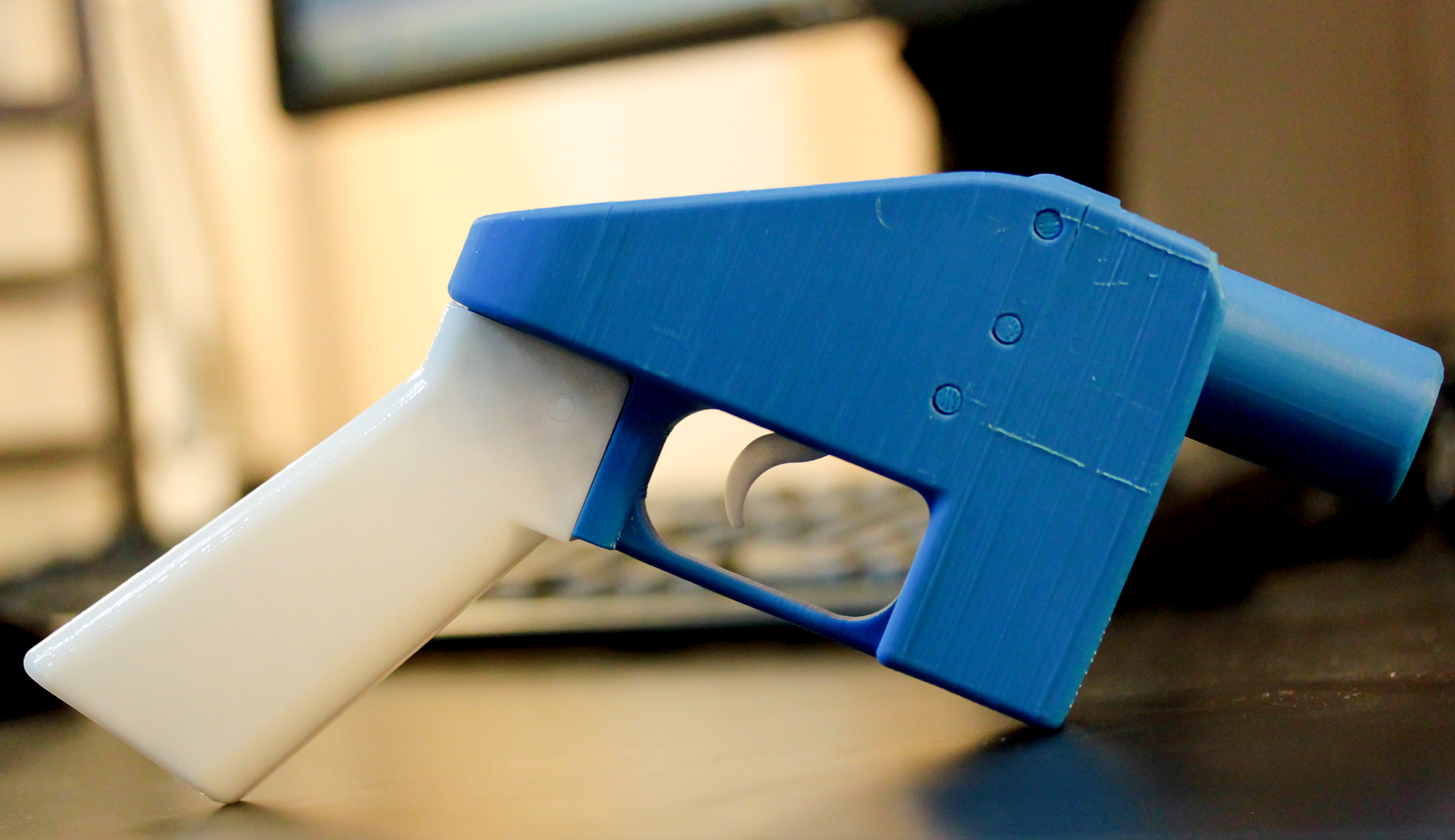
Texas-based Defense Distributed has indefinitely delayed plans to release new 3D printable gun files, an attorney for the group says, amid mounting political pushback and widespread complaints about inaccurate news reporting.
Many Democratic officials, joined by President Trump, have expressed unease about 3D-printed guns, with Trump tweeting Tuesday, “I am looking into 3-D Plastic Guns being sold to the public. Already spoke to NRA, doesn’t seem to make much sense!”
Recommended Stories


Defense Distributed decided Friday to delay publication of new printable gun files, attorney Josh Blackman told the Washington Examiner, before resistance to a planned Aug. 1 release date reached new intensity in Washington.
Blackman said the delay was made as part of litigation brought by state attorneys general. As reported Monday by the New York Times, the organization struck a deal with Pennsylvania “to bar state residents from downloading the plans.” But Blackman said it covers all states.
“We will not post any new files anywhere [tomorrow],” Blackman said.
Defense Distributed had planned to release new printable gun files Wednesday, saying on its website the date was when “[t]he age of the downloadable gun formally begins.” Sen. Bill Nelson, D-Fla., filed legislation to prevent the plan.
[Democrats blast Trump administration for 3D printed gun ‘death warrant’]
The group already republished a 3D printer file for the Liberator, a proof-of-concept, mostly plastic gun design published by Defense Distributor founder Cody Wilson in 2013. The Liberator file was downloaded 100,000 times in two days in 2013, before the State Department claimed it was an illegal arms export, resulting in a long court battle that ended this month.
Wilson told the Washington Examiner in an interview earlier this year that he felt unfairly singled out by the government. He pointed to many other 3D-printed gun designs available online, and that his gun was the only one that he know about being forced offline.
Ahead of a new wave of printable gun files, news outlets frequently confused Wilson’s offerings. He separately sells an auto-milling device that drills partially complete metal AR-15 lower receivers, making unregistered semiautomatic weapons. Other AR-15 parts can be purchased without government background checks or registration.
The AR-15 auto-milling software requires someone to buy a microwave-sized piece of equipment from Defense Distributed for $1,675, or to buy one second hand. Wilson told the Examiner this year that he sold about 200 Ghost Gunner machines on an average month, with sales surging after the February high school shooting in Parkland, Fla.
“The machine will live many different lives…. It continues to float around the market [and] who knows where they end up,” Wilson said. He said he believes a “very conservative” estimate would be that 25,000 to 30,000 AR-15s are in circulation because of his machine, the first generation of which was introduced in 2014.
Watch: AR-15 lower receiver finished with auto-milling machine:
Many news outlets confused the 3D plastic printing and metal auto-milling technologies.
The Times reported Monday that “blueprints for 3D printed AR-15 semiautomatic rifles” were downloaded 2,500 times after being published “late last week” by Defense Distributed. The firm only has files for auto-milling AR-15 parts, not 3D printing them, and the AR-15 files have long been available.
Newsweek published an article titled, “3-D Printed AR-15 Rifle Plans Have Already Been Downloaded More than 1,000 Times.”
Citing Pennsylvania Democratic Attorney General Josh Shapiro’s office, Newsweek reported that “[p]lans were meant to be available on the website starting on Wednesday, but according to a news release from Shapiro’s office they were leaked early and had been downloaded more than 1,000 times before Sunday. The plans were for AR-15 rifles.”
CNN reported, also citing Shapiro’s office, that “by Sunday more than 1,000 people had already downloaded plans to print an AR-15-style semiautomatic assault rifle.”
Watch: Liberator gun made with a 3-D printer:
Blackman told the Examiner there were no printable AR-15 files — only the files available for milling — but that he had not contacted the news outlets to request corrections. He said he does not know what style of printable gun files Wilson had intended to release this week.
Shapiro’s office did not respond to a request for comment.
Wilson also did not respond to requests for comment, nor did Alan Gura, a prominent Second Amendment litigator who has represented Defense Distributed.
Gura told the Washington Examiner earlier this year that the struggle over printable guns was largely about the First Amendment, as is deals with access to information.
“There is always the danger you can put science to an illegal purpose,” Gura said. “You can learn chemistry and make a bomb or illegal drugs, you can learn something about physics and make a nuclear weapon, but that doesn’t mean you can’t share scientific knowledge.”
