

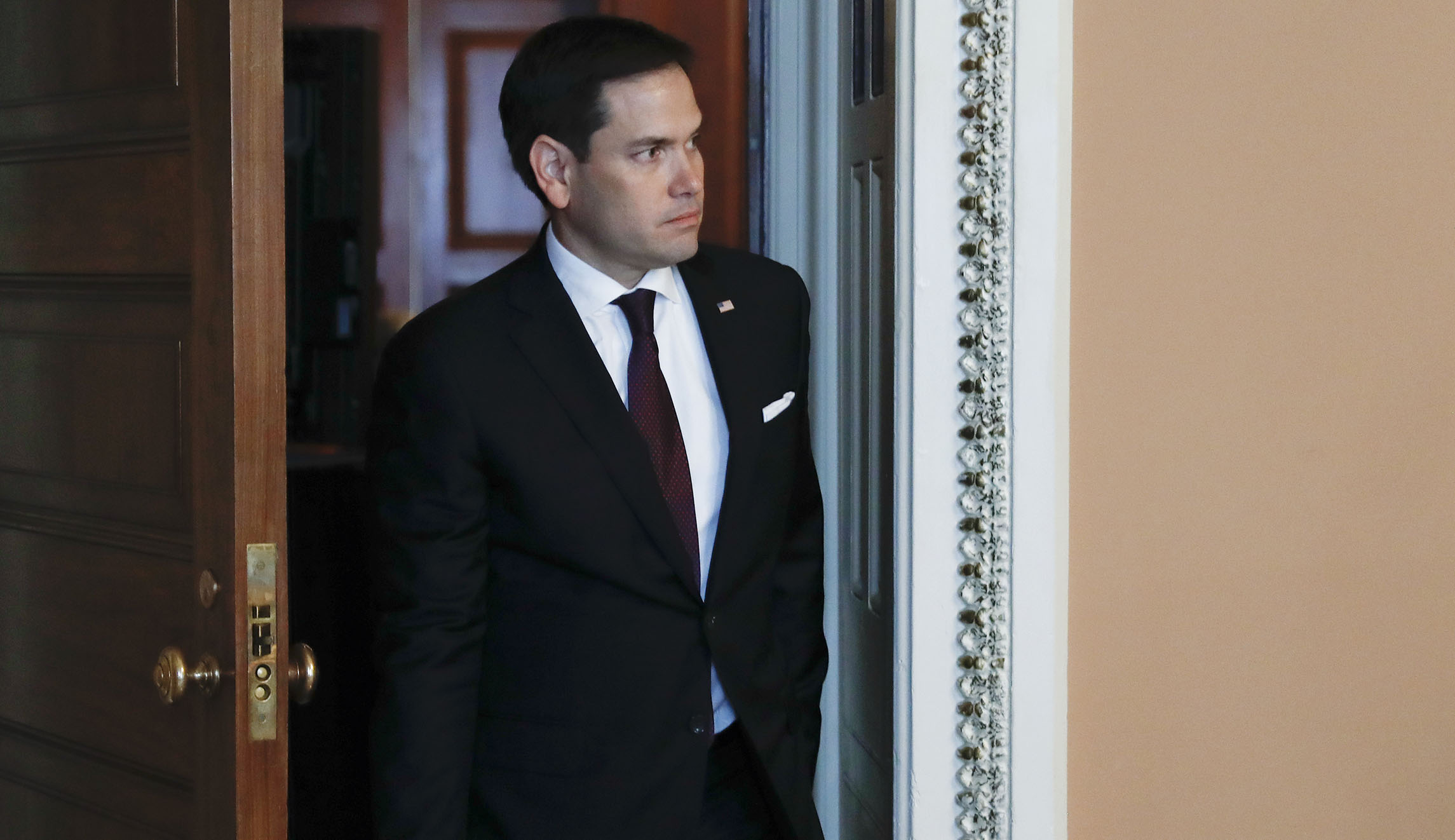
China knows more than it’s letting on about the latest apparent “sonic attack” on an American diplomat, according to Sen. Marco Rubio.
“I know that China knows what happens in their country,” the Florida Republican, who sits on the Foreign Relations and Intelligence committees, told the Washington Examiner. “The notion that something that sophisticated could happen without them either knowing who did it or doing it themselves is far-fetched.”
Recommended Stories


The State Department’s announcement that a U.S. official deployed to China “reported subtle and vague, but abnormal, sensations of sound and pressure” deepened what was already an ongoing mystery. More than two dozen American officials suffered various degree of brain injury due to mysterious and apparently similar attacks in Cuba, causing the Trump administration to make a permanent reduction in U.S. staff at the embassy in Havana.
“We had an officer who suffered a medical incident that is consistent with what happened to American officers that were serving in Havana,” Secretary of State Mike Pompeo told the Senate Foreign Relations Committee. “It’s gone from a localized incident to one that is much, much broader, and now the question is, ‘Where all might we see this?’”
Details of the incident remain sparse, even for lawmakers. “We don’t know too much about the last one in China, other than that something happened,” Rubio said.
President Trump blamed the Castro regime for the Cuba incidents, although the administration was open to the idea that a third-party nation might have carried out the attacks.
“The public evidence we have is consistent with two theories that are diametrically opposed: One is the Chinese are behind this, and the other is somebody is trying to frame the Chinese,” a Senate Republican aide told the Washington Examiner. “Are the Russians capable of screwing with our diplomats in Cuba and China in order to paint the Cubans or the Chinese? Of course they are. But are the Chinese capable of screwing with our diplomats in Cuba and [China] because they don’t like us? Of course they are.”
For Rubio, though, the distinction between those two scenarios is smaller than it might seem. “It happened in China, another closed society where it’s heavily monitored, so you would conclude that, at some point, the Chinese either did it or know who did it,” he said.
Whether through omission or commission, the injury to the State Department official is a manifestation of China’s subtle aggression, Rubio suggested. The announcement of Cuba-style attack came just a few weeks after the United States accused the Chinese military of using lasers to inflict “minor injuries” on two U.S. pilots deployed to Djibouti.
“I think it’s a strategy of incrementalism,” Rubio said. “They push and they push and they measure the global response and they keep pushing until the world sort of accepts it and they’ve established a new bright line.
