

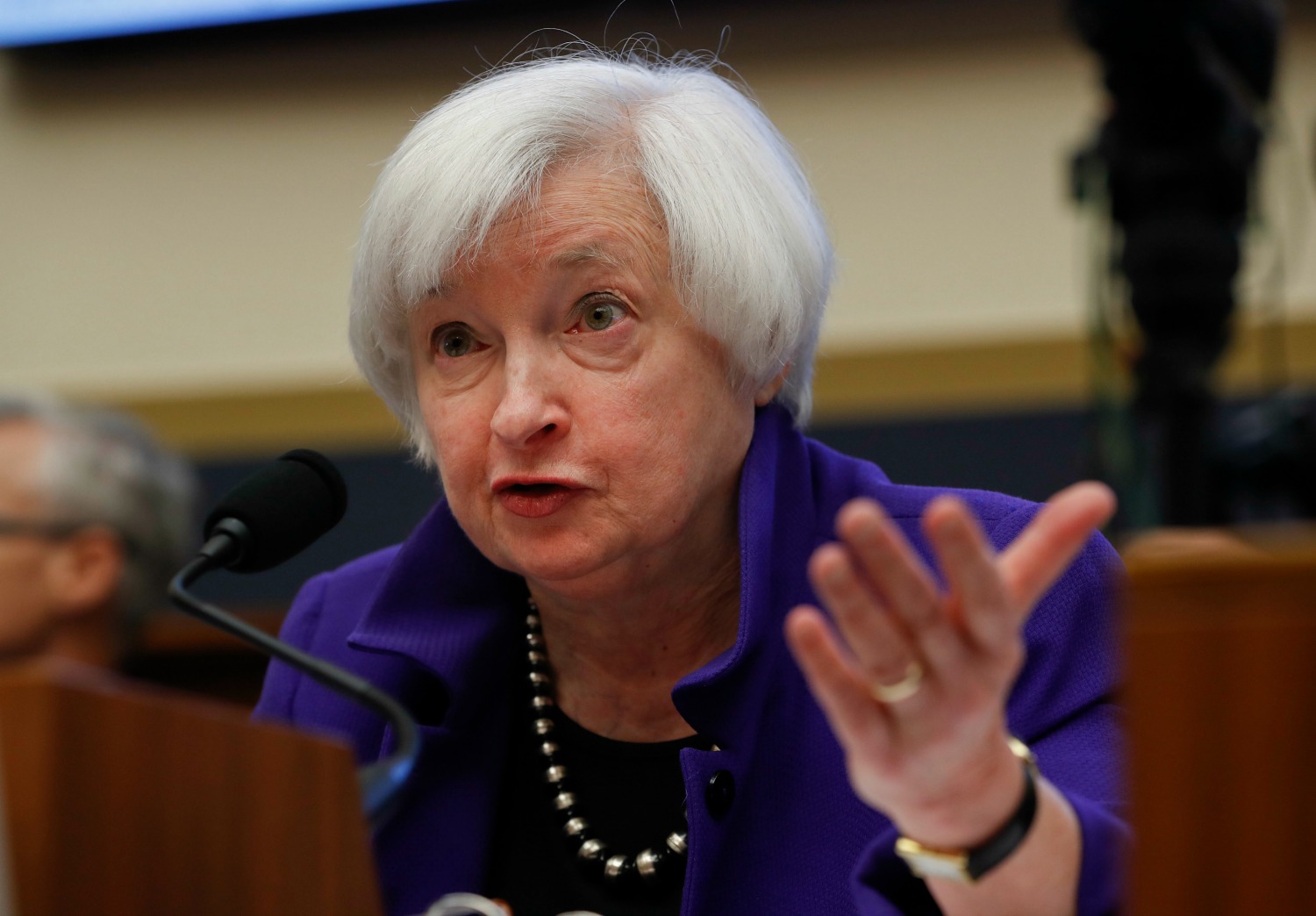
Facing sustained criticism from Republicans, Federal Reserve Chairwoman Janet Yellen is avoiding commenting on the presidential election or its implications for markets, a stance that could leave the central bank underprepared for the risks that some investors see in a Trump victory.
Ignoring an election with significant ramifications for U.S. economic policy is unusual for the Fed. Anything that could spook investors would generally be a reason for the central bank to exercise caution and delay raising rates. Just this year, the Fed has cited shaky global financial markets and the uncertainty generated by the anticipation of the United Kingdom’s Brexit vote to leave the European Union as reasons to stave off rate hikes.
But a U.S. election would be different for the Fed, which is keen to project an image of studious nonpartisanship and independence in the face of widespread skepticism of its role in government, particularly, recently, from Republicans. Maintaining that public presentation promises to be a difficult task for Yellen, given that the Fed has a monetary policy meeting scheduled for Nov. 1 and 2, a week before the Nov. 8 election.
“There’s no way she would ever explicitly call out election uncertainty as a variable in the monetary policy outlook,” said Keith Hembre, chief economist for Nuveen Asset Management.
“I’m not going to get into politics,” Yellen said last week during a press conference in Washington, when asked if the Fed was weighing the possibility that uncertainty about the election could hurt the economy. “Those are factors that we don’t consider, and I’m not going to get involved in commenting on the election.”
In other words, not only is Yellen avoiding picking sides or opining on the election, she’s also steering clear of the market implications of the election.
It’s clear that the Fed does take such scenarios into account in other circumstances. At its June meeting, for instance, officials declined to raise rates partly because they were worried about the possible market reaction to the “Brexit” vote. As it turned out, the “yes” vote caused massive swings in global markets.
In fact, politics may be restraining Yellen from preparing for a similar possibility following the U.S. elections. The politics have become heated: Last week, Donald Trump accused her before a television audience of millions of politicizing the Fed to aid Democrats. This past week, Yellen faced tough questioning from congressional Republicans about claimed conflicts of interest between the Fed and Hillary Clinton’s campaign.
Another possibility, however, is that investors are simply not worried about the outcome of the election and that there is not as much for the Fed to worry about as there was, for instance, in the lead-up to the British vote.
So far, there are few signs of rising uncertainty, said Scott Baker, an economist at Northwestern’s Kellogg School of Management. Baker is one of the creators of an index that measures uncertainty about future government policy based on news headlines and other factors.
The lack of market response to the election could reflect the possibility that investors are already pricing in a Clinton victory. “Given that Hillary seems to be the more ‘establishment candidate,’ say, and supporting more of the existing policies in a lot of dimensions, it might be the case that if Trump did win, it certainly would be a surprise to the market and generate uncertainty,” Baker said.
In that case, uncertainty would spike only after Trump’s election, as it did following the surprise victory for Brexit. In that scenario, stock prices could fall if investors repriced assets to take into account the probability that some of Trump’s policies actually take effect. A recent Moody’s analysis laid out the fear that the economy could tip into recession if Trump succeeded in cutting off trade deals and deporting illegal immigrants on a large scale.
Yet it’s also possible that investors just don’t see much risk in the prospect of a Trump presidency. That was the conclusion of a separate Moody’s analysis released Friday that compared changes in stock markets to changes in bettors’ odds of a Trump victory. The study found that Trump’s odds were not correlated with market movements, and that investors “suggest no economic costs from the election.” It also discovered that past elections had little effect on markets.
Some anecdotal evidence points the other way. For example: The Mexican peso’s value, relative to the dollar, soared during the presidential debate as Trump struggled, suggesting that the currency is highly influenced by the odds of a Trump presidency. Trump has pledged to transform U.S.-Mexico relations and, in particular, build a wall on the U.S.-Mexico border. Some analysts blamed the movement on other factors, but Bank of Mexico governor Augustin Carstens attributed it to Trump. Carstens said that Trump would be a “hurricane of much higher intensity” in a radio interview Friday, according to Bloomberg.
“A Trump victory … will likely be greeted by a sharp sell-off in risk assets,” Steven Ricchiuto, chief economist for Mizuho USA, wrote in a note Friday. The fact that neither candidate has a clear edge now is allowing investors to prepare for either scenario, he explained.
