

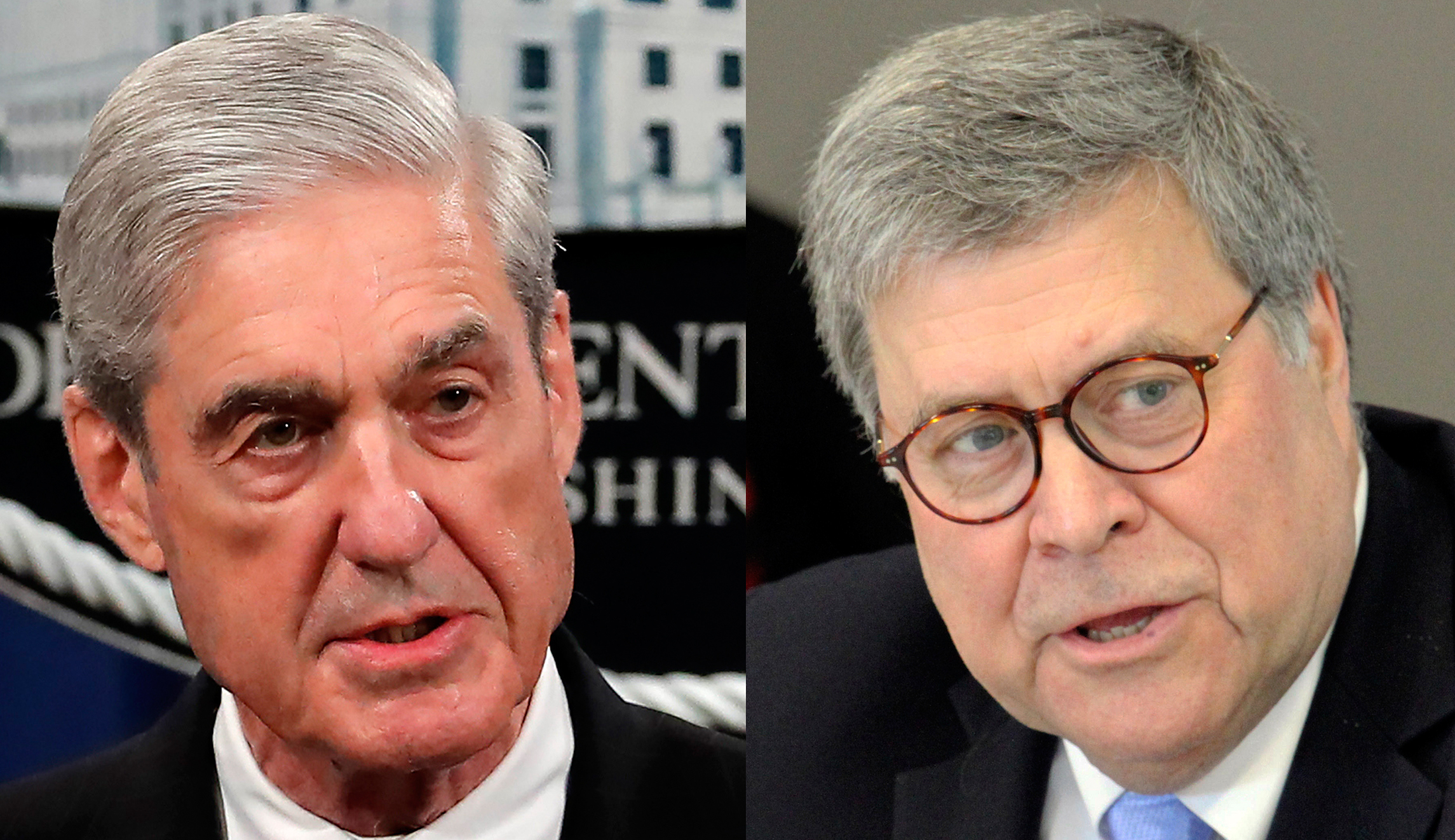
Attorney General William Barr said he believes special counsel Robert Mueller could have made a decision about whether President Trump obstructed justice as part of his 22-month-long investigation into Russian interference in the 2016 election.
One day after Mueller delivered a public statement on his findings, Barr contradicted the reasoning the special counsel gave about why he did not make a determination on obstruction.
Recommended Stories


“I personally felt he could’ve reached a decision,” Barr said during an interview with CBS on Thursday. Barr said Mueller “had his reasons for not doing it” but declined to explain. “I’m not going to, you know, argue about those reasons,” he said.
Mueller, both in his report and in his public statement, contended that he “did not make a determination as to whether the President did commit a crime” due to a Justice Department Office of Legal Counsel opinion that precludes a sitting president from being charged with a crime.
Barr disagreed with that reasoning. “The opinion says you cannot indict a president while he is in office, but he could’ve reached a decision as to whether it was criminal activity,” he said.
The attorney general said that when Mueller did not reach a conclusion on obstruction of justice, he “felt it was necessary” for himself and then-Deputy Attorney General Rod Rosenstein “to reach that decision.” Barr and Rosenstein concluded that there was insufficient evidence to show Trump had committed obstruction of justice.
Asked about the whether Mueller suggested that Congress should take up his investigation, Barr pushed back, emphasizing that it is the job of the Justice Department to decide whether crimes had been committed. “I’m not sure what he was suggesting,” Barr said. “But the Department of Justice doesn’t use our powers of investigating crimes as an adjunct to Congress.”
NEW: Attorney General Barr tells @JanCBS he “personally felt” Special Counsel Robert Mueller “could’ve reached a decision” on obstruction of justice by President Trump.
More on @CBSEveningNews tonight and @CBSThisMorning Friday. #CTM pic.twitter.com/b8ik2q32ZK
— CBS This Morning (@CBSThisMorning) May 30, 2019
Mueller did not reach a conclusion about obstruction, but he did lay out 10 scenarios that his team examined in his 448-page report. Democrats argue this gave them a roadmap to continue the inquiry. Rank-and-file Democrats and 2020 candidates for president have called for impeachment proceedings, but House Speaker Nancy Pelosi, D-Calif., has so far been resistant to such calls.
Trump seized on Mueller’s statement by declaring “the case is closed,” but many politicians, pundits, and journalists saw it differently and predicted an protracted fight between Congress and the Justice Department that would be fueled by a break between Mueller and Barr.
Although Barr says he does not think Mueller came up with his decision on obstruction in exactly the right way, the two put up a united front late Wednesday to end speculation that Mueller, during his press conference, contradicted Barr during his press conference about how he went about handling the obstruction issue.
“The Attorney General has previously stated that the Special Counsel repeatedly affirmed that he was not saying that, but for the OLC opinion, he would have found the President obstructed justice. The Special Counsel’s report and his statement today made clear that the office concluded it would not reach a determination — one way or the other — about whether the President committed a crime. There is no conflict between these statements,” a joint statement from DOJ spokeswoman Kerri Kupec and Mueller spokesman Peter Carr said.
Weeks before Mueller submitted his final report to the Justice Department, Barr met with the special counsel on March 5.
Barr testified on May 1 that he was “surprised” to learn from Mueller that his team of more than a dozen prosecutors would not make a determination about obstruction.
Barr said he asked Mueller to give him a reason, but the special counsel told him that his team was still formulating an explanation. He said Mueller also brought up the Office of Legal Counsel opinion during that meeting.
“Special counsel Mueller stated three times to us in that meeting, in response to our questioning, that he emphatically was not saying, but-for the OLC opinion, he would’ve found obstruction,” Barr told the Senate Judiciary Committee. “He said that in the future, the facts of the case against the president might be such that the special counsel would recommend abandoning the OLC opinion, but this is not such a case.”
