

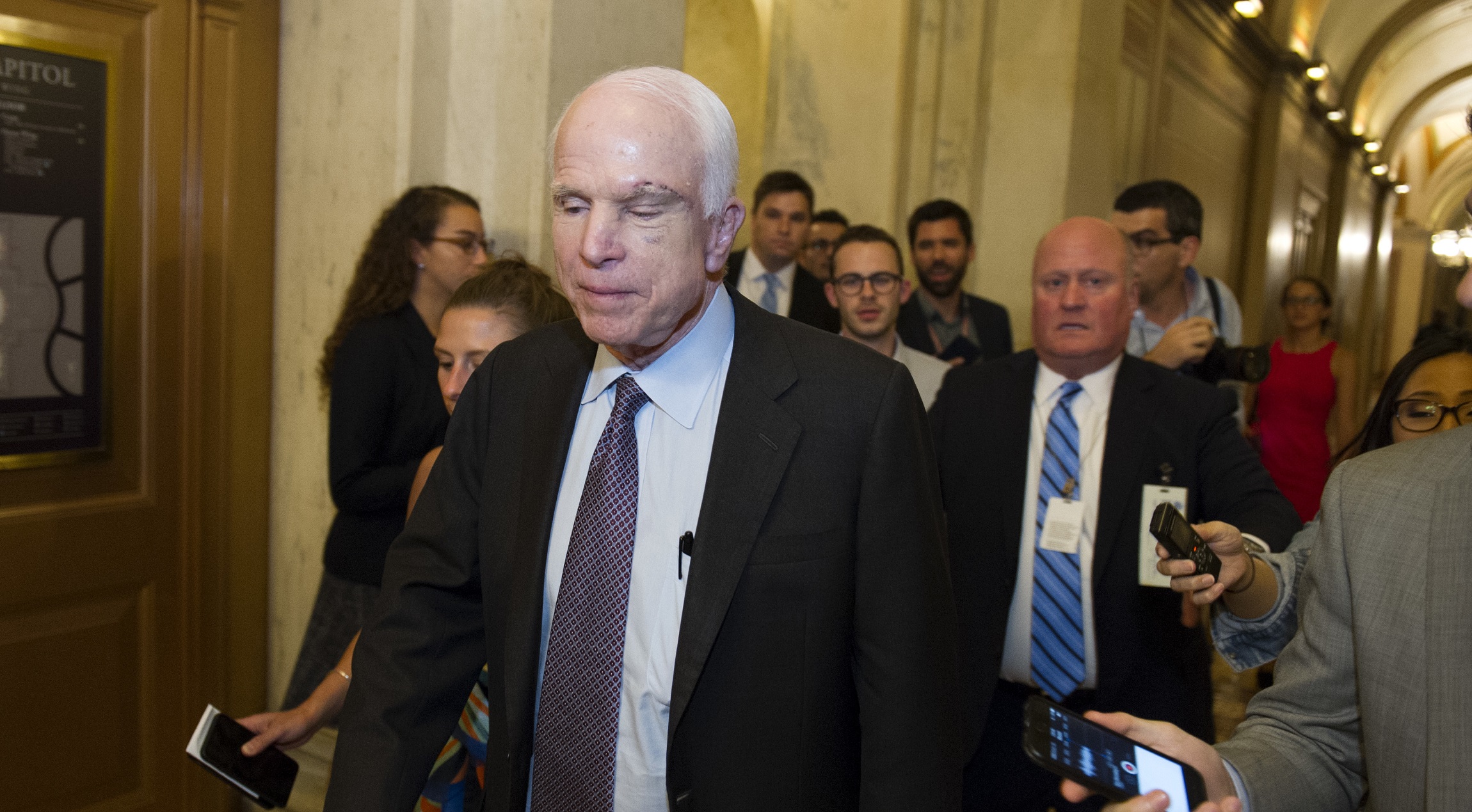
Sen. John McCain delivered an unexpected “no” vote in the early hours of Friday morning that helped defeat an amendment to repeal portions of Obamacare, and said later in a statement that he did so because he wasn’t confident that the bill eventually would not become law.
The bill, which removed only parts of Obamacare, was being pitched to Republicans as a vehicle to get something out of the Senate and into a conference with the House where senators hoped it will be improved into a more comprehensive replacement of Obamacare.
Recommended Stories



McCain, R-Ariz., however, said he was concerned because there was no guarantee that the House would not send the bill directly to President Trump’s desk. A statement issued by House Speaker Paul Ryan, R-Wis., did not assuage his concerns.
“The Speaker’s statement that the House would be ‘willing’ to go to conference does not ease my concern that this shell of a bill could be taken up and passed at any time,” he said.
Others had shared his concerns, including GOP Sens. Lindsey Graham of South Carolina and Ron Johnson of Wisconsin, but were won over after a phone call with Ryan.
Unveiled only hours earlier, the bill was formally known as the Health Care Freedom Act but dubbed a “skinny repeal” of Obamacare, because it merely made a few modifications to the law. Still, a Congressional Budget Office analysis projected that by 2018 premiums would rise by 20 percent and that 16 million more people would be uninsured.
Ahead of a dramatic vote that was in doubt until the final minutes, Vice President Mike Pence was seen working McCain in the Senate chamber. McCain flew into Washington this week from Arizona, where he was resting after a diagnosis with brain cancer, to participate in healthcare votes.
After he flew in on Tuesday, he voted to advance debate on Obamacare repeal, and then delivered a speech to his colleagues about the importance of working together. He echoed similar sentiments on Friday.
“We must now return to the correct way of legislating and send the bill back to committee, hold hearings, receive input from both sides of the aisle, heed the recommendations of nation’s governors, and produce a bill that finally delivers affordable healthcare for the American people,” he said.
The legislation the Senate was looking to pass, he said, would not lower costs, improve competition or improve care.
