

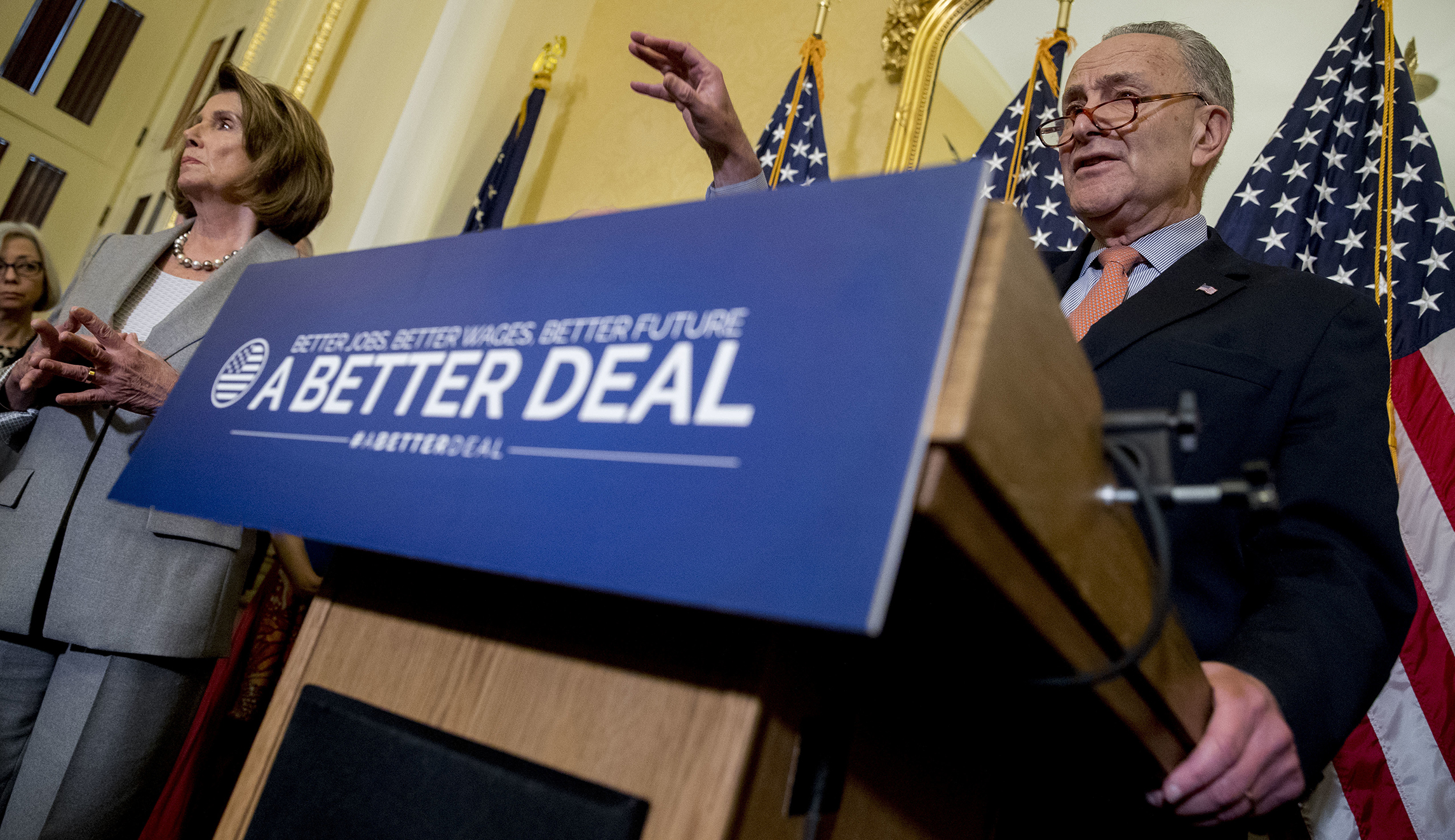
The Democratic leadership united Wednesday to end all state right-to-work laws, saying labor unions need to be protected from their impact.
The Democrats’ agenda would strip the workers in 27 states of the right to refuse to join or otherwise financially support a union as a condition of employment.
Recommended Stories



Senate Minority Leader Chuck Schumer, of New York, House Minority Leader Nancy Pelosi, of California, and other top party officials joined with top labor leaders Wednesday to announce their joint “A Better Deal” agenda to boost the union movement. A key plank in the agenda is “Ban state laws that undermine worker freedoms to join together and negotiate,” which the agenda later identifies as right-to-work laws.
“These laws — often misleadingly called ‘right to work’ laws — do not give anyone the right to a job; they merely weaken unions by starving unions of the compensation they need to get their job done,” the agenda states. “A Better Deal will end these special-interest laws and ensure that workers have the freedom, and resources, to build a future for themselves and their families.”
Right-to-work laws specifically prohibit private-sector union-management contracts that require employers to fire a worker who refuses to join a union or pay it a regular fee. Such provisions are dubbed “security clauses” by unions and are a key source of revenue for them. Unions argue they are owed the fees to compensate for collective bargaining on behalf of the workers. In states where the practice is prohibited — 27 have laws against it — unions often struggle to keep members and their dues money. Democrats said the laws have accounted for 10 percent drops in union membership in the states where they were recently adopted.
It is not just the private sector, noted Lee Saunders, president of the American Federation of State, County and Municipal Employees. He noted that the Supreme Court is taking up a case called Janus v. American Federation of State, County and Municipal Employees that challenges the 1977 Abood v. Detroit Board of Education precedent that said public-sector workers could be obligated to back unions. “The entire public sector could be under right-to-work by next spring thanks to the Supreme Court,” Saunders said at Wednesday’s event, adding that he “appreciated” the Democrats for including the ban in their agenda.
It was the only direct reference to right-to-work during the event, however. Democrats generally stuck to more general claims that the union movement was under attack.
“The No. 1 reason for the decline of the middle class is the assault on unions and labor that has come over the last 30 years. Labor created the middle class,” Schumer said.
Unions are major Democratic Party donors, so losing that funding could severely hurt the party as well. Organized labor gave Democrats more than $59 million in the 2016 election cycle alone, according to the Center for Responsive Politics. Conservative groups put the total unions give to Democrats, various liberal activist groups and political action committees between 2012 and 2016 at $765 million.
Business groups and Republicans generally back right-to-work laws, arguing they give states an edge in attracting business and that joining a union should be a choice left to individual workers, not employers and union leaders acting together.
“Let’s be clear what this is really about: Big Labor knows the only way they’re going to get a ‘better deal’ is at the expense of worker rights,” said Bethany Aronhalt, spokeswoman for the House Education and the Workforce Committee.
Five states have adopted the laws in the last five years, and and a sixth, Missouri, will have a ballot referendum on adopting one next year. The laws’ spread has alarmed Democrats and labor groups. Democratic Sens. Elizabeth Warren, D-Mass., and Sherrod Brown, D-Ohio, introduced legislation this year to amend the National Labor Relations Act to prohibit right-to-work laws.
