

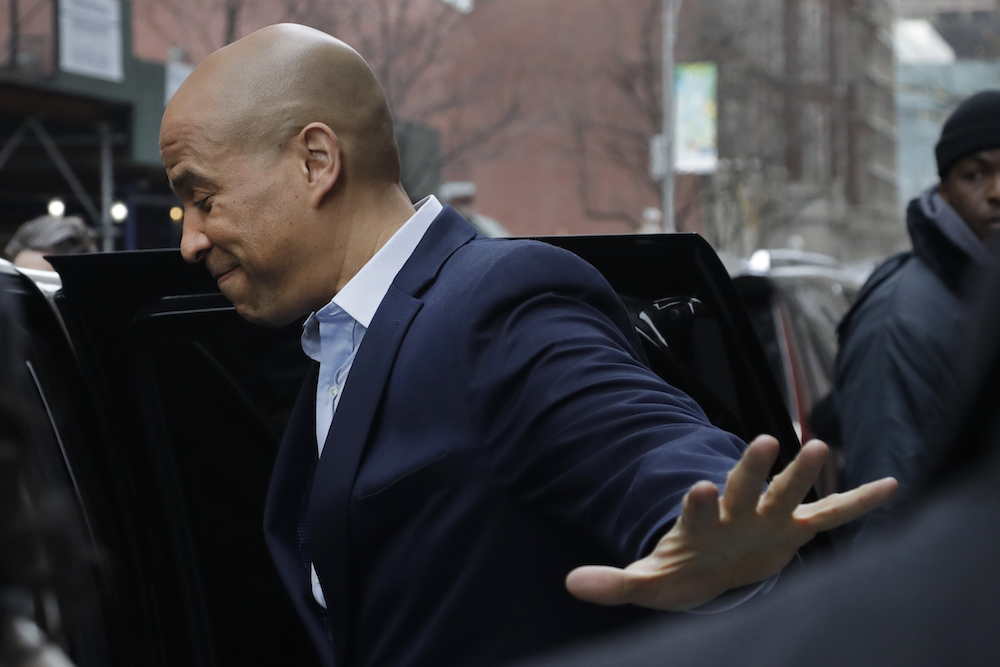
When Cory Booker jumped into the 2020 presidential race on Friday, he promised to build his campaign the “right way,” without money from corporate political action committees and federal lobbyists.
The millions of dollars in donations he accepted from Wall Street in the past, however, and his defense of Mitt Romney’s Bain Capital in 2012 may still come back to haunt him.
Recommended Stories


“I’m not about to sit here and indict private equity,” he said during a “Meet the Press” interview while still mayor of Newark, N.J. At the time, Obama’s presidential campaign was attacking Romney, who ultimately lost, in an ad describing him as someone who “takes from the poor and the middle class and gives to the rich.”
To be sure, Booker subsequently changed tack, blasting GOP efforts to take advantage of his statements and reaffirming his support for Obama, saying the president’s campaign had a right to scrutinize Romney’s characterization of himself as a job creator.
And in the Senate, he opposed a compromise bill passed last year rolling back some of the restrictions on Wall Street imposed under the Dodd-Frank reform law in 2010.
“In the wake of the greed- and excess-fueled financial crisis, big banks got a massive bailout while millions of Americans lost their homes,” he said in March. “We shouldn’t be weakening the very safeguards put in place to prevent such a catastrophe from repeating itself.”
Still, the finance industry contributed $2.8 million to Booker’s Senate campaign in 2014, with some of the largest donations coming from employees of three of the country’s biggest banks, according to records compiled by the Center for Responsive Politics.
Workers at Goldman Sachs gave $80,400, compared with $78,120 from employees of Morgan Stanley and $64,582 from employees of JPMorgan Chase.
Law firms with major securities-industry practices gave even more: Attorneys at Paul Weiss chipped in $177,020 while their peers at Sullivan & Cromwell donated $137,950.
Booker’s haul, which has already drawn scrutiny from progressives, far outstripped the industry’s contributions to any of his Democratic peers campaigning to move from the Senate to the White House in 2020.
Sen. Kirsten Gillibrand of New York, whose state is home to the headquarters of banks from Goldman to Citigroup, garnered only $1.15 million from the industry in her 2018 race.
Sen. Kamala Harris of California drew only $727,674 from Wall Street in her 2016 campaign, while Sen. Elizabeth Warren of Massachusetts received just $355,271 in her re-election campaign last fall.
