

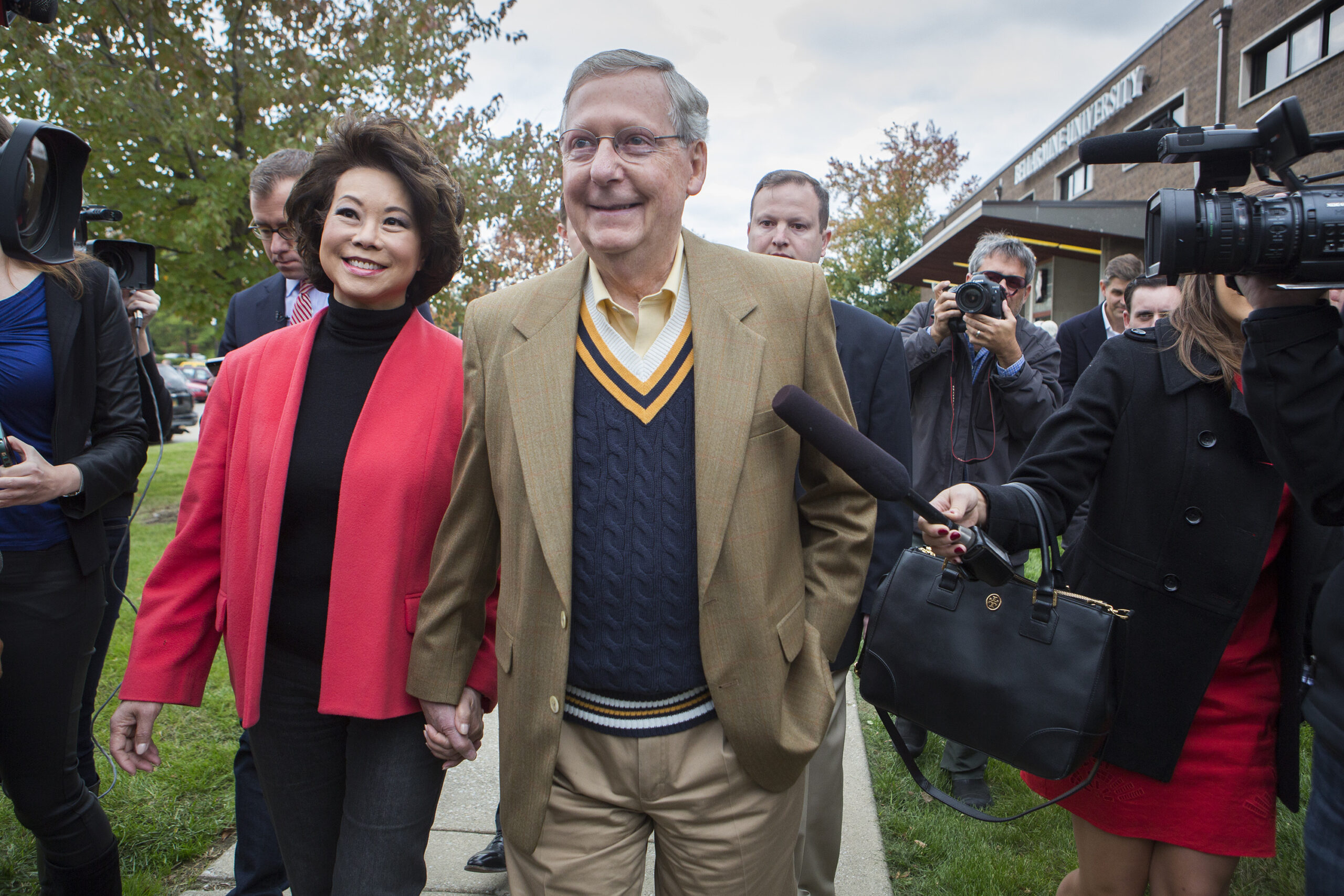
LOUISVILLE, Ky. — Republican Mitch McConnell defeated Democrat Alison Lundergan Grimes on Tuesday in a race that positioned him to become the next majority leader of the U.S. Senate.
The expensive, hard-fought race was called by CNN as soon as the polls closed, with McConnell leading 55 percent to 42 percent with just 8 percent of precincts reporting. He ultimately won by 15 points, among the best showings of his career. In his victory speech, McConnell said his race against Grimes was not about the two candidates vying for a Senate seat rather “a government that can’t be trusted” and is “too busy imposing its view of the world on people who don’t share that view.”
“Too many in Washington have forgotten that their job is to serve,” McConnell said.
The outcome of the battle for Senate control wasn’t known when the 72-year-old Senate minority addressed a crowd of supporters Tuesday evening inside a Louisville hotel ballroom. But about an hour after McConnell left the stage and retired for the night, Republicans had won more than the six seats they needed to replace Sen. Harry Reid, D-Nev., as majority leader — a job that has been his long-term goal.
McConnell, who has said a GOP-controlled Senate would aim to strike a conciliatory tone, said Tuesday night that the two parties have an “obligation” to work together. “Just because we have a two-party system doesn’t mean we have to be in perpetual conflict,” he said. “I think I’ve shown that to be true at critical times in the past. I hope the president gives me the chance to show it again.”
Just to retain his seat was a serious battle for McConnell. In a year when the White House was not up for grabs, McConnell’s defeat was the highest prize sought by the Left in general and by Hollywood moguls in particular.
He had to scrape and claw through what supporters say was perhaps the toughest campaign of his three decades in the Senate. He only recently managed to establish a clear lead over Lundergan Grimes after trailing her earlier in the year.
In the days before the election McConnell set it up as a referendum on President Obama, saying, “Most people in my state — and I hope around the country — believe that we need to go in a different direction. If you want to go in a different direction, there’s only one thing that can be accomplished in 2014, and that’s to change the Senate make me the leader of a new majority.”
The Bluegrass State tends to vote Republican in statewide federal races, and Obama’s approval rating here is among the lowest in the country. The issues favored McConnell, too, particularly anger in Kentucky coal country over Obama’s environmental policies.
But there are more registered Democrats than Republicans in this culturally conservative bastion, and Democrats have been successful in races for state office. The sitting governor is popular Democrat Steve Beshear. That, combined with McConnell’s own low job approval and his position as a national party leader when the public hates Washington, produced a toxic political atmosphere for the five-term senator.
Grimes, 35, secretary of state and scion of a powerful Kentucky Democratic family close to Bill and Hillary Clinton, tried to exploit McConnell’s weaknesses. The Clintons were a frequent presence in Kentucky as they campaigned for Grimes. They paid more personal attention to her than to any other Democrat running for Senate.
Grimes was a tentative campaigner and often appeared too scripted. Her lack of fluency on national and international issues damaged her long before her prospects were mortally wounded by her refusal to say whether she voted for Obama in 2008 and 2012.
But Grimes had the potential to outflank her sometimes dour, stiff Republican opponent by appealing to voters with a more likable, upbeat image.
Grimes was briefly helped by wealthy businessman Matt Bevin, a Tea Party Republican who spent about $5.5 million to dislodge McConnell in the primary. It forced the incumbent to fight on two fronts, against a restless conservative base on the right and the Democratic establishment on the left that was happy to open its wallet for Grimes.
“It was certainly unique among the challenges he’d ever faced,” said Billy Piper, McConnell’s former chief of staff and a veteran of the senator’s campaigns.
The Center for Responsive Politics, which tracks fundraising and spending in congressional races, reported Tuesday that Grimes had raised nearly $17.5 million. Democratic groups dumped another $10 million into the race. McConnell raised almost $28 million. Although national GOP political committees stayed out of Kentucky at McConnell’s request, allied conservative groups, including a super PAC organized to support the senator, spent more than $15 million in the campaign.
McConnell, never hesitant to play hardball, began his campaign four years ago by reaching out to Rand Paul the day after the Tea Party favorite beat McConnell’s preferred candidate, then-Secretary of State Trey Grayson, in the 2010 GOP Senate primary.
McConnell had filmed a television ad for Grayson in that campaign’s final days, but his influence over the Kentucky Republican Party, which he had built from nothing, was eclipsed by Paul’s rising star power.
McConnell quickly made nice. Josh Holmes, his chief of staff, advised Paul during his 2010 general election, and McConnell and Paul have developed a strong personal and professional bond in the Senate. This led first to a productive alliance on Capitol Hill and then to a durable compact on the 2014 campaign trail. With Paul at his side, McConnell forestalled the possibility of an effective Tea Party rebellion against him.
Jesse Benton, a senior Paul adviser, was hired as McConnell’s campaign manager and served in that role until early this year when Holmes, the senator’s chief campaign decision-maker, took over. McConnell defeated Bevin, 60 percent to 35 percent, in the GOP primary. By the time Tuesday’s general election rolled around, a solidified GOP base served as the foundation of McConnell’s win over Grimes.
How much does McConnell value his collaboration with Paul? On Monday, the final day of campaigning before Election Day, the only two public figures on his plane for a seven-city campaign blitz were his wife, former Labor Secretary Elaine Chao, and Paul.
McConnell held his final rally in Bowling Green, Paul’s hometown.
“Rand and Mitch have teamed up in the Senate to give Kentucky the most powerful senators of any state in our country, and Rand and [his wife] have been incredible friends to us,” Chao told a crowd of McConnell supporters Monday during a campaign swing through Louisville.
In some ways, McConnell aides are now willing to say, the primary challenge from Bevin was a blessing.
It forced McConnell to ramp up early and allowed his team to test its political strategy and field operations. The elements that worked were kept and refined; those that didn’t were dropped. McConnell hired more than one pollster to guard against data misfires, while assembling what campaign insiders say was a presidential-level communications strategy and data and voter turnout operation. When Grimes announced her candidacy, McConnell’s operation was already running at full speed when it otherwise might not have been.
Much has been written about the millions of dollars worth of campaign ads that flooded Kentucky’s airwaves this year. What was underreported was McConnell’s approach to getting his message out to the state’s dozen media markets. Rather than running single spots for statewide consumption, McConnell, as the Obama campaign famously did in 2012, aired spots specifically tailored to each locality.
CMAG, the campaign data analysis group, trumpeted McConnell’s ad strategy in a tweet posted Oct. 30.
“CMAG @CMAGAdFacts · Oct 30
Wow. In #kysen @Team_Mitch had 17 unique ads on the air yesterday. For context, Obama’s 2012 PREZ campaign had around 20 up on any given day.”
On the ground, McConnell’s team ran a modern, data-driven effort that identified the universe of voters favorable to the senator’s candidacy. At the outset a crucial decision was made to integrate all categories of supporters — donors, grassroots volunteers, etc. — into one list. It sounds simple, but it’s something Republicans have been slower to embrace than Democrats.
Through mid-October, the McConnell campaign made it a priority to secure voters identified as persuadable but not yet sold, after which the campaign shifted into straight turnout mode. Kentucky only allows absentee voters to cast ballots by mail, so a lot of work took place over the final 72 hours of the campaign to make sure McConnell supporters showed up at the polls on Election Day.
But McConnell’s secret sauce was probably the way his campaign rehabilitated his image with many voters. The campaign’s final internal and public opinion polls suggested he might win more women’s votes than Grimes.
McConnell is a political brawler known for his ferocity. Yet he used positive campaign spots to gain popularity. In the closing weeks of the campaign, McConnell insiders estimated they almost ran as many positive ads as negative ones. In a Survey USA poll for the Louisville Courier-Journal in January, McConnell’s favorable-unfavorable rating was an abysmal 27 percent to 50 percent. In the last Survey USA poll of the race, his favorable ratings had jumped 10 points, and he was beating Grimes among women 47 percent to 43 percent.
Noelle Hunter, a Democrat-turned-Republican African American woman who filmed a testimonial ad for McConnell, said the senator’s Washington image masks a softer, empathetic side that voters can relate to. Some years back, Hunter’s daughter was abducted by her father and taken to Africa. McConnell helped Hunter get her daughter back, and she said she is not surprised that Kentucky voters ultimately came around to supporting him for a sixth term.
“The thing that I understand about him, which I didn’t know before I met him … he has a pretty tender heart. He’s compassionate,” Hunter said Monday during a brief interview with the Washington Examiner. “I guess by virtue of where he has to be in the Senate that doesn’t always come across.”
This article has been updated.
