

The Trump administration’s sped-up war on the coronavirus, 43 moves so far, is aimed at reaching the highest recovery rate possible and even matching that of South Korea.
Surgeon General Dr. Jerome Adams today set the Asian nation as a model that the administration is aiming for, as opposed to the disaster unfolding in Italy.
On NBC’s Today show, he urged people to stay close to home, six feet away from others, and stay clean, efforts he said could reduce the infection rate and boost recovery.
“We want them to understand that, look, chances are they don’t have the coronavirus. Chances are that if you do have it, you will recover based on the Korea data — 99.3% of people recover. But what we don’t want to do is have you or anyone else out there spreading it to people who are at high risk,” said Adams.
Officials believe that more and more people are heeding federal and state cautions on the virus, though the administration continues to be criticized for its actions.
Most of the White House has been put on coronavirus duty. They are working with Vice President Mike Pence’s task force to settle on daily changes and initiatives to quell the crisis.
And they are also looking at the messaging with an eye on President Trump’s approval rating and the upcoming reelection campaign.
Trump has taken a slight hit in his approvals, though mostly among independents, not partisans. Gallup today said that its Trump’s approval rating dropped from 49% after impeachment to 44% today. The drop came mostly from independents, whose approval rating of Trump fell from 42% to 35%.
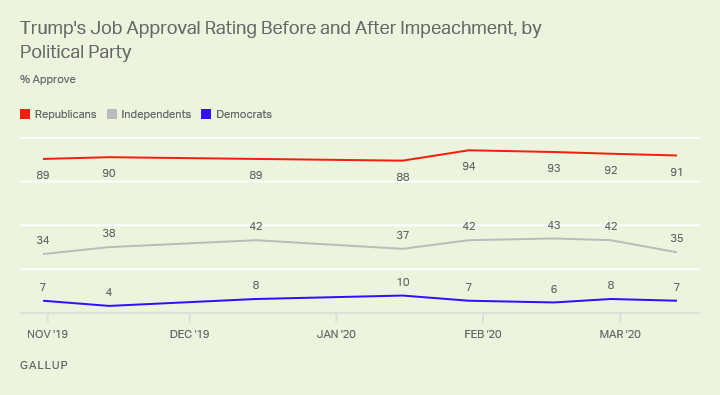
“The president’s approval rating has been elevated due to higher ratings from Republicans and independents since it was clear that he was going to be acquitted in his impeachment trial in the U.S. Senate. While Trump’s approval rating among Republicans (91%) and Democrats (7%) remains stable, independents’ approval fell seven points in the last two weeks to 35%,” said Gallup.
One official said that the daily briefings by Trump, Pence, and others on the virus have helped to keep approval ratings from falling, and each day, they distribute talking points and lists of responses to media, surrogates, and supporters.
The latest list of responses to the virus includes 43 key moves, listed below:
WHOLE-OF-GOVERNMENT RESPONSE
- President Trump signed legislation securing $8.3 billion for coronavirus response.
- President Trump declared a national emergency, inviting states, territories, and tribes to access over $42 billion in existing funding.
- To leverage the resources of the entire government, the president created a White House Coronavirus Task Force to coordinate response.
- The vice president named Dr. Deborah Birx to serve as the White House Coronavirus Response Coordinator.
TRAVEL RESTRICTIONS
- In January, President Trump reacted quickly to implement travel restrictions on travel from China, buying us valuable time to respond to the virus.
- The president has announced further travel restrictions on global hot spots, including Europe, the United Kingdom and Ireland, and Iran.
- American citizens returning from travel-restricted countries are being routed to specific airports, where they can be screened and isolated as needed.
- The administration raised travel warnings to their highest level for other hot spot locations, like Japan and South Korea.
- The president has expanded airport screenings to identify travelers showing symptoms and instituted mandatory quarantines.
EXPANDING TESTING ACCESSIBILITY
- The FDA issued emergency approval for new commercial coronavirus tests to significantly expand testing across the country.
- The president secured legislation that will ensure Americans are able to be tested for free.
- The administration is working with state and local partners and the private sector to open up drive-through testing sites.
- The administration is working with the private sector to develop a website that Americans can utilize to determine whether they need a test and, if so, where to get it.
- HHS is providing funding to help accelerate the development of rapid diagnostic tests for the coronavirus.
- The FDA cut red tape to expand testing availability.
- The administration is working to provide states with flexibility to approve coronavirus testing laboratories.
- Admiral Brett Giroir — the Assistant Secretary for Health and head of the Public Health Service — has been appointed to coordinate coronavirus testing efforts.
HELPING IMPACTED BUSINESSES
- The Small Business Administration has announced disaster loans which provide impacted businesses with up to $2 million.
- The president has met with bank executives, insurers, pharmaceutical executives, and other industry leaders.
- The president directed the Energy Department to purchase large quantities of crude oil for the strategic reserve.
- President Trump has held numerous calls and meetings with business leaders from the pharmaceutical industry, health insurers, grocery stores, retail stores, banks, and more.
SUPPORTING FAMILIES AND WORKING AMERICANS
- The administration negotiated legislation which will provide tax credits for eligible businesses that give paid leave to Americans affected by the virus.
- The administration took action to provide more flexibility in unemployment insurance programs for workers impacted by the coronavirus.
- The president has directed the Education Department to waive interest on student loans held by the federal government.
- The president has directed the Treasury Department to defer tax payments for certain impacted individuals and businesses.
- President Trump has called on Congress to pass a payroll tax cut.
- USDA announced new flexibilities to allow meal service during school closures.
INFORMING THE PUBLIC
- The administration launched a website — coronavirus.gov — to keep the public informed about the outbreak.
- The president announced guidelines for Americans to follow and do their part to stem the spread of the virus.
- The Task Force is holding nearly daily press conferences to provide the American people with the latest information.
- The Task Force has recommended mitigation strategies to heavily impacted communities, like those in New York, Washington, and California.
- CMS announced guidance to protect vulnerable elderly Americans and limit medically unnecessary visits to nursing homes.
SUPPORTING HEALTHCARE PROVIDERS
- In January, the administration declared the coronavirus to be a public health emergency.
- The president signed a memorandum directing his administration to make general-use face masks available to healthcare workers.
- HHS announced it will be purchasing 500 million N95 respirators for the Strategic National Stockpile.
- The president took action to give HHS authority to waive rules and regulations so that healthcare providers have maximum flexibility to respond to this outbreak.
- CMS is giving flexibility to Medicare Advantage and Part D plans to waive cost-sharing for coronavirus tests and treatment.
- CMS created new billing codes for coronavirus tests to promote better tracking of the public health response.
- The administration announced that health plans with health savings accounts will be able to cover coronavirus testing and treatment without co-payments.
DEVELOPING VACCINES AND THERAPEUTICS
- The administration is working to help accelerate the development of therapeutics and a vaccine to combat the disease.
- The Trump administration is actively working with drug manufacturers to monitor any potential drug supply chain issues.
- The administration is expanding research and consulting with experts to better understand the transmission of coronavirus.
- The National Institutes of Health has announced the beginning of a clinical trial for a coronavirus vaccine candidate.
